
The fund is important, but the electricity gap is much bigger
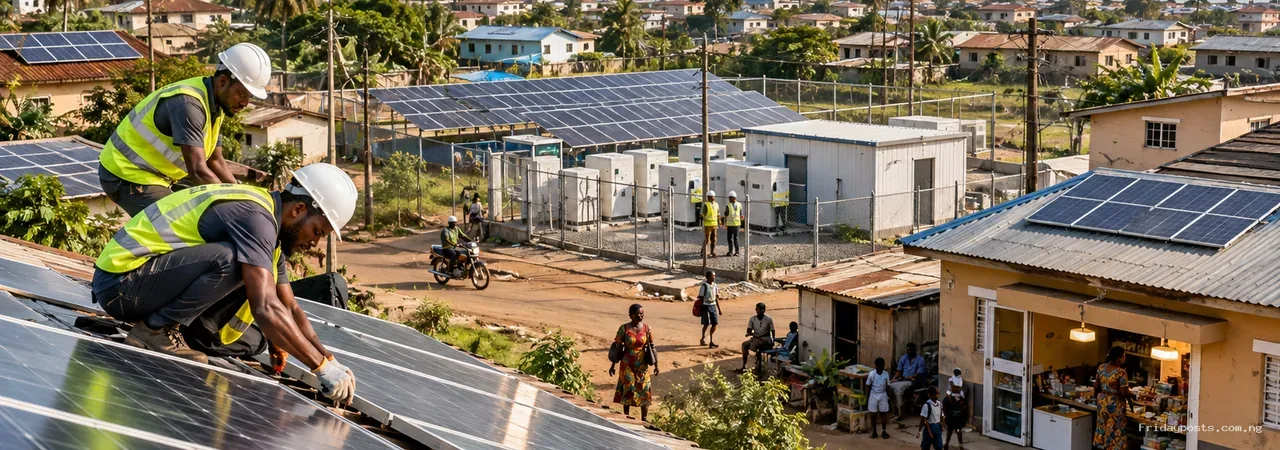
Nigeria has launched a $300 million Distributed Renewable Energy Fund through the Nigeria Sovereign Investment Authority, Africa50 and Sustainable Energy for All. The commercial launch, announced in September 2026, moves the vehicle from structuring into active capital deployment. Its purpose is to finance distributed renewable energy, especially solutions such as mini-grids and standalone solar systems that can serve homes, businesses and communities without waiting for conventional grid expansion.
The announcement is significant, but the first thing to understand is scale. Nigeria's electricity-access challenge is far larger than $300 million. The World Bank's National Energy Compact says universal last-mile access will require more than $23 billion in investment. It also estimates that distributed renewable energy can provide a least-cost path to electricity for more than 60 million Nigerians who are not well served by existing grid infrastructure.
The fund therefore should not be judged by whether $300 million can 'solve' electricity. It cannot. It should be judged by whether that capital can prove business models, attract additional private money and make reliable electricity financeable in places where the grid is unlikely to expand quickly enough.
What distributed renewable energy actually means
Distributed renewable energy is electricity generated close to where it is consumed rather than produced at a distant power station and carried entirely through the national transmission and distribution system.
A solar mini-grid serving a rural town is DRE. So is a hybrid solar-and-battery system supplying a market, industrial cluster, hospital or agricultural processing centre. Standalone solar home systems also belong to this category, although they usually provide lower levels of electricity than a mini-grid.
This matters in Nigeria because the country does not have one electricity problem. Dense urban neighbourhoods, remote rural communities, farms, industrial estates, schools and telecom sites have different load profiles and different economics. Extending the national grid is appropriate in many places, but it is not automatically the fastest or cheapest option everywhere.
The World Bank's DARES programme, for example, is designed to provide new or improved electricity access to 17.5 million people and support productive electricity use by as many as 237,000 micro, small and medium-sized enterprises. That gives a sense of what distributed power can do when financing, regulation and demand are brought together.
The $300m is an investment fund, not a household giveaway
The phrase 'clean-energy fund' can easily create the wrong expectation. The public information released at commercial launch does not describe a programme in which individual households simply apply for free solar panels.
The vehicle is designed as an investment platform. NSIA provides Nigerian market experience, Africa50 brings infrastructure investment and fund-management capacity, while SEforALL contributes energy-access expertise. Earlier work around the platform also emphasised equity finance, private capital mobilisation and support for bankable distributed-energy businesses and projects.
For developers, mini-grid operators, solar companies and infrastructure investors, this distinction is crucial. Many viable energy projects fail to reach construction because they cannot assemble enough patient equity, local-currency finance or risk protection. A fund that can supply part of that missing capital can make it easier for commercial lenders and other investors to participate.
For households and small businesses, the benefit is indirect but potentially important: more projects can reach financial close, more systems can be built and customers may gain access to electricity that would otherwise arrive years later.
What the fund could power if it is deployed well
The most valuable DRE projects will not merely add light bulbs. They will improve economic productivity.
Consider a farming community where electricity powers irrigation, cold storage and crop processing. The economic return is much larger than household lighting alone. A refrigerated cold room can reduce spoilage. A rice mill or cassava processor can add value before produce leaves the community. A clinic can keep vaccines cold. A school can operate digital-learning equipment. A market can remain productive after sunset.
This is why Nigeria should increasingly distinguish electricity access from productive electricity access. A connection is useful, but the deeper development question is what people can do with the power.
The strongest projects will connect energy planning with local economic activity: agriculture in one region, hospitality and tourism in another, light manufacturing in an industrial cluster, or digital services around universities and commercial centres.
The financing problem is as important as the technology
Solar panels are no longer the main mystery. The harder questions are financing and commercial sustainability.
Many Nigerian customers need electricity but cannot afford the full cost of a system upfront. Developers need capital before customers begin paying. Equipment may be purchased in foreign currency while customer revenue is earned in naira. Interest rates can be high. Some communities have irregular income. Tariffs must be high enough to maintain the system but affordable enough to attract users.
Those mismatches make otherwise useful projects difficult to finance. This is why the Nigeria DRE Fund's ability to mobilise local and international capital could matter more than the headline dollar figure. If $1 of catalytic equity consistently attracts several additional dollars of commercial capital, the fund's influence becomes much larger than its original balance sheet.
The opposite is also true. If projects are chosen for political visibility rather than bankability and social value, the fund could become another pool of capital that produces installations without sustainable operations.
Five tests should determine whether the fund works
First, Nigeria should measure connections and reliability, not simply the amount of money committed. A project announcement is not an electricity outcome.
Second, productive-use electricity should be tracked. How many farms, shops, clinics, schools and small industries became more productive because of the systems financed?
Third, the fund should disclose how much private capital it mobilises. The central promise of blended and catalytic finance is that public or development capital reduces risk enough to attract larger commercial investment.
Fourth, affordability and service quality should be monitored together. Cheap electricity that is unreliable is not a success; reliable electricity that customers cannot afford is not sustainable either.
Fifth, project selection should remain commercially disciplined and geographically transparent. Nigeria needs energy where it produces the greatest social and economic return, not only where project announcements are politically convenient.
Distributed power should complement the grid, not excuse its weaknesses
Nigeria should resist a false choice between the national grid and off-grid solar. The country needs both.
Large industrial loads, major cities and interconnected electricity markets still require stronger generation, transmission and distribution networks. Distributed renewable energy is valuable because it can move faster in underserved areas, reduce pressure on weak networks and provide targeted solutions where grid extension is uneconomic in the short term.
The long-term system may therefore become more decentralised: a stronger national grid, state electricity markets, embedded generation, mini-grids, rooftop solar, battery storage and commercial systems operating together.
That is a more realistic picture of Nigeria's electricity future than waiting for one central solution to fix every location.
The real opportunity is to make electricity investable
Nigeria has announced many energy programmes before. The $300 million DRE Fund will deserve attention only if it converts capital into functioning assets and functioning assets into economic activity.
Its larger significance is the possibility of changing the conversation from 'government must build electricity' to 'Nigeria must create conditions in which reliable electricity can be financed, built, paid for and maintained at scale'.
If the fund helps establish that model, it could do more than install solar systems. It could demonstrate how Nigeria turns an infrastructure deficit into an investable market. That would make the $300 million useful far beyond the projects it directly finances.
A. Joshua Adedeji
A. Joshua Adedeji is a leadership strategist, organisational development consultant, author, teacher and values-driven transformation leader. He writes on leadership, strategy, governance, organisational effectiveness, business, personal development and Nigeria’s social and economic transformation, connecting ideas and current realities to practical implications for leaders, institutions, entrepreneurs and citizens. His work is shaped by a commitment to clear thinking, responsible leadership, stronger institutions and the development of people and systems capable of producing lasting impact.






Reader conversation
0 approved comments