
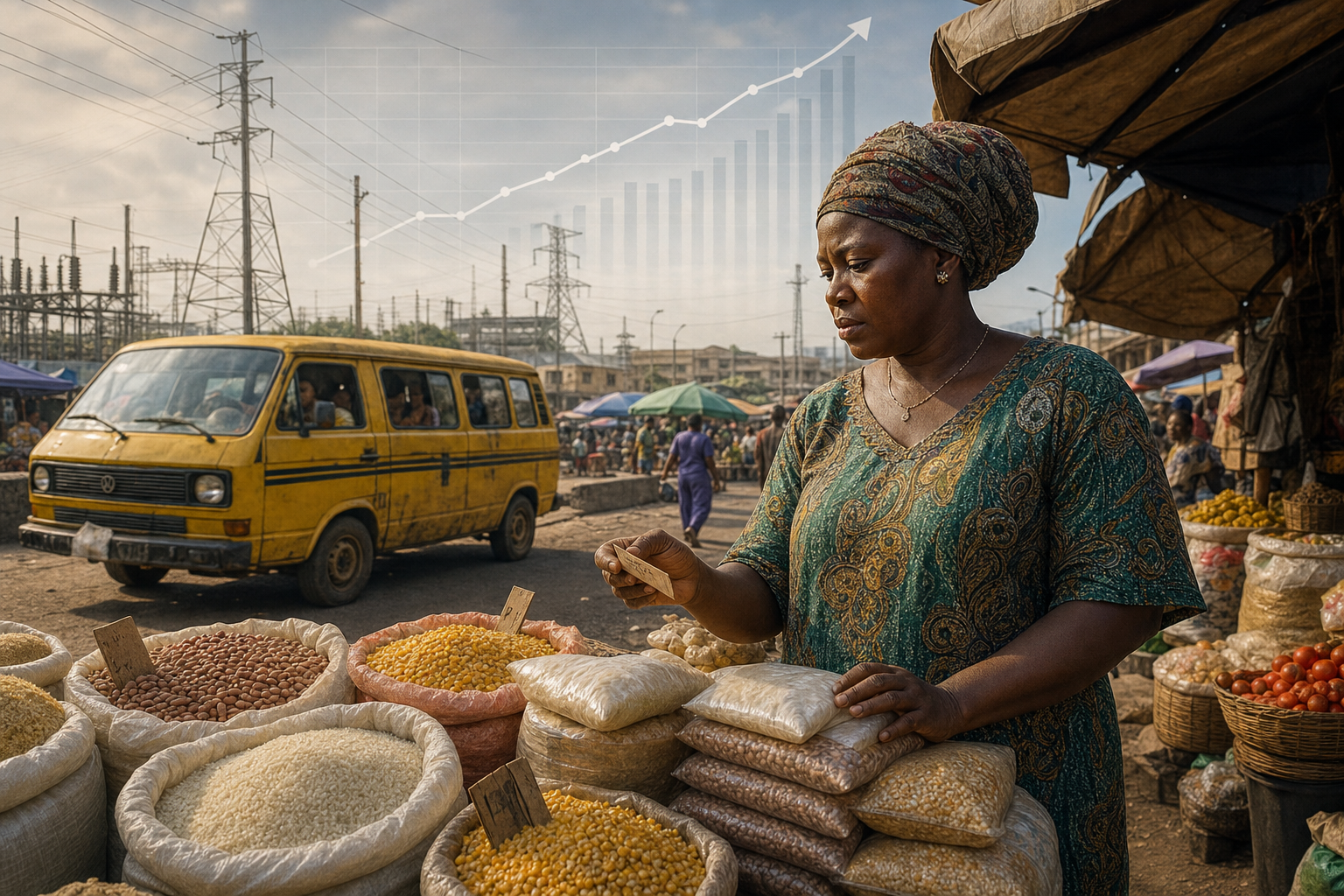
Nigeria’s economy is growing faster, but the household recovery remains difficult to see. Real GDP expanded by 4.43 per cent year-on-year in the second quarter of 2026, improving on both the 4.23 per cent recorded in the same quarter of 2025 and the 3.89 per cent recorded in the first quarter of 2026. Yet July’s inflation data delivered a less comfortable message: headline inflation slowed to 15.43 per cent, while monthly food inflation accelerated sharply to 5.56 per cent.
That combination is not contradictory. It is a reminder that economic growth and household welfare measure different things. GDP asks how much the economy produced. Households ask whether their income can buy food, pay transport fares, keep children in school and absorb an unexpected medical bill.
What the GDP figure actually shows
The Q2 result indicates that economic activity strengthened. Services grew by 4.60 per cent, agriculture by 4.39 per cent and the oil sector by 7.31 per cent. Non-oil GDP grew by 4.31 per cent. Services remained the largest broad sector, contributing 56.62 per cent of real GDP, while agriculture contributed 26.15 per cent.
The composition matters. Information and communication grew by 9.62 per cent, construction by 6.75 per cent, and finance and insurance by 9.29 per cent. These figures suggest that parts of the modern services economy are expanding, alongside agriculture and oil production.
But the picture is not uniformly strong. Industrial growth slowed from 7.46 per cent in Q2 2025 to 3.96 per cent in Q2 2026. Electricity, gas, steam and air-conditioning supply contracted by 10.63 per cent. Trade, which represents a substantial share of the economy, grew by only 2.40 per cent.
In other words, the economy is expanding, but some of the systems that most directly affect business costs, household bills and productive capacity remain weak. A recovery that does not improve electricity reliability, logistics, manufacturing output and purchasing power will struggle to become broadly felt.
Why lower inflation does not mean lower prices
July’s headline inflation rate was encouraging only in a limited sense. At 15.43 per cent, it was lower than June’s 15.91 per cent and substantially below July 2025’s 24.94 per cent. But inflation is a rate of change, not a measure of whether prices are affordable.
If the price of a staple rises by less than it did last year, the price is still rising. And for households that have already endured several years of high food, rent, transport and energy costs, a slower increase does not restore lost purchasing power.
The food figures make the distinction clearer. Annual food inflation eased to 20.31 per cent, but monthly food inflation rose from 3.75 per cent in June to 5.56 per cent in July. The NBS-linked report identified increases in items including rice, tomatoes, onions, pepper, garri, beef, eggs and plantain.
Food inflation matters disproportionately in Nigeria because poorer households spend a larger share of their income on necessities. A professional household may respond to higher prices by postponing a purchase or switching brands. A low-income household may reduce the number or quality of meals. The same inflation rate therefore produces unequal welfare consequences.
The missing bridge: incomes, jobs and costs
The central question is not whether GDP is growing. It is whether income growth is reaching people faster than the cost of living is rising.
That requires looking beyond aggregate output. Are formal wages increasing in real terms after inflation? Are informal workers getting more hours, more customers or higher margins? Are small businesses surviving higher diesel, electricity, rent, transport and finance costs? Are new jobs productive and stable, or are more Nigerians being pushed into low-income survival activities?
The Q2 GDP release, by itself, cannot answer those questions. It records production, not the distribution of earnings. It does not show whether growth is concentrated among large firms, capital-intensive sectors or regions with limited links to household employment.
Nor does a lower core-inflation reading automatically mean that the cost pressures facing families have disappeared. Housing, transport, school fees, healthcare and energy can remain unaffordable even when the national average begins to moderate.
The IMF’s 2026 assessment captures this tension. It acknowledged stronger macroeconomic outcomes and improved resilience, while warning that poverty and food insecurity remained serious concerns and that higher food and transport costs could weigh on activity.
What would show that recovery is reaching Nigerians?
Government claims about recovery should be tested against a wider welfare dashboard. The most important signals would be sustained growth in real household incomes; employment growth in manufacturing, agriculture, construction and tradable services; falling food and transport costs; improved electricity supply; and stronger output among micro, small and medium-sized businesses.
Policymakers should also track whether household consumption is recovering without a corresponding rise in debt, whether school attendance and healthcare access are improving, and whether regional disparities are narrowing. For Nigerians in the diaspora, remittance data and the naira value of transfers matter too: a stronger macroeconomic position is more useful to families when remittances retain purchasing power and are not absorbed by rising living costs.
Social protection is another test. If cash transfers and targeted support are timely, well-funded and transparently delivered, vulnerable households may be able to survive the adjustment period while reforms produce longer-term benefits. Without that protection, the burden of stabilisation falls mainly on families least able to bear it.
A recovery, but not yet a household turnaround
Nigeria’s Q2 growth figure should neither be dismissed nor oversold. It indicates genuine improvement in aggregate economic activity. The fall in annual headline inflation also suggests that some macroeconomic pressures have eased.
But July’s food-price acceleration shows why the government’s growth narrative is incomplete. Nigeria may be moving from crisis-level instability towards macroeconomic stabilisation without yet reaching broad-based household recovery.
The decisive evidence will come when Nigerians can point to more affordable food, predictable transport costs, reliable power, better-paying work and stronger small businesses. Until those changes appear consistently in household budgets, 4.43 per cent GDP growth is best understood as a promising macroeconomic signal—not proof that welfare has caught up.

A. Joshua Adedeji
A. Joshua Adedeji is a leadership strategist, organisational development consultant, author, teacher and values-driven transformation leader. He writes on leadership, strategy, governance, organisational effectiveness, business, personal development and Nigeria’s social and economic transformation, connecting ideas and current realities to practical implications for leaders, institutions, entrepreneurs and citizens. His work is shaped by a commitment to clear thinking, responsible leadership, stronger institutions and the development of people and systems capable of producing lasting impact.










Reader conversation
0 approved comments