
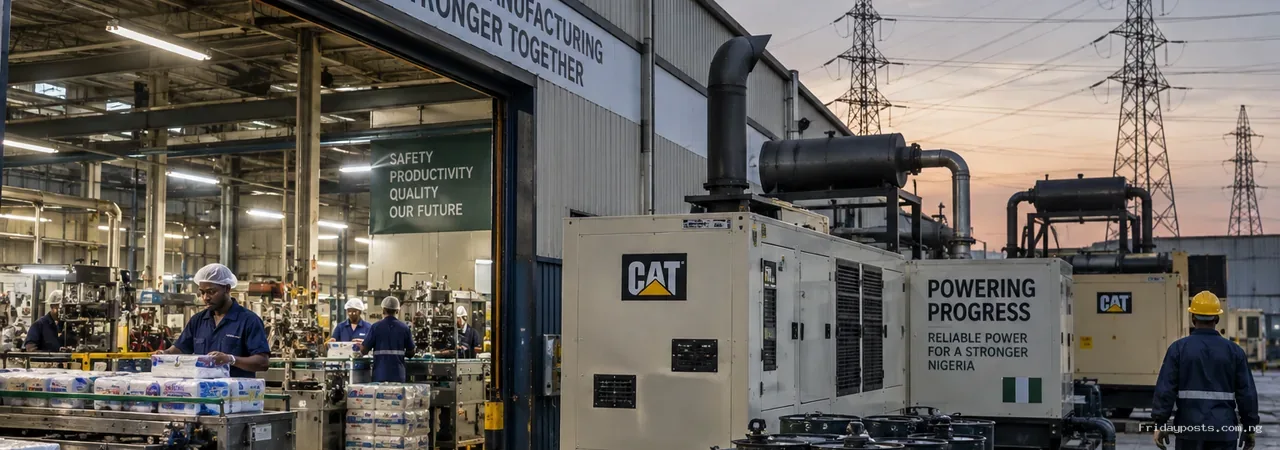
Imagine running a factory where electricity is not simply a utility you purchase, but an infrastructure problem you must partly solve yourself.
You buy transformers. You install generators. You purchase diesel or gas. You maintain engines. You employ technicians. You build power infrastructure that manufacturers in more reliable electricity markets rarely need to provide for themselves.
Then you still pay electricity bills.
That is the reality facing many Nigerian manufacturers.
Data from the Manufacturers Association of Nigeria reported this week show that manufacturers spent approximately ₦1.34 trillion on alternative electricity in 2025, up about 21 per cent from ₦1.11 trillion in 2024. At the same time, MAN said average daily grid electricity available to manufacturers deteriorated from 16.7 hours in the first half of 2025 to 13.1 hours in the second half.
The ₦1.34 trillion figure is striking.
But it does not capture the full economic cost.
When a factory has to become its own electricity company simply to remain in production, Nigeria pays in several other ways: higher prices, weaker competitiveness, reduced investment, lower profits, slower job creation and businesses that never grow as large as they otherwise might.
This is why electricity should not be treated only as an energy-sector problem.
It is an industrial-policy problem.
₦1.34 Trillion Is Not Simply a Generator Bill
MAN's data describe spending on alternative electricity sources, which can include diesel generation, gas, low-pour fuel oil and other off-grid or captive-power arrangements.
The nominal figure has risen dramatically in recent years. Alternative-power expenditure was reported at ₦144.5 billion in 2022, ₦781.7 billion in 2023, ₦1.11 trillion in 2024 and ₦1.34 trillion in 2025.
Those figures require careful interpretation.
The increase does not mean electricity unreliability alone became nine times worse between 2022 and 2025. Nigeria also experienced high inflation, currency depreciation, changing diesel and gas prices and sharply higher equipment and maintenance costs.
But that qualification does not weaken the central issue.
Manufacturers are committing enormous amounts of capital to producing electricity instead of using that capital principally to produce goods.
A company that spends ₦500 million installing and running additional generators has ₦500 million that cannot simultaneously finance another production line, additional warehouse capacity, research, automation or market expansion.
This is what economists call an opportunity cost.
The generator solves one problem while preventing the money from solving another.
Nigeria's Electricity Problem Is Also a Productivity Problem
Nigeria's electricity system has improved in some respects, but the gap between installed infrastructure and dependable supply remains significant.
NERC reported that in April 2026 Nigeria had around 13,625 megawatts of installed grid-connected capacity, but only about 4,286 MW was available for dispatch on average, producing a plant availability factor of roughly 31 per cent.
Earlier, NERC reported an average available generation capacity of 5,366.88 MW during the first quarter of 2025, with roughly 60 per cent of installed capacity unavailable for dispatch at any particular point during that quarter.
The World Bank's latest Enterprise Survey indicators add another perspective: 82 per cent of Nigerian firms surveyed in 2025 reported experiencing electrical outages.
This means unreliable power is not a marginal inconvenience affecting only a few companies.
It is part of Nigeria's business environment.
And business environments affect productivity.
A machine that should operate for eight uninterrupted hours cannot produce efficiently if electricity disappears repeatedly.
Production batches may be interrupted. Raw materials may be wasted. Cold chains can be compromised. Equipment can suffer damage. Workers can remain idle while still being paid. Delivery schedules can be missed.
Factories then build redundancy into their operations.
That redundancy costs money.
The Consumer Eventually Pays Part of the Bill
Manufacturers cannot absorb rising costs indefinitely.
Suppose a food processor faces higher electricity, diesel, transport, finance and raw-material costs.
The company has only a few options.
It can reduce its profit margin.
It can become more efficient.
It can reduce staffing or investment.
It can shrink the quantity or quality of its product.
Or it can raise its selling price.
Most companies eventually use a combination of these responses.
This means electricity unreliability can quietly appear in the price of cement, bread, beverages, packaged food, pharmaceuticals, plastics, household products and other locally manufactured goods.
Nigerian consumers may therefore pay for poor electricity twice.
They pay directly when they purchase generators, fuel, inverters, batteries or solar systems for their homes.
Then they pay indirectly through the higher prices businesses charge to recover their own energy costs.
That is why unreliable electricity functions like a hidden infrastructure tax.
It may never appear on a Federal Inland Revenue Service notice, but households and companies pay it nevertheless.
Small Manufacturers Are Hit Harder
A multinational manufacturer can build a dedicated gas plant.
A major cement company can develop captive generation.
A large industrial group can employ specialist engineers and negotiate fuel-supply agreements.
A small Nigerian manufacturer often cannot.
The owner of a bakery, furniture workshop, printing operation, food-processing business, plastics factory or small packaging plant may depend on a combination of grid electricity and a diesel or petrol generator.
Smaller firms also purchase fuel in smaller quantities, have weaker access to finance and cannot spread the cost of energy infrastructure over millions of units of production.
This creates an uneven playing field.
The large manufacturer pays heavily for self-generation but may at least gain reliability.
The small manufacturer pays heavily and can still remain vulnerable.
Energy unreliability can therefore contribute to one of Nigeria's persistent business-development problems: firms surviving without scaling.
Expensive Power Makes Nigerian Products Harder to Export
Nigeria does not compete only with itself.
A Nigerian manufacturer producing detergent, textiles, processed food, pharmaceuticals, packaging materials or industrial components competes with producers in other countries.
If the Nigerian company must finance electricity generation, expensive logistics, security and multiple other infrastructure gaps, its product begins the competition carrying additional costs.
The foreign manufacturer may have advantages before productivity, management or product quality are even compared.
This matters particularly as Nigeria seeks to benefit from the African Continental Free Trade Area.
AfCFTA creates access to a larger market.
It does not guarantee Nigerian companies will dominate that market.
If manufacturers in Egypt, Morocco, South Africa or other African production centres can make comparable goods at significantly lower cost, opening borders alone will not make Nigerian factories competitive.
Nigeria needs an export cost structure, not simply an export ambition.
Reliable industrial electricity is part of that cost structure.
There Is Also an Environmental Cost
Nigeria's dependence on distributed generators has environmental consequences.
Millions of individual diesel and petrol generators are generally less efficient than modern large-scale generation systems. They create noise, local air pollution and greenhouse-gas emissions.
For manufacturers, moving from diesel towards gas, solar, storage and hybrid systems can lower some of these costs.
But private renewable investment should complement a functional electricity market, not become an excuse for accepting permanent grid failure.
Nigeria should be careful about celebrating every factory that goes off-grid.
For the individual business, captive power may be a rational solution.
For the country, the trend can also represent a warning.
If the strongest industrial customers progressively abandon distribution companies because they can obtain more reliable electricity elsewhere, the remaining electricity market can become even harder to finance.
Nigeria's Power Problem Is Not Simply Lack of Generating Plants
Another mistake is to reduce the problem to one number: megawatts.
Electricity moves through a system.
Generation matters, but so do gas supply, transmission, distribution, metering, pricing, maintenance, investment, collection efficiency and regulation.
NERC's 2025 annual reporting shows continuing commercial weaknesses as well. Distribution companies reportedly supplied electricity valued at about ₦3.68 trillion during the year, billed around ₦2.99 trillion and collected roughly ₦2.32 trillion, representing collection efficiency of about 77.6 per cent.
That matters because an electricity industry that cannot reliably collect revenue struggles to invest.
At the same time, customers cannot reasonably be asked to accept continually higher tariffs without corresponding improvements in service.
Nigeria therefore faces a difficult but necessary transition.
Electricity must become commercially sustainable enough to attract investment while becoming reliable enough to justify what customers are paying.
Price reform without reliability creates resentment.
Reliability without sustainable financing eventually collapses.
Nigeria needs both.
State Electricity Markets Create an Important Opportunity
The structure of Nigeria's electricity market is also changing.
The Electricity Act 2023 created greater room for states to develop and regulate electricity markets within their jurisdictions, and the number of state regulators has continued to expand.
NERC and state electricity regulators are now working through the Forum of Nigerian Electricity Regulators to coordinate the country's increasingly decentralised electricity system.
This could be particularly important for industrial clusters.
Instead of thinking only about supplying every Nigerian factory through one centrally managed national model, states can begin asking more targeted questions.
What electricity does the industrial estate need?
Can a manufacturing cluster support embedded generation?
Can gas, solar and storage be combined?
Can distribution infrastructure serving factories attract dedicated private investment?
Can states create industrial power zones where manufacturers receive dependable electricity under commercially sustainable arrangements?
Nigeria's industrial electricity problem may ultimately require several solutions operating together rather than one national solution imposed everywhere.
Five Things Must Change
Nigeria should now treat industrial electricity as a measurable competitiveness programme rather than a recurring complaint.
First, industrial clusters need substantially more reliable grid and embedded electricity, with performance measured by actual hours and quality of supply rather than installed capacity.
Second, transmission and distribution infrastructure must receive investment alongside new generation. Producing electricity that cannot reach customers reliably does not solve the problem.
Third, gas supply to industrial and power-generation users must become more dependable. Nigeria possesses significant gas resources, yet inadequate infrastructure continues to restrict their productive use.
Fourth, state electricity markets should be used to test new industrial-power models, particularly around major manufacturing corridors.
Fifth, government should publish an annual Industrial Energy Competitiveness Dashboard comparing electricity reliability, industrial tariffs, self-generation costs and energy intensity across Nigeria's major manufacturing clusters.
What gets measured consistently becomes harder to ignore.
Imagine What ₦1.34 Trillion Could Have Done Elsewhere
This may be the most useful way to think about the MAN figure.
The ₦1.34 trillion was not necessarily wasted. It kept machines running, factories operating and Nigerian products on shelves.
Without alternative power, the economic damage could have been greater.
But businesses should not have to devote this scale of resources simply to replacing a basic infrastructure service.
Imagine if a larger portion of that money could instead finance new factories, machinery, worker training, research, export expansion, automation or cheaper products.
That is the opportunity Nigeria is losing.
The real cost of blackouts is therefore not ₦1.34 trillion.
That is merely one visible part of the bill.
The larger cost lies in factories that produce below their potential, Nigerian goods that become unnecessarily expensive, companies that delay expansion, jobs that are never created and investment that chooses another country.
Nigeria often speaks about becoming a manufacturing and export economy.
Reliable electricity is not one item on that agenda.
It is one of the conditions that determines whether the agenda is credible.
A factory should primarily be in the business of manufacturing its product.
It should not also have to become its own power company.
Principal Sources
- Manufacturers Association of Nigeria data reported on 9 September 2026 show alternative-power expenditure of ₦1.34 trillion in 2025, up approximately 21 per cent from ₦1.11 trillion in 2024, alongside weaker average grid availability in the second half of the year.
- NERC's operational data show the continuing gap between installed electricity capacity and capacity actually available for dispatch.
- World Bank Enterprise Survey data indicate that 82 per cent of surveyed Nigerian firms experienced electrical outages in 2025.
- NERC's 2025 reporting also highlights continuing commercial challenges in electricity distribution, including collection inefficiencies.

A. Joshua Adedeji
A. Joshua Adedeji is a leadership strategist, organisational development consultant, author, teacher and values-driven transformation leader. He writes on leadership, strategy, governance, organisational effectiveness, business, personal development and Nigeria’s social and economic transformation, connecting ideas and current realities to practical implications for leaders, institutions, entrepreneurs and citizens. His work is shaped by a commitment to clear thinking, responsible leadership, stronger institutions and the development of people and systems capable of producing lasting impact.








Reader conversation
0 approved comments