
Nigeria's 2027 presidential campaign has produced an early warning sign.
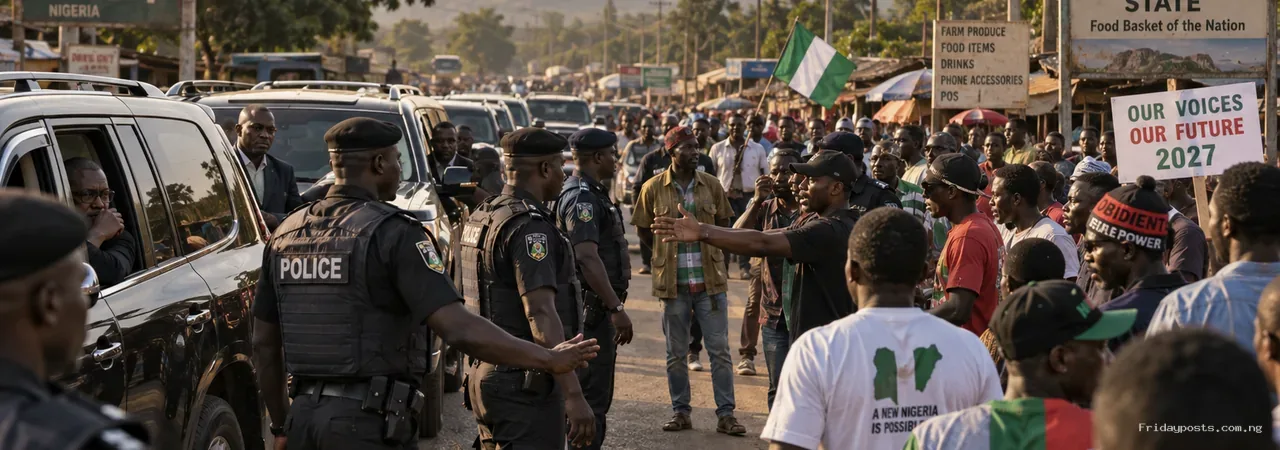
On Tuesday, 8 September 2026, a group of youths blocked the convoy of Peter Obi, presidential candidate of the Nigeria Democratic Congress, on the Makurdi-Gboko highway in Benue State as he attempted to travel to Yelwata.
Obi said he intended to visit families and communities affected by the deadly 2025 attacks in Yelwata. He alleged that the people who blocked him were hired thugs and suggested that individuals connected to the Benue State Government were involved.
The Benue State Government strongly denied that allegation. It said Governor Hyacinth Alia and his administration did not organise the obstruction and initially argued that Obi had failed to follow appropriate protocol by informing the state government about his visit.
Those competing claims should not be collapsed into one established version of events.
What is established is that Obi's convoy was blocked.
The police have since arrested 46 suspects in connection with the incident, while Benue State Commissioner of Police Cletus Nwadiogbu said investigations were continuing and warned against political intolerance ahead of the general election.
That makes the incident relevant far beyond Peter Obi.
The central question is whether Nigeria can conduct a competitive election in which candidates, supporters and citizens are able to participate without intimidation becoming an accepted political instrument.
What Actually Happened in Benue?
Obi arrived in Benue on Tuesday and proceeded towards Yelwata, where he said he planned to meet families affected by the June 2025 violence.
His convoy encountered a roadblock mounted by youths on the Makurdi-Gboko highway.
According to Obi, members of the group shouted at him to return. He said he decided not to force his way through because doing so could create disorder or endanger people.
The obstruction also affected other road users as traffic built up around the blockade.
The Benue State Government subsequently denied involvement.
Its representatives argued that the governor had not been formally notified of Obi's visit and rejected allegations that government officials mobilised the youths.
But an important detail emerged afterwards.
A letter dated 7 September showed that the NDC had notified the Benue State Commissioner of Police of Obi's scheduled visit and requested security protection.
Premium Times reported that a police officer confirmed receipt of the letter. The Commissioner of Police later said the command received notice of the visit on Monday evening and deployed security personnel, including police escort vehicles.
This does not establish that the state government itself received formal notification.
It does, however, establish that the police were aware of the visit and had made security arrangements.
That distinction matters.
The Question of Sponsorship Remains Unresolved
Political events in Nigeria often become partisan conclusions before investigations have established the facts.
That should be avoided here.
Obi and his party have alleged that the obstruction was politically sponsored.
The Benue government has denied that allegation and suggested that the incident could have arisen from political disagreements unrelated to the state administration.
At the time of writing, the police investigation has not established publicly who organised the blockade, whether anyone financed it or whether government or party officials directed those involved.
The arrest of 46 suspects is significant, but arrest is not proof of political sponsorship.
FridayPosts therefore cannot responsibly state that a government, party or named official organised the incident unless an investigation produces evidence to support that conclusion.
But uncertainty about sponsorship does not make the physical obstruction itself acceptable.
That is where the wider democratic issue begins.
Political Competition Cannot Become Territorial Control
Elections require disagreement.
Political parties are supposed to compete.
Communities are free to prefer one candidate over another.
Citizens may criticise candidates, protest against them, refuse to attend their rallies and vote against them.
But there is an important difference between political rejection and physical obstruction.
If a community dislikes a candidate, the democratic response is not necessarily to prevent the candidate from entering.
It is to refuse the candidate electoral support.
A political system becomes dangerous when geographical areas begin to be treated as territories belonging to particular parties, governors, ethnic blocs or political leaders.
That logic can easily spread.
If Candidate A can be physically prevented from campaigning in a state controlled by Party B, supporters of Candidate A may eventually justify similar behaviour when Candidate B enters their territory.
The result is escalation.
Politics moves away from persuasion and towards territorial enforcement.
Nigeria has experienced enough electoral violence to understand where that process can lead.
The Cross-Party Condemnation Is Significant
One of the more encouraging responses to the Benue incident came from outside Obi's own party.
Aviation Minister Festus Keyamo, a senior member of the governing political establishment, condemned the obstruction regardless of who was responsible.
Keyamo argued that whether the incident resulted from internal NDC disagreements, rival-party involvement or anger over Obi's visit, candidates should be allowed to move and practise politics without physical interference.
He also made another useful point: the standard should apply to everyone.
When supporters attack, stone, obstruct or intimidate candidates from governing parties, the behaviour should not suddenly become acceptable because the victim belongs to a party one dislikes.
That principle deserves to become a national norm before 2027.
Political violence does not become democratic merely because the target is unpopular.
Nigeria Is Already Seeing Warning Signs Ahead of 2027
The Benue incident should also be considered alongside wider concerns about Nigeria's political environment.
During preparations for the August 2026 Osun governorship election, Yiaga Africa warned about political violence, hate speech, voter inducement and security risks. The organisation described security neutrality and public trust as important tests ahead of the 2027 general election.
Off-cycle elections occur within one state.
A general election magnifies these risks nationally.
Candidates will travel across states controlled by rival parties.
Opposition rallies will be held in areas dominated by incumbents.
Governors will campaign outside their political strongholds.
Political rhetoric will become more aggressive as February 2027 approaches.
If security institutions do not establish clear standards early, isolated confrontations could develop into patterns.
Nigeria should not wait until campaign violence becomes widespread before deciding that political tolerance matters.
Security Agencies Must Be Neutral Before They Can Be Effective
The role of the police is particularly important.
Protecting candidates is not an endorsement of their politics.
It is a democratic responsibility.
Security agencies must be willing to protect an opposition candidate in a governing-party stronghold with the same seriousness with which they protect a government candidate in an opposition-controlled area.
Neutrality must also be visible.
A candidate should not reasonably conclude that police intervention depends on political affiliation.
Likewise, security agencies must act against supporters of opposition parties when they intimidate governing-party candidates.
This requires a national protocol before campaigns intensify.
Political parties should know what notice is required for major events.
Police commands should know their responsibilities.
Candidates should understand security procedures.
Governors and local authorities should know the limits of their roles.
Clear rules reduce the opportunity for political actors to weaponise ambiguity.
The “Protocol” Argument Needs Clearer Boundaries
The Benue government has argued that Obi should have observed protocol by notifying the state administration.
For high-profile visits, advance coordination may be sensible, especially where security concerns exist.
But administrative protocol should not evolve into an informal system under which political competitors appear to require the permission of incumbent governments to enter a state.
That would create an obvious conflict of interest.
The appropriate security agencies can reasonably require information necessary to protect candidates, manage traffic and prevent clashes.
But democratic competition requires that such procedures be transparent, politically neutral and consistently applied.
The emerging evidence that police were notified ahead of Obi's visit makes this issue even more important.
Rather than continuing a political argument over notification, authorities should clarify nationally what campaign and high-profile political visit protocols actually require.
Intimidation Can Suppress More Than Candidates
Political violence does not affect only politicians.
Ordinary citizens watch what happens.
If people see convoys attacked, rallies disrupted, supporters beaten or candidates blocked, some will decide that political participation is dangerous.
That can reduce rally attendance.
It can discourage volunteering.
It can prevent citizens from wearing party colours.
Eventually, fear can affect voter turnout.
The damage therefore extends beyond one politician's movement.
A genuinely competitive election requires citizens to believe they can support unpopular candidates without exposing themselves unnecessarily to violence.
Parties Must Control Their Own Supporters
Government and security agencies cannot carry the entire responsibility.
Political parties must discipline supporters.
Candidates should explicitly reject intimidation committed in their names.
They should avoid language that describes whole communities as enemies or treats rival supporters as traitors.
They should also stop celebrating incidents in which opposing politicians are chased, stoned or humiliated.
That behaviour eventually becomes reciprocal.
Nigeria cannot build peaceful elections while political actors applaud intimidation when their opponents suffer it and condemn it only when it reaches their own side.
A credible democratic principle must survive a change of victim.
The Police Investigation Now Matters
The arrest of 46 suspects creates an opportunity to establish facts rather than allow partisan narratives to become permanent truth.
The police should determine:
Who organised the roadblock?
Was the action spontaneous or coordinated?
Did anyone provide money or instructions?
Were weapons involved?
Did any political party, public official or government employee participate?
Why was the highway allowed to become blocked despite advance knowledge of Obi's visit?
And what should security agencies do differently next time?
The answers should be made public where legally appropriate.
If evidence establishes sponsorship, those responsible should face the law.
If the allegations of political sponsorship cannot be substantiated, that should also be stated clearly.
Accountability should follow evidence rather than party loyalty.
2027 Will Test Nigeria's Democratic Maturity
The Benue incident may eventually prove to be an isolated confrontation.
That would be the preferable outcome.
But it can also serve as an early warning.
Between now and February 2027, every major political party will need access to communities where it is unpopular.
Candidates will make provocative statements.
Supporters will become emotionally invested.
Rumours and manipulated media will spread rapidly.
The strength of Nigeria's democracy will not be measured by whether these disagreements disappear.
They will not.
It will be measured by whether disagreement remains political rather than violent.
Peter Obi should be able to enter a state where many voters oppose him.
President Bola Tinubu and candidates associated with his party should be able to campaign where they are unpopular.
Other presidential candidates should receive the same protection.
Citizens should answer politicians they dislike with questions, protests where lawful, counter-arguments and ultimately the ballot.
Not roadblocks.
Not intimidation.
Not violence.
That is the standard Nigeria should establish before 2027.
The Benue blockade should therefore be investigated fully, but its wider lesson is already visible.
A credible election requires more than accurate counting of votes. It requires a political environment in which Nigerians are genuinely free to compete for those votes.
Principal Sources
- Premium Times, 9 September 2026: document confirming that the NDC notified Benue State Police before Obi's visit and police acknowledgement of the notice.
- Premium Times and Channels Television, 9 September 2026: police arrest of 46 suspects, police deployment and ongoing investigation.
- Channels Television, 8–9 September 2026: Obi's account, Benue State Government's denial and its protocol argument.
- Channels Television and Punch, 9 September 2026: Festus Keyamo's cross-party condemnation of physical interference with candidates.
- Yiaga Africa, August 2026: concerns about political violence, hate speech, security neutrality and electoral risks ahead of 2027.

A. Joshua Adedeji
A. Joshua Adedeji is a leadership strategist, organisational development consultant, author, teacher and values-driven transformation leader. He writes on leadership, strategy, governance, organisational effectiveness, business, personal development and Nigeria’s social and economic transformation, connecting ideas and current realities to practical implications for leaders, institutions, entrepreneurs and citizens. His work is shaped by a commitment to clear thinking, responsible leadership, stronger institutions and the development of people and systems capable of producing lasting impact.







Reader conversation
0 approved comments