
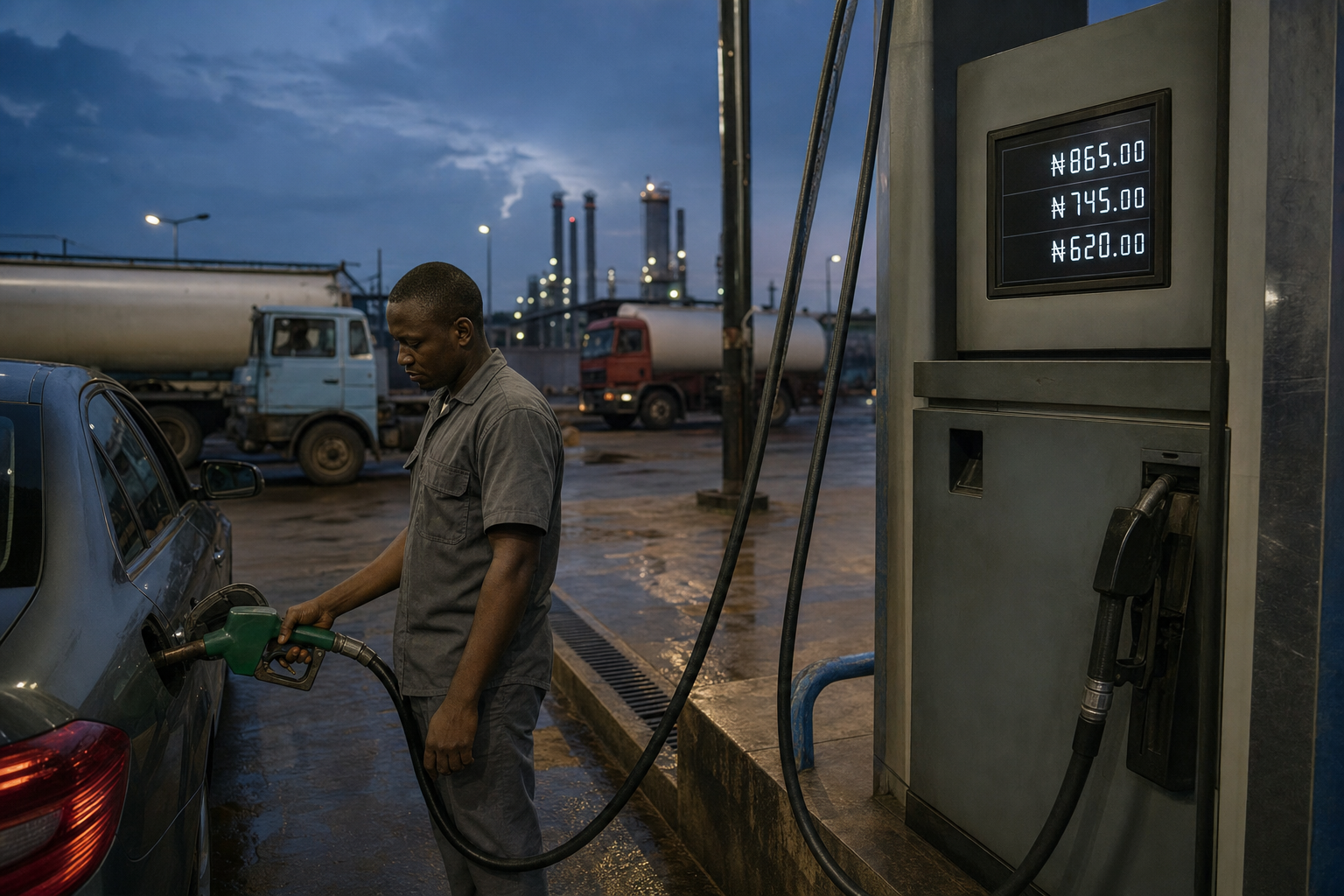
Petrol prices are rising again in parts of Nigeria, after reports that Dangote Petroleum Refinery increased its gantry price to about ₦1,265–₦1,266 per litre. The reported increase followed three adjustments within eight days, with a cumulative rise of roughly ₦100 per litre, according to Business Times Nigeria and Vanguard.
The Nigeria Labour Congress rejected the latest increase and called for greater domestic crude supply to local refineries, The Trent reported.
For households, transport operators and fuel-dependent businesses, the immediate concern is straightforward: whether higher refinery and depot prices will translate into more expensive journeys, deliveries, food distribution and generator use. The longer-term question is more complicated. The price paid at a filling station is the end of a chain, and domestic refining is only one part of it.
How the price chain works
The chain begins with crude oil. A refinery must obtain crude, either through domestic supply or other arrangements, and pay for it under agreed commercial terms. The crude then has to be transported, processed and converted into petrol and other products.
The refinery-gate, or gantry, price is the amount at which the refinery sells the product to buyers. It is not necessarily the final pump price. From the refinery, petrol may move to a depot, where storage and handling costs arise. Marketers then arrange transportation to filling stations, adding logistics and other operating costs along the way.
At the station, the retail price may therefore reflect the refinery-gate price, depot charges, transport, storage, marketer and station costs, as well as local market conditions. Vanguard reported depot prices reaching about ₦1,290 per litre in some markets on September 2, 2026. That does not establish a single national pump price: prices still require market-by-market verification.
Why crude supply is central—but not the whole explanation
The NLC’s argument focuses on the availability of Nigerian crude for Nigerian refineries. NUPRC reported that 61.9 million barrels were allocated to local refineries in the first quarter of 2026, but only 28.5 million barrels were actually supplied. The regulator attributed the gap primarily to pricing differences between crude producers and domestic refiners.
That evidence supports the importance of commercial terms in the supply chain. NUPRC has said domestic-crude transactions operate on a willing-buyer, willing-seller basis, with pricing remaining a significant factor. It is also consulting stakeholders on a domestic crude-and-gas swap intended to reduce supply costs and improve availability.
But the supply picture changed significantly in the second quarter. NUPRC said 53.7 million barrels were supplied to local refiners, representing 97.4 per cent performance under the relevant supply framework. This means the current dispute should not automatically be described as a continuing supply failure.
Analysis: Even a substantial increase in domestic crude supply would not, by itself, prove that petrol must become cheap. Commercial terms, crude quality, financing, refinery operating costs and logistics can all affect the refinery price. Domestic refiners can also remain exposed to international crude and product benchmarks, especially where imported crude or replacement products are involved.
What remains contested
The reported price increases are not yet a complete pricing explanation. The research reviewed does not establish Dangote’s official price circular, precise effective dates or detailed pricing formula for the latest adjustment. It also does not establish the exact volume and price of crude supplied to the refinery in August and September 2026.
It therefore remains unresolved how much of the increase reflects crude costs, foreign-exchange exposure, refinery operating expenses, logistics or market strategy. Those possibilities should not be presented as confirmed causes without supporting documentation.
The relationship between the reported gantry price, depot prices and pump prices also needs verification in individual locations. A filling station close to a depot may face different transport costs from one serving a distant market. Storage capacity, supply timing and local competition can also influence how quickly and fully a refinery or depot price change reaches consumers.
What households and businesses may feel first
Fuel-price movements can affect more than motorists. Transport operators may face higher running costs, while logistics businesses may have to review delivery charges. Small businesses that rely on petrol-powered generators may see pressure on operating expenses. Higher distribution costs can also affect the movement of food and other goods.
Analysis: The effect on any particular household or business will depend on its exposure to transport, generator use and delivered goods. It would be premature, however, to assign a precise inflationary impact from the reported refinery increase alone. That would require verified pump prices, information on pass-through and evidence on how widely the change has spread.
What readers should watch next
- Official price circulars from Dangote Refinery, including effective dates and the stated basis for changes.
- NUPRC data on crude volumes actually supplied to local refineries, not only volumes allocated.
- The commercial terms behind domestic crude transactions and progress on the proposed crude-and-gas swap.
- Depot prices in different regions and whether changes are consistent across markets.
- Verified pump prices, rather than relying on one reported station or location.
- Crude prices, exchange-rate exposure, imports and the cost of transporting and storing petrol.
What is confirmed—and what is not
Confirmed in the research pack: the NLC rejected the latest reported Dangote increase; reports placed the gantry price at about ₦1,265–₦1,266 per litre; NUPRC reported a Q1 supply gap and substantially improved Q2 performance; and the regulator is consulting on a crude-and-gas swap.
Reported but requiring continued verification: the exact relationship between the gantry figure, depot prices and pump prices, and the precise causes of the latest increase.
The National Bureau of Statistics’ statistical portal currently lists PMS at ₦1,596.25 per litre, but its reference period and methodology should be confirmed before the figure is used for comparison. Until those details are checked, the safest conclusion is that Nigeria’s petrol-price question is not simply about whether crude is available. It is about the price and terms of that crude, the cost of refining and moving the product, and the level of competition at each stage.

A. Joshua Adedeji
A. Joshua Adedeji is a leadership strategist, organisational development consultant, author, teacher and values-driven transformation leader. He writes on leadership, strategy, governance, organisational effectiveness, business, personal development and Nigeria’s social and economic transformation, connecting ideas and current realities to practical implications for leaders, institutions, entrepreneurs and citizens. His work is shaped by a commitment to clear thinking, responsible leadership, stronger institutions and the development of people and systems capable of producing lasting impact.










Reader conversation
0 approved comments