
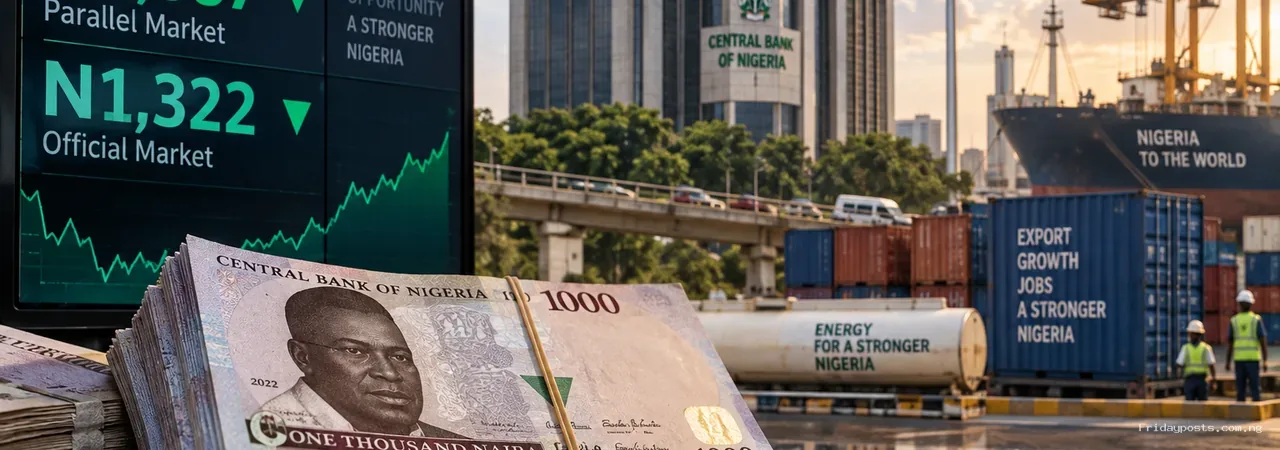
For Nigerians who have watched the naira lose substantial value over the past few years, recent movements in the foreign-exchange market offer some relief.
On 9 September 2026, the naira traded at about ₦1,387 to the dollar in the parallel market, compared with around ₦1,405 a few days earlier. In the official Nigerian Foreign Exchange Market, the currency had strengthened to around ₦1,322.50 per dollar by 4 September, before moving around the ₦1,320s subsequently. The difference between official and unofficial rates has also narrowed considerably compared with periods when both markets seemed to operate in almost different worlds.
Nigeria's external reserves provide another encouraging signal.
Central Bank of Nigeria data reported in early September showed gross external reserves reaching approximately $54.08 billion on 3 September, up from about $45.56 billion at the beginning of 2026. That represents an increase of more than $8 billion in eight months and the country's strongest reserve position in many years.
The question, however, is not simply whether the naira has strengthened.
It is whether Nigeria has finally built the conditions that can keep it relatively stable.
That distinction matters because currencies can strengthen temporarily for reasons that disappear quickly.
Why the Naira Has Become Stronger
Exchange rates ultimately respond to supply and demand.
When more dollars enter Nigeria relative to the amount businesses, governments and individuals want to buy, pressure on the naira tends to ease. When dollar demand persistently exceeds supply, the naira comes under pressure.
Several developments have improved the supply side.
Nigeria's external position strengthened significantly during 2025. The IMF estimates that the current account recorded a surplus equivalent to 4.8 per cent of GDP, supported by oil and gas exports and reduced imports of refined petroleum products as domestic refining increased. Gross international reserves rose from about $40 billion at the end of 2024 to about $46 billion at the end of 2025 and have continued climbing in 2026.
Foreign portfolio investment has also returned strongly.
National Bureau of Statistics data show that Nigeria attracted about $10.37 billion in capital imports during the first quarter of 2026, up 83.8 per cent from the corresponding period of 2025.
But there is an important detail inside that impressive number.
About $9.86 billion, or 95.1 per cent, was portfolio investment. Foreign direct investment accounted for only about $135 million, or 1.3 per cent.
That difference matters greatly for the sustainability of the naira.
Not All Foreign Exchange Is Equally Durable
A dollar entering Nigeria to build a factory is different from a dollar entering Nigeria to purchase a short-term financial instrument.
Both increase foreign-exchange supply.
But their economic characteristics are different.
Foreign direct investment is normally connected to factories, telecommunications infrastructure, mines, farms, technology companies or other productive assets. Such capital tends to have a longer investment horizon because it cannot simply disappear at the press of a button.
Portfolio investment can move much faster.
Foreign investors may buy Nigerian government securities because interest rates are attractive. But if global interest rates rise, political risk increases, oil prices collapse or investors become nervous about emerging markets, some of that money can leave quickly.
The IMF has specifically warned Nigeria about excessive dependence on portfolio flows with rollover risk.
This does not mean portfolio investment is bad.
It means Nigeria should not mistake short-term capital inflows for a permanent solution to its foreign-exchange problem.
A sustainable naira needs foreign exchange that the Nigerian economy earns repeatedly.
Oil Still Matters Enormously
Nigeria cannot discuss currency stability without discussing crude oil.
Oil remains one of the country's largest sources of export earnings and government foreign exchange.
There has been positive movement in production.
The Nigerian Upstream Petroleum Regulatory Commission reported average crude production of approximately 1.505 million barrels per day in July 2026, excluding condensates, meaning Nigeria met its OPEC quota for a third consecutive month. Combined crude and condensate output was about 1.67 million barrels per day.
More production means more potential export earnings.
Higher international oil prices can increase those earnings further.
Crude prices have now risen above $100 per barrel amid escalating Middle East tensions. For Nigeria, this could produce additional export and fiscal revenues.
But high oil prices are not an uncomplicated blessing.
Nigeria now operates a deregulated petroleum market, and higher international crude prices can increase the cost of petrol and other petroleum products domestically. Higher transport and energy costs can then feed back into inflation.
Nigeria could therefore earn more dollars from crude while Nigerian households simultaneously face higher fuel and transportation costs.
More importantly, a currency that depends heavily on unusually high oil prices remains vulnerable when those prices fall.
Sustainable naira stability requires broader export earnings.
Domestic Refining Is Quietly Important for the Currency
The expansion of domestic refining may eventually prove almost as important for Nigeria's exchange rate as increasing crude exports.
For many years Nigeria exported crude oil and then spent billions of dollars importing petrol and other refined products.
That arrangement created foreign-exchange demand that a major oil-producing country should ideally have been able to reduce.
The IMF attributes part of Nigeria's stronger current-account performance to lower refined-product imports as domestic refining capacity increased.
This demonstrates an important principle.
The naira can become stronger not only when Nigeria earns more dollars, but also when the country needs fewer dollars for things it can efficiently produce locally.
That does not mean Nigeria should attempt to manufacture every imported product.
Forced self-sufficiency can become extremely expensive.
But areas where Nigeria has clear economic advantages, including petroleum refining, agriculture, petrochemicals and some manufactured goods, can reduce unnecessary import dependence while expanding exports.
Inflation Still Matters
Exchange-rate stability is difficult to sustain when domestic prices rise much faster than those of major trading partners.
Nigeria's headline inflation fell to 15.43 per cent in July 2026, a substantial improvement from previous levels. But food inflation remained above 20 per cent.
The Central Bank has consequently maintained a tight monetary stance, retaining the Monetary Policy Rate at 26.5 per cent at its July meeting.
Lower inflation matters for the naira because persistent domestic inflation gradually erodes purchasing power.
If Nigerian goods become much more expensive while productivity fails to improve, pressure eventually builds on the exchange rate.
A stable currency therefore cannot be separated from disciplined monetary policy, responsible government finances and increased domestic production.
The strongest naira is not created primarily by defending a particular exchange-rate number.
It comes from strengthening the economy behind the currency.
Nigeria Must Also Watch Import Demand
A growing economy naturally imports.
Factories need machinery.
Technology companies purchase equipment.
Manufacturers need intermediate inputs.
Airlines require aircraft and parts.
Businesses pay for foreign software, professional services and logistics.
The Central Bank expects merchandise imports to increase in 2026 as demand for capital goods and intermediate inputs grows.
That is not automatically a problem.
The crucial distinction is between imports that expand future productive capacity and imports driven mainly by consumption.
Importing a machine that allows a Nigerian factory to produce goods for export can eventually generate foreign exchange.
Importing luxury consumption produces no comparable future earning capacity.
Nigeria therefore needs to improve the quality of its foreign-exchange demand, not merely suppress demand administratively.
The Official-Parallel Market Gap Must Keep Shrinking
Another encouraging development is the narrowing difference between official and parallel exchange rates.
A very large gap creates damaging incentives.
People who obtain dollars cheaply in one market may attempt to resell them elsewhere.
Businesses may struggle to determine the real cost of imports.
Investors face uncertainty.
Foreign-exchange transactions move outside formal channels.
Government statistics become less representative of actual market conditions.
When official and parallel rates move closer together, these distortions decline.
But convergence must come through improved supply, confidence and functioning markets rather than simply enforcement against informal dealers.
A credible foreign-exchange system needs enough liquidity that legitimate businesses can obtain dollars through recognised channels at transparent market prices.
Reserves Matter, But They Are Not the Economy
The rise above $54 billion in external reserves is undoubtedly positive.
Reserves give the Central Bank greater capacity to meet external obligations, manage periods of market stress and provide confidence that Nigeria can pay for essential imports.
But reserves should not become the main measure of success.
A central bank can spend reserves defending an exchange rate temporarily.
What it cannot do indefinitely is manufacture the productivity required to support that exchange rate.
Nigeria ultimately needs an economy capable of continuously replenishing reserves.
That means exporters earning dollars.
Diaspora Nigerians sending money through formal channels.
Foreign companies making long-term investments.
Nigerian technology and professional-service companies selling abroad.
Manufacturers exporting products.
Tourism attracting foreign spending.
Agricultural businesses selling processed products internationally.
Oil and gas remaining productive while other export sectors expand.
The quality of reserves accumulation matters as much as the size of reserves.
What Would Make the Naira Recovery Sustainable?
Nigeria should watch seven fundamentals rather than celebrate individual days of currency appreciation.
First, oil production must remain reliably high, rather than improving briefly before operational disruptions reduce output again.
Second, non-oil exports must grow faster. Nigeria needs more manufactured goods, processed agricultural products, digital services, petrochemicals and professional services earning foreign currency.
Third, foreign direct investment must become a much larger share of capital inflows. The current dominance of portfolio money makes the external position more sensitive to investor sentiment.
Fourth, inflation must continue falling. A currency cannot maintain purchasing power indefinitely while domestic prices rise rapidly.
Fifth, local production must reduce avoidable import demand where Nigeria can genuinely produce competitively.
Sixth, foreign-exchange policy must remain predictable. Investors and businesses should not constantly fear abrupt rule changes, multiple exchange rates or difficulty repatriating legitimate earnings.
Seventh, reserves must continue to grow from genuine external earnings rather than excessive borrowing or temporary financial inflows.
Those indicators tell us much more about currency health than whether the naira gained ₦5 in one trading session.
What Would a Stronger Naira Actually Mean for Nigerians?
For households and businesses, the value of currency stability lies in its consequences.
A more predictable exchange rate can make imported raw materials easier to price.
Businesses can plan.
Airlines can manage foreign obligations.
Manufacturers can make investment decisions with greater confidence.
Importers face less uncertainty.
Government can budget more realistically.
Eventually, exchange-rate stability can also reduce one source of inflationary pressure.
But Nigerians should not expect every shop price to fall immediately simply because the naira appreciates.
Businesses may still be selling inventories purchased when the exchange rate was weaker. Energy, transport and labour costs may remain high. International commodity prices may rise.
Currency stability works through the economy gradually.
Its greatest benefit may therefore not be that every imported product suddenly becomes cheaper.
It is predictability.
An economy cannot invest confidently when nobody knows whether the exchange rate will be ₦1,300, ₦1,700 or ₦2,000 within a short period.
The Real Test Is What Happens When Conditions Become Difficult
Nigeria should welcome the naira's recent improvement.
Foreign reserves are stronger.
Official and parallel-market rates are closer.
Oil production has improved.
Capital is returning.
Domestic refining is reducing some import dependence.
Those are meaningful changes.
But currencies reveal their true strength when conditions become less favourable.
What happens if oil returns to $70?
What happens if foreign investors move money back into American or European assets?
What happens when import demand rises?
Can Nigeria continue supplying the foreign-exchange market without burning through reserves?
If the answer increasingly comes from exports, productivity, investment and domestic production, then the naira's recovery will have stronger foundations.
Nigeria does not merely need a stronger naira this week.
It needs an economy capable of supporting a more stable naira for years.
That is the real measure of recovery.
Principal Sources
- Central Bank of Nigeria data on foreign reserves and monetary policy, including the July 2026 MPC decision to retain the policy rate at 26.5 per cent.
- National Bureau of Statistics, Q1 2026 Capital Importation Report, showing $10.37 billion in inflows, with portfolio investment accounting for 95.1 per cent.
- International Monetary Fund, Nigeria 2026 Article IV Consultation, covering exchange-rate reforms, current-account performance, reserve accumulation and risks associated with dependence on portfolio flows.
- Nigerian Upstream Petroleum Regulatory Commission, July 2026 crude-production figures.
- Vanguard, 9 September 2026, on recent official and parallel-market exchange-rate movements.

A. Joshua Adedeji
A. Joshua Adedeji is a leadership strategist, organisational development consultant, author, teacher and values-driven transformation leader. He writes on leadership, strategy, governance, organisational effectiveness, business, personal development and Nigeria’s social and economic transformation, connecting ideas and current realities to practical implications for leaders, institutions, entrepreneurs and citizens. His work is shaped by a commitment to clear thinking, responsible leadership, stronger institutions and the development of people and systems capable of producing lasting impact.










Reader conversation
0 approved comments