
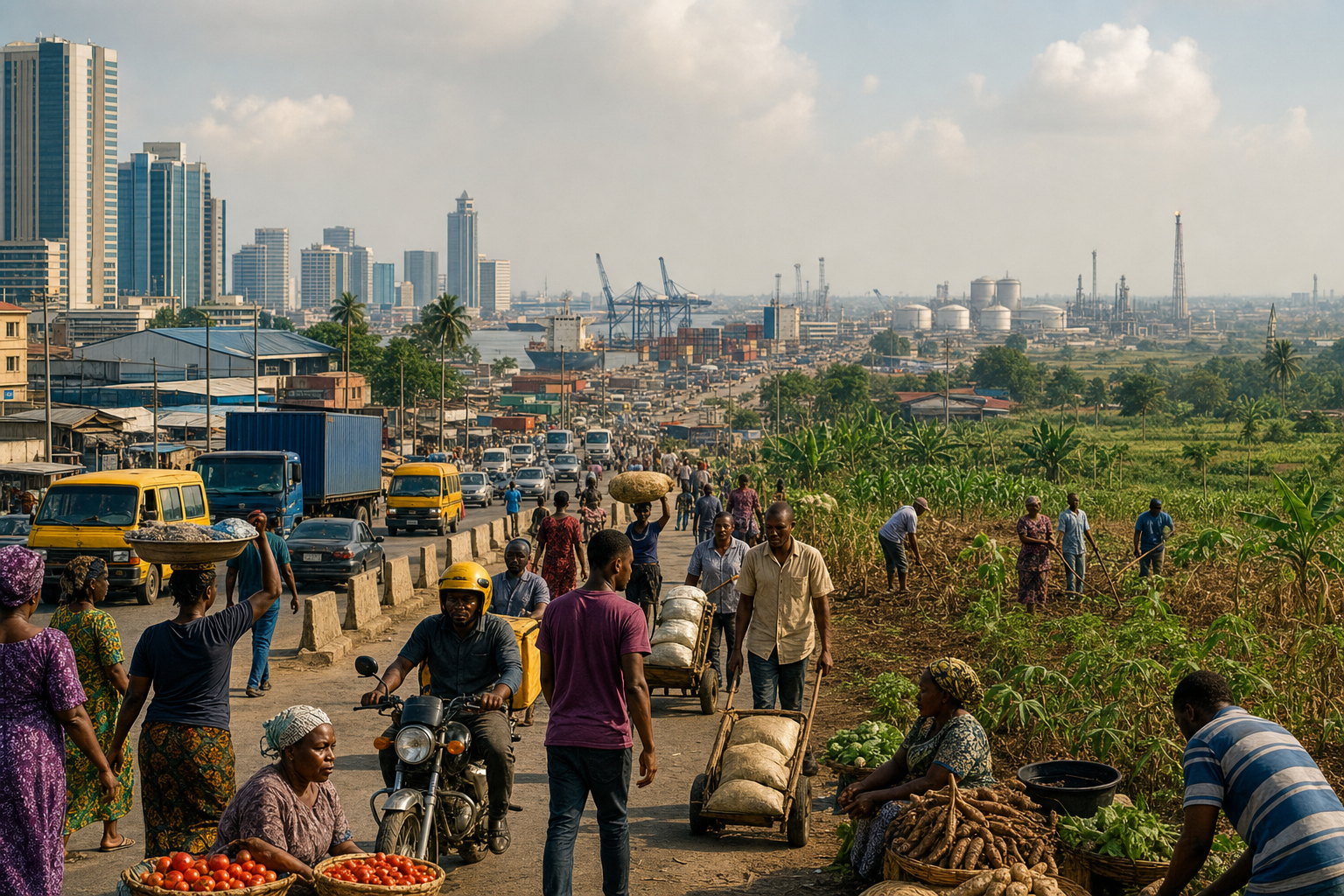
Nigeria’s economy grew faster in the second quarter of 2026, but the headline improvement leaves a harder question unanswered: is stronger national output translating into better incomes, more secure work and relief for households?
Real gross domestic product grew by 4.43% year-on-year in Q2 2026, according to figures attributed to the National Bureau of Statistics (NBS). That was up from 3.89% in Q1 and 4.23% in Q2 2025.
The result is significant. It suggests that the recovery strengthened during the quarter. But GDP measures the value of goods and services produced, not how that output is distributed. The evidence in the research pack therefore supports a cautious conclusion: Nigeria is growing, but it is too early to say that the recovery is broad-based or inclusive.
What the latest GDP figures show
Nominal GDP reached ₦119.29 trillion in Q2 2026, compared with ₦100.73 trillion a year earlier—an 18.43% increase, according to reporting by Punch citing the NBS.
That nominal increase should not be read as an equivalent rise in Nigerians’ purchasing power. Nominal GDP reflects current prices, while real GDP growth is adjusted for price changes. A larger naira value can coexist with households buying less if prices rise faster than incomes.

Analysis: The more useful test for living standards is whether real earnings, employment and household consumption are improving alongside output. The Q2 GDP release alone cannot answer those questions.
Services remain the main engine
Services accounted for 56.62% of real GDP and grew by 4.60% year-on-year. This makes services the largest part of the economy and the strongest broad sectoral contributor to the quarter’s expansion.
However, service-sector growth does not automatically mean enough formal, well-paid jobs. The sector includes activities with very different levels of productivity, wages and security. Without accompanying labour-market data, it is not possible to establish how many jobs were created, their quality or who benefited.
This distinction matters in a country where the World Bank says roughly 3.5 million people enter the labour force every year. Output can rise while competition for decent work remains intense if employment does not expand quickly enough or if new opportunities are concentrated in low-income activities.
Agriculture improved, but food pressure remains a concern
Agriculture contributed 26.15% of real GDP and grew by 4.39%, up from 2.82% in Q2 2025. The stronger performance is an important part of the recovery, particularly because agriculture remains central to rural livelihoods and food supply.
Yet agricultural growth does not by itself prove that food has become more affordable or that farmers’ incomes have risen. Farmers may face high input costs, insecurity and weak rural infrastructure even when sector output expands. Consumers, meanwhile, may continue to experience high food prices.
The research pack identifies July 2026 as the latest available NBS inflation listing by the reporting date, but it does not provide the corresponding headline or food-inflation figures. That limits any precise comparison between Q2 growth and household purchasing power.
Industry is the warning sign
Industry contributed 17.23% of real GDP but grew by 3.96% in Q2 2026. That was a sharp slowdown from 7.46% in Q2 2025, according to Nairametrics’ report citing the NBS.
The industrial figures complicate the recovery narrative. Manufacturing and other industrial activities are important for productivity, supply chains and better-paid employment. Slower industrial growth may indicate that the expansion is not yet sufficiently anchored in businesses that can scale production and create a wider range of jobs.
Analysis: A recovery led mainly by services and commodity-linked activity may lift GDP without resolving the structural constraints facing manufacturers and other productive businesses. The available figures do not establish the causes of the industrial slowdown, but they show why the sector requires close attention.
Oil helped, even as non-oil activity dominated
The oil sector grew by 7.31% year-on-year and accounted for 4.16% of real GDP. Average crude-oil production rose to 1.72 million barrels per day in Q2 from 1.55 million barrels per day in Q1, according to Premium Times, citing the NBS.
The non-oil sector remained much larger, accounting for 95.84% of real GDP and growing by 4.31%. This is important: the quarter’s performance was not solely an oil story. Nevertheless, higher oil production appears to have provided additional support to the headline result.
The central uncertainty is whether that improvement will be durable and whether it will produce economy-wide welfare gains. GDP data cannot show how oil-related gains are distributed across households, regions or businesses.
Growth has not yet settled the household question
The World Bank says Nigeria’s growth has remained robust and service-led, while household incomes have not fully recovered and poverty remains high. It estimates that more than 60% of Nigerians lived below the national poverty line in 2025.
That context makes the Q2 figure encouraging but insufficient. Families judge the economy through the cost of food, transport, housing, energy and education; workers judge it through wages and job security; businesses judge it through demand, finance and operating costs. None of those outcomes can be inferred reliably from the GDP rate alone.
For Nigerians in the diaspora, the same distinction matters when assessing whether improved macroeconomic figures signal better conditions for relatives at home or a stronger basis for investment. Growth is a necessary foundation, but not evidence by itself of improved household welfare.
What would confirm an inclusive recovery?
The next assessment should bring the GDP figures together with the latest NBS labour-force data, inflation and food-price data, household-income indicators and business surveys. Particular attention should go to job quality, real wages, agricultural incomes, manufacturing activity and the regional distribution of gains.
The Q2 numbers establish that output expanded more quickly than in the previous quarter and the same quarter a year earlier. They also show a service-led economy, stronger agriculture, higher oil production and a marked slowdown in industry.
Bottom line: Nigeria’s recovery is real in the national accounts, but its social reach remains unproven. The decisive measure will be whether growth begins to reduce the distance between macroeconomic improvement and the daily economic experience of ordinary Nigerians.

A. Joshua Adedeji
A. Joshua Adedeji is a leadership strategist, organisational development consultant, author, teacher and values-driven transformation leader. He writes on leadership, strategy, governance, organisational effectiveness, business, personal development and Nigeria’s social and economic transformation, connecting ideas and current realities to practical implications for leaders, institutions, entrepreneurs and citizens. His work is shaped by a commitment to clear thinking, responsible leadership, stronger institutions and the development of people and systems capable of producing lasting impact.









Reader conversation
0 approved comments