
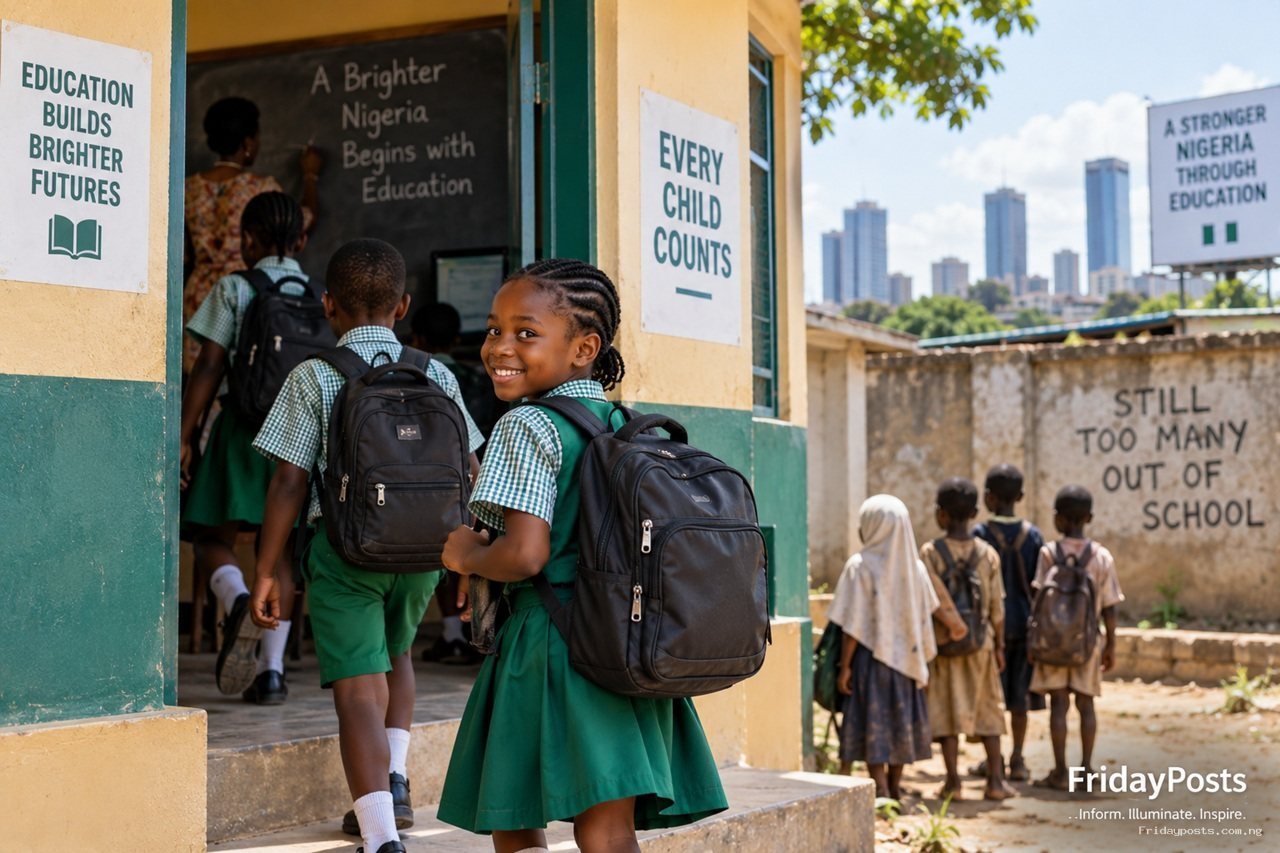
More than one million Nigerian children who were previously out of school have returned to classrooms within the last 20 months, according to the Federal Government.
Education Minister Dr Tunji Alausa announced the figure in Abuja while receiving the new UNESCO Country Representative to Nigeria, Professor Isaiah Barreto Da Rosa. The minister also said almost 6.7 million girls had benefited from interventions designed to improve access to education and keep children in school.
Returning one million children to school would be an important achievement in any country.
In Nigeria, however, it immediately raises another question:
How many children are still out of school?

Surprisingly, there is no simple answer.
Nigeria's out-of-school crisis is not only an education problem. It is also a data problem.
The Famous 18.3 Million Figure Is Not a Fresh 2026 Count
For several years, one number has dominated discussion about Nigeria's education crisis: 18.3 million out-of-school children.
UNICEF has reported that 10.2 million primary-school-age children and another 8.1 million children of junior-secondary-school age are outside school.
That figure has rightly attracted national and international concern.
But it needs context.
The underlying estimates are not the result of a nationwide census carried out in 2026. UNICEF's recently published work on basic education notes that the 10.2 million and 8.1 million estimates draw from older education data, including figures reported by UBEC in 2019.
The Education Minister has himself challenged continued reliance on the 18.3 million figure, arguing earlier this year that it does not adequately reflect more recent interventions or population mapping being undertaken by government.
Meanwhile, the Federal Ministry of Education's Nigeria Education Sector Renewal Initiative currently describes the national out-of-school population as approximately 15 million, while reporting around one million children as reintegrated.
This leaves Nigeria with an uncomfortable reality.
We know the crisis is enormous.
We do not yet know its exact present size with sufficient confidence.
Why the Government Is Mapping Children Household by Household
Government is now trying to solve that problem through better data.
The Federal Ministry of Education has expanded digital education-management systems, learner identification numbers, annual school censuses and more targeted mapping of out-of-school children.
At the 2026 Basic Education in Nigeria Bootcamp, the ministry described credible learner data as central to finding children outside school, targeting interventions and tracking whether they remain in education.
Kaduna offers an interesting example.
The state carried out household-level mapping to identify individual out-of-school children and the families to which they belonged. The Federal Government has since said it intends to adopt that approach more widely.
Kaduna State says its exercise helped reduce the estimated number of out-of-school children there from about 550,000 to fewer than 180,000.
If independently verified and successfully replicated, this type of mapping could change education policy significantly.
Instead of saying there are several million unidentified children somewhere outside the education system, government can begin asking:
Who is the child?
Where does the child live?
Why is the child not in school?
Did the child previously enrol and drop out?
What intervention would bring that child back?
And, critically, did the child remain in school after returning?
That is a much stronger basis for policy.
Returning a Child to School Is Only the First Step
The phrase "returned to school" can also conceal another problem.
Getting a child into a classroom matters.
Keeping the child there matters more.
And ensuring the child actually learns matters most.
Nigeria's education crisis therefore has at least three dimensions:
Access, retention and learning.
A child may be enrolled today and drop out next year because of poverty, insecurity, displacement, child labour, early marriage, school distance or household pressures.
Another child may attend school for years without acquiring foundational literacy or numeracy.
UNICEF reported in 2024 that 74 per cent of Nigerian children aged seven to 14 lacked basic reading and mathematics skills.
The World Bank's 2026 human-capital assessment also found that Nigeria's education performance remains weak compared with other lower-middle-income countries. Its education-pillar score was 64, against a median of 88 for comparable economies, while Nigerian student test scores in 2025 remained slightly below their 2010 level.
That means Nigeria could successfully enrol more children and still face an education crisis.
The ultimate objective cannot simply be:
How many children entered school?
It must become:
How many entered, stayed, learned and completed useful education?
The Problem Is Not Evenly Distributed Across Nigeria
National totals also hide important differences.
Nigeria's out-of-school crisis is much more severe in some regions and among some groups than others.
Poverty is one major factor.
When households struggle to afford food, transport, uniforms, books or other basic needs, education can become vulnerable even where tuition is officially free.
Insecurity is another.
UNICEF reported that attacks and insecurity had forced school closures in parts of Borno, Adamawa and Yobe, while a 2025 education assessment estimated that about two million children were out of school in Nigeria's north-east alone.
Gender also matters, but not uniformly.
Girls continue to face serious barriers in many communities, including poverty, early marriage, domestic responsibilities and social norms.
At the same time, the Education Minister is now warning that policy must pay more attention to boys in locations where male school participation is deteriorating. His latest statement argues that the gains made in girls' education should continue without allowing boys to become another neglected group.
There are also children with disabilities, displaced children, street-connected children, Almajiri learners and children in remote rural communities whose educational circumstances cannot be addressed with a single national programme.
This is why one national number, however dramatic, can never tell the whole story.
What Is Government Actually Doing?
The Federal Government has placed out-of-school children among six pillars of its Nigeria Education Sector Renewal Initiative.
Its current programme includes the National Commission for Almajiri and Out-of-School Children's Education, Back2School initiatives, learning centres, Tsangaya teacher training and plans to integrate literacy and numeracy more effectively into non-formal learning.
The ministry has also reported investments in classroom renovation, teacher development, textbooks, education data and digital systems.
These interventions address different parts of the problem.
But Nigeria should resist measuring success primarily through activities.
Building a learning centre is an activity.
Training teachers is an activity.
Distributing textbooks is an activity.
Registering a child is an activity.
The real outcomes are different:
Did school attendance improve?
Did dropout decline?
Can the child read?
Can the child perform basic mathematics?
Did the child complete primary education?
Did the learner successfully transition to secondary education?
A serious education reform programme must answer those questions.
One Million Is Significant, But It Needs Better Verification
There is another reason stronger public data are necessary.
The Education Minister's descriptions of the one-million achievement have not always used the same timeframe.
In May 2026, he told Channels Television that more than one million children had returned to classrooms over approximately 30 months.
This week's statement describes more than one million returning within 20 months.
This does not necessarily mean either claim is wrong. They may refer to revised datasets, different programme periods or improved reporting.
But government should explain the methodology.
For an achievement of this scale, Nigerians should be able to see:
- how many children were identified;
- in which states;
- how "out of school" was defined;
- when each child was enrolled;
- what programmes facilitated the return;
- how many remain enrolled after six or twelve months;
- how many returned to formal versus non-formal education;
- what the latest national baseline now is.
Publishing such data would strengthen rather than weaken the government's achievement.
Nigeria Must Stop Treating Education Data as an Estimate Forever
The most encouraging part of the current reforms may ultimately be the attempt to build a reliable national learner-identification system.
Nigeria cannot manage the education of tens of millions of children with periodically disputed estimates.
Every child entering the basic education system should eventually have a trackable learner identity, subject to appropriate privacy safeguards.
Government should know when the child enrols, whether the child attends, whether the learner transfers schools, whether the child drops out and whether intervention is needed.
That would allow education authorities to move from national approximation towards individual accountability.
A child disappearing from school should become visible to the system.
The Bigger Crisis Is Human Capital
This matters far beyond classrooms.
The children outside school today are part of Nigeria's future workforce.
The child who cannot read today becomes the young adult who struggles to acquire advanced skills tomorrow.
The teenager who drops out may face decades of lower income and limited employment opportunities.
The World Bank estimates that Nigeria's current weaknesses in health, education and workplace skills are imposing an enormous cost on future earning potential. It calculates that increasing effective schooling to 12 years could raise long-term labour earnings by about 20 per cent.
Education is therefore not simply a social-service expenditure.
It is economic policy.
It affects productivity, poverty, employment, inequality, security and Nigeria's ability to compete internationally.
What Nigeria Should Measure Next
The Federal Government's announcement should therefore be welcomed, but it should also lead to a more demanding national scorecard.
Nigeria should publish, at least annually:
- the verified number of school-age children;
- the number currently enrolled;
- the number genuinely out of school;
- new enrolments of previously excluded children;
- retention after one and two years;
- dropout rates by state and gender;
- primary-to-secondary transition rates;
- foundational literacy and numeracy results;
- data for children with disabilities and displaced learners;
- state-by-state progress.
Only then can Nigerians accurately answer the question of whether the crisis is shrinking.
Getting Children Into School Is Not Enough
Returning more than one million children to education would represent important progress.
It should be recognised.
But Nigeria should not allow a large headline number to create the impression that the problem has been solved.
Depending on the dataset used, the country still appears to have many millions of children outside school, and government itself is still working to establish a more accurate contemporary baseline.
Beyond that is an equally difficult challenge: ensuring that children who enter classrooms actually learn.
Nigeria's real education target should therefore not be one million children returned to school.
It should be much more ambitious:
Every Nigerian child identified. Every child given access to education. Every child kept in school. Every child learning.
The one-million figure can be an important milestone.
It should not become the finish line.

A. Joshua Adedeji
A. Joshua Adedeji is a leadership strategist, organisational development consultant, author, teacher and values-driven transformation leader. He writes on leadership, strategy, governance, organisational effectiveness, business, personal development and Nigeria’s social and economic transformation, connecting ideas and current realities to practical implications for leaders, institutions, entrepreneurs and citizens. His work is shaped by a commitment to clear thinking, responsible leadership, stronger institutions and the development of people and systems capable of producing lasting impact.









Reader conversation
0 approved comments