
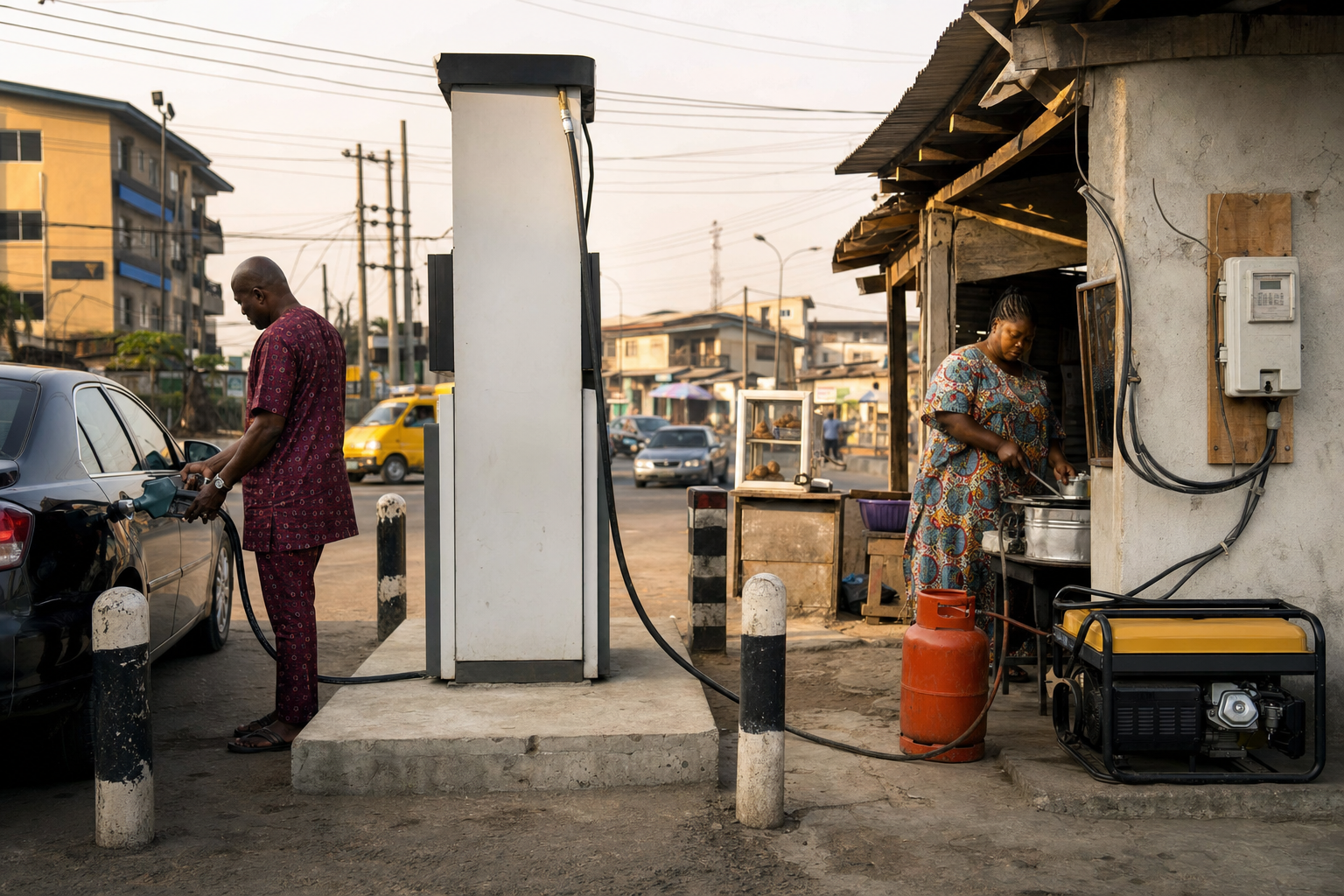
For Nigerians, the cost of energy is measured in more than the price displayed at a filling station. It is the fare paid to work, the diesel used by a small factory, the cooking gas bought by a family and the electricity bill paid despite hours without supply.
That is why petrol prices remain politically and economically important even after the emergence of large-scale domestic refining. The central question is not simply whether Nigeria can produce petrol locally. It is whether households and businesses can obtain dependable energy at a cost that supports incomes, investment and national productivity.
Petrol is cheaper at the refinery than at many filling stations
The latest publicly accessible NBS dashboard figure identified in this review puts the national average retail price of petrol at ₦1,596.25 per litre in May 2026. That figure reflects what consumers paid across the country, not merely the price at a refinery gate.
In August, Dangote Refinery adjusted its reported gantry price several times. The price moved from ₦1,165 to ₦1,185 per litre on August 21 and then to ₦1,200 on August 26, according to industry reporting. A further increase to ₦1,265 was reported as taking effect on August 29. These figures should be read as refinery or gantry prices: transport, storage, margins, taxes and local scarcity can produce different pump prices.
The gap between ex-depot and retail prices is therefore not automatically evidence of profiteering. But it does create a public-interest obligation for regulators and marketers to explain the components clearly. Consumers need to know how much of every litre reflects crude and refining costs, logistics, distribution margins, taxes and other charges.

Domestic refining changes the market, but not the economics of oil
The Dangote refinery is strategically significant because it can reduce reliance on imported refined products and potentially lower pressure on Nigeria’s foreign-exchange market. However, domestic refining does not make petrol immune to global market forces. Crude oil remains an internationally priced commodity, while equipment, finance, shipping, insurance and some operating inputs are exposed to exchange-rate and global-cost movements.
This explains why a local refinery can raise prices even when consumers expect domestic production to mean cheaper fuel. The refinery’s commercial incentive is shaped by the value of crude and competing product prices, not only by the location of the plant. Domestic supply can improve security and reduce import bottlenecks without producing permanently low prices.
The more important test is competition. Nigeria needs transparent access to crude for domestic refiners, credible regulation of wholesale and retail markets, reliable pipelines and storage, and enough competing suppliers to prevent any single commercial decision from having an outsized effect on consumers.
Diesel and LPG reveal the wider energy burden
Petrol attracts the most attention because it affects transport immediately, but many businesses depend more heavily on diesel. The NBS dashboard lists average automotive gas oil, commonly called diesel, at ₦3,277.47 per litre. For manufacturers, hospitals, telecommunications companies, retailers and offices that operate generators, diesel is a direct production cost.
Cooking gas is another pressure point. NBS lists the average price of a 5kg LPG cylinder at ₦8,706.93. For households that shifted from kerosene or firewood to LPG, repeated price increases can make the transition fragile. When families reduce gas use because of cost, the consequences may include greater reliance on unsafe fuels, poorer indoor air quality and higher household time costs.
These prices also expose a weakness in public debate: energy policy is often discussed in separate compartments. Petrol is treated as a transport issue, diesel as a business issue, LPG as a household issue and electricity as a utility issue. In reality, they are connected. When grid supply deteriorates, demand for diesel rises. When transport costs increase, food distribution becomes more expensive. When cooking gas becomes unaffordable, households change fuel sources.
Electricity tariffs are only one part of the electricity bill
NERC’s service-based tariff framework links customer bands to minimum supply expectations. Band A is associated with at least 20 hours of supply daily, while Band E is associated with at least four hours. NERC also states that tariffs vary according to location and service quality, and its July 2026 MYTO orders provide updated regulatory instruments for distribution companies.
For consumers, however, the practical cost of electricity is often much higher than the tariff printed on a bill. A household may pay for prepaid units, generator petrol, repairs, batteries, inverter equipment and lost working time. A business may add diesel, maintenance, security and the cost of replacing damaged appliances caused by unstable supply.
This is the distinction between the price of electricity and its cost. A tariff can be regulated, but unreliable supply transfers the unpaid portion of the energy bill to consumers. Businesses then pass part of that burden into prices, while households absorb it through lower consumption or reduced savings.
What policymakers should measure
Energy affordability should not be judged by pump prices alone. Government and regulators should publish a regular household-and-business energy basket covering petrol, diesel, LPG, electricity tariffs and generator operating costs. The basket should be disaggregated by state and linked to income, transport fares and food prices.
Regulators should also publish a clear downstream pricing template whenever major wholesale prices change. The public should be able to distinguish a genuine change in supply costs from a change in margins or local distribution conditions. NMDPRA’s monitoring responsibilities are especially important in a market where prices can differ sharply between regions.
In the electricity market, enforcement must accompany tariff reviews. Customers should not be charged for a higher service band when the distributor fails to provide the promised minimum supply. Complaints, refunds and band adjustments need to be visible, timely and independently verifiable.
The immediate lesson for Nigerians
There is no single switch that will make energy cheap. Petrol prices depend on crude and refining economics; diesel prices reflect business demand and import or production costs; LPG depends on supply, logistics and household purchasing power; electricity depends on generation, gas, transmission, distribution and tariff discipline.
The realistic objective is dependable energy at transparent and contestable prices. Domestic refining is a major opportunity, but it must be matched by competition and accountability. Electricity tariff reform may be necessary for investment, but it must be matched by measurable service. And relief measures must be targeted at vulnerable households and productive businesses rather than designed as opaque subsidies that conceal costs.
Until those conditions are met, Nigerians will continue to experience energy inflation in several forms at once: the petrol price at the station, the diesel price behind the generator, the LPG price in the kitchen and the hidden electricity charge attached to every interrupted day.

A. Joshua Adedeji
A. Joshua Adedeji is a leadership strategist, organisational development consultant, author, teacher and values-driven transformation leader. He writes on leadership, strategy, governance, organisational effectiveness, business, personal development and Nigeria’s social and economic transformation, connecting ideas and current realities to practical implications for leaders, institutions, entrepreneurs and citizens. His work is shaped by a commitment to clear thinking, responsible leadership, stronger institutions and the development of people and systems capable of producing lasting impact.









Reader conversation
0 approved comments