
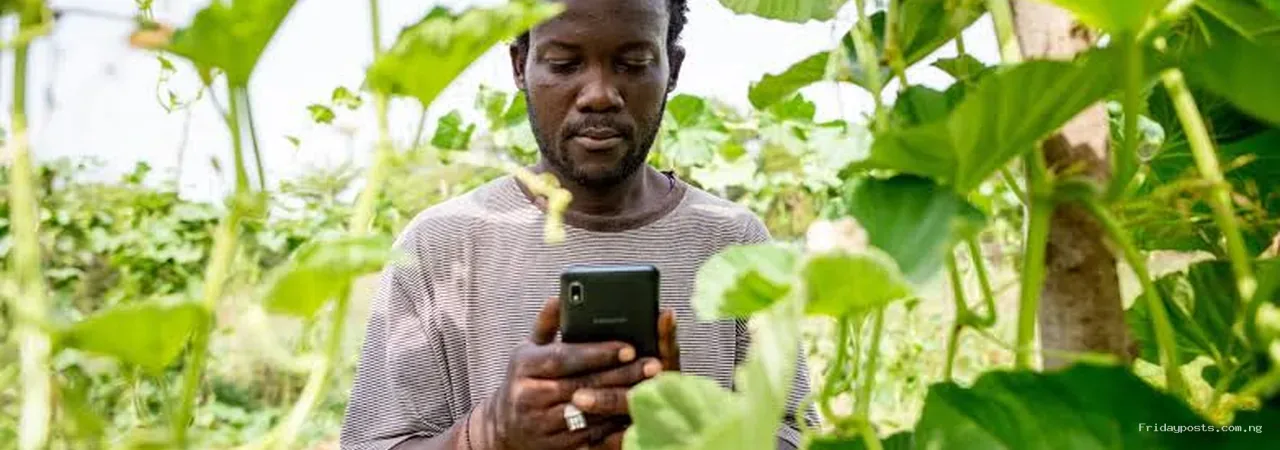
A farmer notices unusual spots on cassava leaves.
The nearest agricultural extension officer is several communities away.
The farmer takes a picture with a smartphone, uploads it to an application and receives a likely diagnosis within seconds.
That sounds like the future.
In parts of agriculture, it is already becoming the present.
Nigeria’s digital-policy institutions are increasingly promoting technology as a way to close the country’s agricultural extension gap. The logic is straightforward. There are too many farmers and too few trained officers to provide regular one-to-one support through the traditional model.
A mobile phone can reach more people than one extension officer.
But this creates an important question.
Can a smartphone actually replace the extension worker?
The short answer is no.
The more useful answer is that technology can replace some functions, strengthen others and allow a smaller number of human experts to serve many more farmers.
That distinction should shape Nigeria’s agricultural technology policy.
Agricultural extension is really an information system
Extension work is often described as visiting farmers.
The deeper function is knowledge transfer.
Farmers need timely information about seed varieties, planting periods, soil fertility, pests, disease, irrigation, weather, storage, markets and finance.
A good extension officer translates technical knowledge into practical advice.
The officer also carries information in the opposite direction.
He or she learns what farmers are experiencing and passes that information to researchers, government agencies or markets.
Extension is therefore a two-way information system.
Digital technology can improve both directions.
Weather information is one of the easiest digital wins
Farmers make decisions based on weather.
When should planting begin?
Will rain continue long enough for germination?
Is a dry spell likely?
Should fertiliser be applied now or delayed?
Traditionally, farmers rely on experience and local observation.
That knowledge remains valuable, but climate variability makes historical patterns less reliable.
Mobile weather alerts can give farmers more current information.
The challenge is localisation.
A forecast for an entire state may be too broad.
Agriculture needs information close to the farm.
Digital systems become more useful as weather data become more geographically specific and easier to understand.
Pest identification can become dramatically faster
A farmer who notices an unfamiliar insect or leaf pattern may lose days before receiving expert advice.
Image-based tools can reduce that delay.
A photograph can be compared with databases of known pests and diseases.
The system can suggest likely causes and recommended actions.
This does not mean the diagnosis will always be correct.
Poor image quality, multiple diseases and local variations can confuse a model.
The right design is therefore not to pretend the machine is a perfect agronomist.
It is to use technology as first-line triage.
Simple cases can be handled automatically.
Uncertain or serious cases can be escalated to human experts.
Market prices can reduce exploitation
Farmers often sell into markets where they have less information than buyers.
If a farmer knows the current price of maize in several nearby markets, negotiating power improves.
Digital platforms can provide price information, buyer contacts and logistics options.
This can also reduce unnecessary travel.
But market-price systems have to be trusted.
A price posted online is useless if it is outdated or does not reflect the quality grade the farmer is selling.
Platforms need regular data collection and clear definitions.
Technology improves markets only when the information is credible.
Fertiliser advice needs more than a general recommendation
A common weakness in agricultural advice is treating every field as if it were the same.
Soil differs.
Crop variety differs.
Previous land use differs.
Rainfall differs.
The correct fertiliser recommendation depends on these factors.
Digital tools can help by combining location, crop type, soil data and expected yield.
But Nigeria still needs more soil testing and local agronomic data.
Artificial intelligence cannot manufacture missing evidence.
If the underlying data are weak, the recommendation may only look sophisticated.
This is one reason digital agriculture must be connected to research institutions.
Local language will determine adoption
A farmer does not benefit from a perfect recommendation delivered in language he cannot understand.
Nigeria’s linguistic diversity makes this a serious issue.
Voice tools may be more important than text in some communities.
A farmer should be able to ask a question in Hausa, Yoruba, Igbo, Tiv or another local language and receive an understandable answer.
This is technically difficult but increasingly possible.
The strongest agricultural platforms will not merely translate English sentences.
They will understand agricultural vocabulary and local expressions.
Digital inclusion is partly a language problem.
Smartphones are not universal enough to be the only channel
Nigeria has a large mobile market, but not every farmer uses a smartphone comfortably.
Some farmers use basic phones.
Some have weak data coverage.
Some have smartphones but limited digital literacy.
A national extension strategy therefore needs multiple channels.
Smartphone apps can serve some users.
USSD can serve others.
Voice calls and interactive voice response can reach people with lower literacy.
Radio remains powerful.
WhatsApp groups can support farmer communities.
The best system is not the newest technology.
It is the combination that reaches the farmer reliably.
Human extension officers provide trust
Agriculture involves risk.
A farmer may be deciding whether to spend scarce money on a new seed or pesticide.
Trust matters.
A familiar extension officer who understands the farm can persuade a farmer to adopt a new practice in a way an anonymous app may not.
Human relationships are especially important when advice challenges tradition.
The officer can explain, demonstrate and return later to see what happened.
Technology cannot fully replace this social function.
The digital model should therefore make extension officers more effective rather than make them disappear.
Demonstration plots cannot be downloaded
Some agricultural knowledge is physical.
A farmer may need to see how a new planting density works.
A livestock farmer may need to observe vaccination technique.
A rice grower may need hands-on irrigation guidance.
A smartphone can show a video.
That helps.
But demonstration plots and field days allow farmers to observe results under local conditions.
This is why extension has always included practical demonstration.
Digital tools can prepare the farmer before the visit and reinforce learning after it.
They cannot make every physical learning experience unnecessary.
Credit decisions could improve with digital records
Agricultural finance is difficult because lenders often lack reliable information about small farmers.
Digital extension systems can create useful records.
What crop is being grown?
How large is the field?
What inputs were purchased?
What yields were recorded?
Has the farmer sold through the platform before?
With proper consent and privacy protection, these data can improve credit decisions.
A farmer who has no formal collateral may still demonstrate a credible production history.
This could help connect extension, markets and finance.
But it also creates data-governance risks.
Farmers should understand who can see their information and what it will be used for.
Insurance can become more practical
Agricultural insurance often struggles with the cost of assessing many small farms.
Satellite imagery, weather data and digital farm records can reduce that cost.
Index insurance can pay farmers when rainfall or other agreed indicators cross defined thresholds.
Digital extension platforms can also explain insurance products and support claims.
Again, technology does not eliminate every problem.
Poorly designed indices can fail to reflect actual losses.
Farmers may not trust products they do not understand.
Human explanation remains important.
Extension workers should become digital coordinators
The extension officer of the future may work differently from the extension officer of the past.
Instead of trying to personally answer every routine question, the officer can use digital tools to manage a larger farmer network.
He or she can monitor alerts.
Farmers with common problems can receive group guidance.
High-risk cases can be prioritised for field visits.
Video sessions can reduce travel.
Local farmer leaders can be trained as first-level support.
This turns technology into a force multiplier.
Nigeria does not need to choose between people and platforms.
It needs to redesign the job.
AI should show uncertainty
One danger in agricultural AI is false confidence.
A system may produce an answer that sounds certain even when the evidence is weak.
In farming, a wrong recommendation can destroy a season.
Platforms should therefore communicate uncertainty.
If the image quality is poor, say so.
If several diseases are possible, list them.
If pesticide use could create safety risks, recommend human verification.
Trust increases when technology admits limits.
Research institutes need to feed the digital system
Nigeria already has agricultural research institutes and universities.
Their knowledge should not remain in reports that farmers never read.
A national digital extension platform could convert research into practical, localised guidance.
Researchers could also use farmer feedback to identify emerging problems.
This would tighten the relationship between science and production.
The value of AI depends heavily on the quality of the knowledge base behind it.
Nigeria should invest in local agricultural datasets rather than depend entirely on foreign models trained on different crops and conditions.
Private technology companies need open standards
The agricultural technology market is growing.
Different companies may build advisory apps, finance platforms, input marketplaces and logistics systems.
Competition is healthy.
But farmers should not become trapped in isolated platforms that cannot communicate.
Government can help by developing open data standards and secure APIs for weather, market information and public extension content.
This allows innovation without every company rebuilding the same basic infrastructure.
The state should provide public digital rails.
Private firms can build services on top.
The business model matters
Who pays for digital extension?
The farmer?
Government?
Input companies?
Banks?
Buyers?
Development partners?
The answer shapes incentives.
If an input company funds advice, the platform may be tempted to recommend that company’s products.
If the farmer pays, poorer farmers may be excluded.
If government funds everything, sustainability may become difficult.
Hybrid models are likely.
Some public-interest information should be free.
Commercial services can charge for premium tools.
Transparency about sponsorship and recommendations is essential.
Women farmers need deliberate inclusion
Women are major participants in Nigerian agriculture but may have less access to land, finance, smartphones or extension services.
A digital strategy can either reduce this gap or widen it.
If platforms require expensive smartphones and formal land documents, many women may be excluded.
Design should consider shared-phone access, local women’s groups, voice services and flexible identity systems.
Technology is not automatically inclusive.
Inclusion has to be designed.
The farmer should remain at the centre
Technology projects sometimes begin with the excitement of the tool.
Agriculture should begin with the farmer’s problem.
What information does the farmer need?
When is it needed?
What decision will it change?
How will the farmer trust the answer?
What happens when the answer is wrong?
These questions are more important than whether the platform uses artificial intelligence.
A simple voice alert delivered at the correct time may create more value than a complex application nobody uses.
Nigeria needs a blended extension system
The country’s extension gap is too large for the old model alone.
Hiring enough officers to visit every farmer regularly would be difficult and expensive.
Digital tools can help.
But replacing human extension completely would also be a mistake.
The strongest model is blended.
Routine information is delivered digitally.
Farmers ask questions through accessible channels.
AI helps classify and answer simple problems.
Extension officers focus on difficult cases, demonstrations, trust building and local coordination.
Researchers feed updated knowledge into the system.
Markets and finance connect around the same data infrastructure.
That is how a smartphone becomes part of the extension service without pretending to be the entire service.
The farmer of the future may carry more expertise in a pocket.
But the most productive agriculture will still combine technology with people who understand the land.
Sources and further reading
- Nigeria Communications Week, October 2026: NITDA digital solutions for agricultural extension
- FridayPosts editorial brief supplied for 5 October 2026





Reader conversation
0 approved comments