
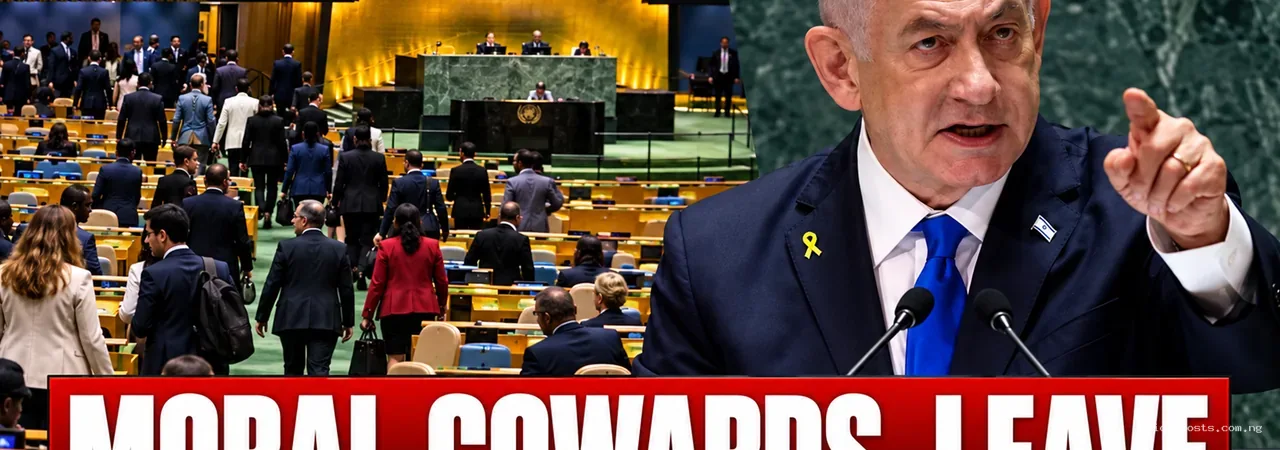
Israeli Prime Minister Benjamin Netanyahu opened his address to the United Nations General Assembly with an unusually direct response to diplomats who had walked out of the chamber.
As order was restored in the hall, Netanyahu addressed the remaining delegates and described those who had left as “moral cowards”, inviting anyone else who wished to leave to do so before he continued.
Dozens of delegates walked out as Netanyahu began speaking at the 81st session of the United Nations General Assembly in New York on September 24, 2026. Reuters reported that the walkout took place as Israel faced growing international criticism over its conduct in the region, particularly the Gaza war.
The walkout immediately set the tone for a speech that became both a defence of Israel’s recent military actions and a broader argument about the country’s security, history and place in the Middle East.
Netanyahu Defends Israel’s Actions Against Iran
One of the first major subjects Netanyahu addressed was Iran.
He recalled appearing before the UN 14 years earlier and drawing a red line to illustrate what he described at the time as the danger of Iran developing nuclear weapons.
In his 2026 address, Netanyahu argued that Israel had now acted against that threat.
He described the military operation against Iranian nuclear facilities as difficult to execute but said the decision itself had been straightforward because, in his view, allowing Iran to acquire nuclear weapons would have posed an existential threat to Israel.
Reuters reported that Netanyahu used the speech to highlight what he characterised as Israel's military successes during the conflict with Iran, which began with joint US-Israeli strikes in February 2026.
Netanyahu went further, claiming that Israel's military actions had also protected countries whose representatives had walked out of the General Assembly.
He said some foreign leaders had privately expressed appreciation for Israel's actions against Iran.
That claim was presented by Netanyahu during his speech and has not been independently established in the material reviewed for this report.
His argument was that there was a contradiction between private diplomatic attitudes towards Israel's actions and the public criticism directed at his government.
A Speech Built Around the Idea of Survival
From Iran, Netanyahu moved backwards in history.
He returned to June 1967, when Israel faced Egypt, Jordan and Syria in the conflict that became known as the Six-Day War.
Rather than presenting the dispute primarily as a struggle over present-day territory, Netanyahu argued that opposition to Israel had existed even before Israel controlled the West Bank, Gaza Strip and Golan Heights.
He used the historical reference to make a larger political argument: that, in his view, the central conflict has been over the existence of the Jewish state itself rather than solely over territorial boundaries.
That interpretation remains strongly disputed within the broader Israeli-Palestinian conflict, where questions of territory, occupation, statehood, security and national rights remain central to international diplomacy.
Netanyahu also rejected accusations of Israeli colonialism.
He pointed to Israel's comparatively small geographic size and criticised European countries, particularly Britain and France, whose histories include extensive colonial empires.
The comparison formed part of Netanyahu's wider attempt to portray some international criticism of Israel as historically inconsistent.
Netanyahu Recalls His Brother Before the Six-Day War
The speech then became more personal.
Netanyahu recalled being a high-school student in Philadelphia shortly before the Six-Day War began.
Five days before fighting broke out, he said, he returned to Israel and went looking for his older brother, Yonatan Netanyahu, commonly known as Yoni, who was serving as a young paratrooper officer.
According to Netanyahu's account, he found his brother with other soldiers camped in orange groves near Ramle.
The brothers embraced, shared military coffee and discussed the uncertainty surrounding the country.
Netanyahu said he asked his brother what would happen.
Yoni's response, as Netanyahu remembered it, was simple:
“We're going to win. We have no other choice.”
Netanyahu used the memory to establish a theme that ran through the rest of his remarks: his belief that Israel's military decisions must be understood through the logic of national survival.
From 1967 to Entebbe
Netanyahu then connected his brother's story to another event that would later become central to both Israeli history and his own family.
Nine years after the Six-Day War, an Air France aircraft travelling from Tel Aviv to Paris was hijacked and eventually taken to Entebbe, Uganda.
The hijackers separated Israeli and Jewish passengers from many of the other hostages.
Israel subsequently launched the July 1976 rescue operation commonly known as Operation Entebbe.
Yonatan Netanyahu commanded the Israeli assault force and was killed during the operation.
In his UN address, Netanyahu began recounting the Entebbe episode after discussing his conversation with Yoni before the 1967 war, connecting the two episodes through the idea that Israel had repeatedly faced moments in which its leaders believed decisive action was necessary for national survival.
The historical references were not merely biographical.
They provided the framework through which Netanyahu asked the international audience to interpret Israel's contemporary military policy.
The Walkout Reflected Wider Diplomatic Divisions
The reaction inside the General Assembly hall was itself part of the political story.
Reuters reported that dozens of delegates left the chamber as Netanyahu began speaking, while supporters in the gallery remained and voiced support for Israel.
The walkout came against a backdrop of widening disagreement over Israel's conduct in Gaza and other parts of the region.
Netanyahu used the wider address to reject accusations against Israel, criticise several foreign governments and political figures, and defend Israeli military operations.
Qatar and Turkey subsequently rejected accusations directed at them during the speech, according to Reuters.
The disagreement therefore extended well beyond the delegates who physically left the hall.
It reflected a much larger diplomatic divide over how governments assess Israel's military actions, Palestinian civilian suffering, the war in Gaza, Iran, regional security and the future of the Israeli-Palestinian conflict.
Netanyahu’s Speech Came at a Politically Sensitive Moment
The address also took place during a significant period in Israeli domestic politics.
Israel was approaching an October 27 general election, and Reuters reported that Netanyahu's political bloc was trailing rivals in opinion polling at the time of the speech. His approximately 40-minute UN appearance therefore had both an international and domestic political audience.
Netanyahu used the platform to present Israel as a country fighting simultaneously on several fronts and portrayed his leadership as central to that struggle.
Critics, however, have challenged his government's conduct, particularly over Gaza and the occupied Palestinian territories.
Netanyahu has consistently rejected allegations that Israel's military campaign amounts to genocide and argues that Israel is fighting armed groups that threaten the country.
His critics, including foreign leaders, rights advocates and Palestinian officials, dispute that account and have focused on civilian casualties, humanitarian conditions and questions of international law.
The disagreement remains one of the most consequential diplomatic disputes confronting the international community.
More Than a Walkout
The most immediately shareable moment from Netanyahu's speech may have been his description of departing diplomats as “moral cowards”.
But the opening minutes of the address reveal a wider message.
Netanyahu sought to place the present conflict with Iran and Israel's other regional confrontations within a long historical narrative stretching from 1967 through Entebbe to the present.
His argument was essentially that Israel's security decisions should be understood as responses to threats that Israeli leaders regard as existential.
For many of the diplomats who walked out, however, the central issue was different: opposition to Israel's conduct and the policies of Netanyahu's government.
That contrast captured the deeper significance of the scene inside the General Assembly.
One group left the room in protest.
Netanyahu remained at the podium and used their departure as the opening argument of his speech.
The result was a highly visible illustration of the diplomatic divisions surrounding Israel at the United Nations in 2026

A. Joshua Adedeji
A. Joshua Adedeji is a leadership strategist, organisational development consultant, author, teacher and values-driven transformation leader. He writes on leadership, strategy, governance, organisational effectiveness, business, personal development and Nigeria’s social and economic transformation, connecting ideas and current realities to practical implications for leaders, institutions, entrepreneurs and citizens. His work is shaped by a commitment to clear thinking, responsible leadership, stronger institutions and the development of people and systems capable of producing lasting impact.









Reader conversation
0 approved comments