
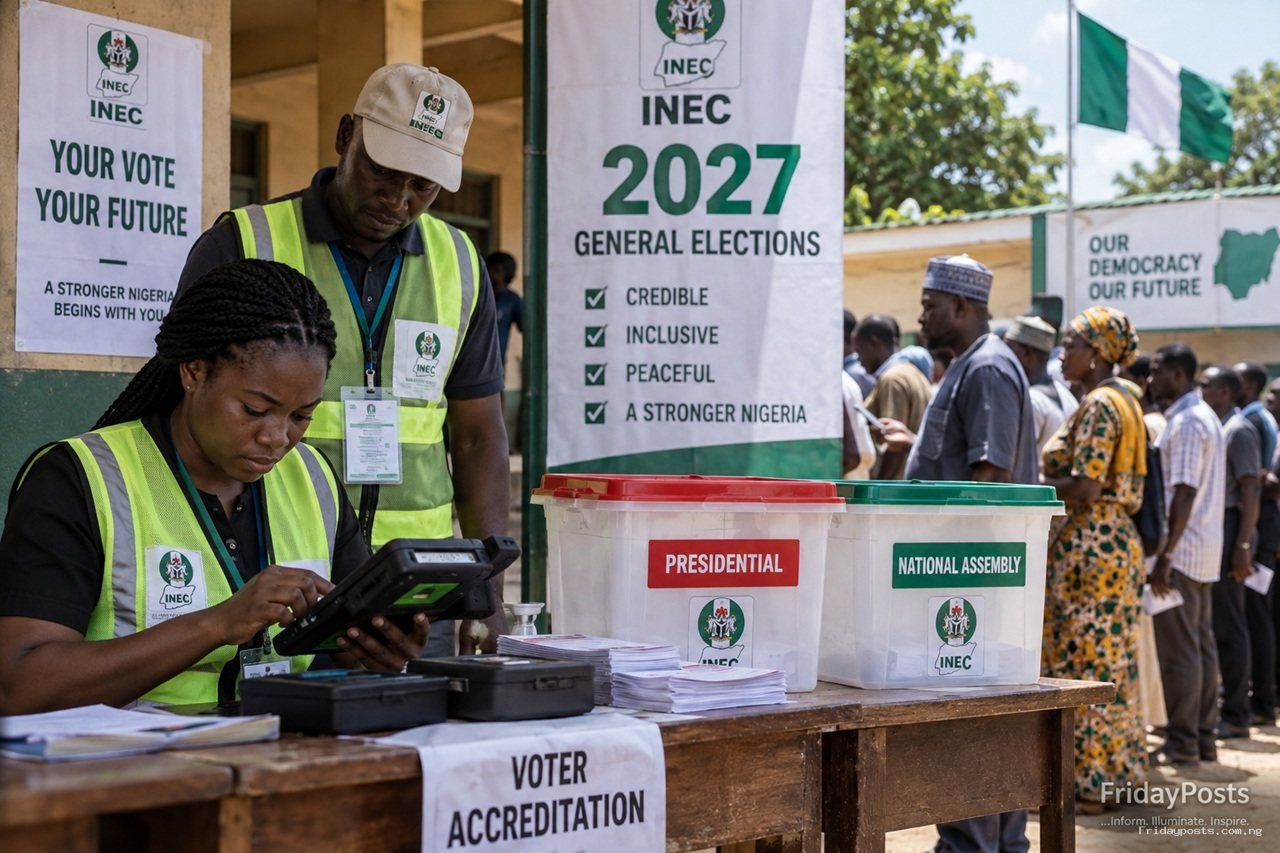
The most important fact in Nigeria's latest voter-register controversy is not simply that the Independent National Electoral Commission removed more than 1.6 million records. It is that the Commission has now moved from saying that a large number of registrations looked suspicious to stating that 1,608,660 registrations were confirmed invalid and removed, while 873 records belonging to verified deceased voters were also expunged. That distinction matters because an automated system can flag records for review without proving that they are invalid. What Nigeria now has is a much firmer administrative finding, accompanied by a more troubling institutional question: how did so many defective registrations enter the system in the first place?
INEC Chairman Joash Amupitan said the Commission harvested 11,088,238 registration records from the three phases of the 2025/2026 Continuous Voter Registration exercise. Its Automated Biometric Identification System initially flagged 1,545,052 records for further examination, but INEC stressed that a flagged record was not automatically an invalid registration. Before the preliminary register was published, 1,277,052 registrations had already been confirmed invalid and excluded. Public claims and objections then triggered further adjudication, after which another 217,722 registrations were removed while 50,278 were cleared as valid and retained. Additional screening identified a further 113,886 invalid records.
That sequence is important for public confidence because it shows that a modern election register is not cleaned by pressing a single software button. Technology identifies anomalies, but authorised review still determines whether a voter should remain on the register. Nigeria needs to preserve that distinction. If the public begins to believe that algorithms can silently erase voters, trust will collapse. If, on the other hand, citizens believe that clearly fraudulent or duplicate records are allowed to remain because officials fear accusations of voter suppression, trust will collapse for a different reason.
What the 1.6 million figure really means
The headline number is large enough to alarm citizens, but it needs proportion. Nigeria's voter register contains more than 100 million registrations. The removal of 1.6 million records does not prove that 1.6 million people were planning to vote illegally. Some of the irregularities involved multiple registration attempts, manipulated photographs, unusual registration patterns, invalid biometric records and other defects. A person may attempt to register twice because he or she has relocated and does not understand the transfer process. Another record may reflect a serious attempt to manipulate the system. The same database can contain both kinds of cases.
That is why INEC's public communication must become more granular. The Commission should publish a category-by-category breakdown showing how many invalid records came from duplicate registration, defective biometrics, manipulated photographs, identity inconsistencies, registration outside approved procedures and other causes. Such data would not require the publication of personal voter information. It would allow Nigerians to understand whether the principal weakness was technological, administrative or deliberate.
The issue becomes more serious because INEC has identified 54 personnel across 10 states for administrative investigation and possible prosecution. Those individuals have not all been found guilty, and they should not be treated as convicted offenders. But the fact that the Commission believes staff conduct requires investigation means the integrity problem may not be explained entirely by confused applicants or system errors. If registration personnel deliberately circumvented procedures, then Nigeria faces an internal-control problem within the election-management process itself.
The register is only as trustworthy as the people and systems that produce it
Election technology is often presented as the answer to political distrust. Biometrics, facial recognition and automated duplicate detection are useful because they make manipulation harder. They do not eliminate human discretion. Registration officers still capture data, approve exceptional procedures, manage equipment and interact with citizens. Supervisors still review records. Administrators still decide how irregularities are investigated. A strong electoral system therefore requires technology and institutional discipline at the same time.
INEC should explain what control failed in the cases now under investigation. Were supervisors unable to detect unusual registration patterns while they were occurring? Did officers misuse procedures designed for persons with disabilities or other exceptional circumstances? Were manipulated photographs accepted because software checks were weak, or because officials deliberately bypassed safeguards? Were suspicious registration centres concentrated in particular locations? These questions are not about embarrassing the Commission. They are how institutions learn.
A credible response would include disciplinary outcomes where evidence supports them, stronger authentication for registration officers, clearer audit logs and automatic alerts when unusual patterns appear. For example, if one registration centre suddenly records a highly unusual number of exceptional biometric cases or repeated demographic patterns, the system should alert supervisors before the exercise is complete. Prevention is more credible than a massive clean-up after public outrage.
Historical problems complicate the 2027 register
INEC has also acknowledged that the integrity challenge extends beyond the latest registration exercise. The national register has evolved through registration and continuous-voter-registration exercises going back to 2011, using different generations of technology, procedures and data-quality standards. The Commission says some of the duplicate names and suspicious photographs circulated publicly relate to older records rather than the 2025/2026 exercise.
This means the current clean-up does not close the issue. Removing confirmed invalid entries from the newest registration cycle is necessary, but historical duplicates and inconsistent records may remain. INEC had considered a wider voter revalidation exercise but deferred it because stakeholders were concerned that a large-scale revalidation close to the 2027 election could disenfranchise legitimate voters. That concern was reasonable. A hurried national revalidation can create as much risk as it solves.
The Commission now has to manage a difficult balance. It must keep cleaning the register without introducing a process so disruptive that legitimate voters are excluded or forced to complete complex procedures shortly before the election. The safest approach is targeted verification, transparent correction channels and repeated public communication.
Legitimate voters need protection from wrongful deletion
The removal of invalid records is only half of register integrity. The other half is protecting eligible citizens from being wrongly removed. INEC says some Nigerians who believed their names had disappeared had previously registered in another location and then tried to register afresh after moving. The biometric system voided the later attempt while the original registration remained valid at the old location.
For a voter, that can feel like deletion even when the original record still exists. The practical problem is that an old registration in a former polling location may be useless to a citizen who now lives hundreds of kilometres away. The Commission must therefore make transfer and verification procedures easy enough for ordinary people to understand.
Between now and the publication of the final register on 15 December, voters should be able to confirm their registration status, polling unit and any outstanding correction. Where a record has been excluded, there should be a documented route for challenging the decision. INEC should publish the number of successful corrections and restorations as well as removals. A clean register is not one with the maximum number of deletions. It is one that contains eligible voters once, accurately and at the correct polling location.
Public scrutiny improved the process and should be institutionalised
One positive lesson from the latest episode is that public scrutiny mattered. The preliminary register attracted complaints about unusual photographs, repeated identities and records of deceased persons. INEC says public objections contributed to additional adjudication and further removals. That is how a transparent register is supposed to work: citizens and political actors identify problems, the election body investigates them, and verified corrections follow.
The challenge is to prevent the process from degenerating into partisan accusation. Political parties have an obvious interest in the register, but every anomaly is not evidence of a conspiracy. At the same time, INEC should not dismiss criticism simply because it comes from political opponents. The best defence against misinformation is data. If the Commission publishes clear figures, methodology and outcomes, political claims become easier to test.
Civil-society organisations could also build a non-partisan register-integrity tracker. Such a tracker would monitor records flagged, confirmed invalid, restored after review, removed as deceased, personnel investigated and corrective measures introduced. It could also document whether voters are able to resolve transfer or registration problems before the final register is published.
The 54-person investigation could become the real credibility test
Removing bad records is important, but institutional accountability will be judged by what happens to officials who may have contributed to the problem. If the 54 personnel are investigated and evidence shows that some did nothing wrong, their names should be cleared appropriately. If evidence shows deliberate misconduct, disciplinary action and prosecution should follow the law.
The public should eventually know the categories of misconduct established, without compromising fair hearings or sensitive personal information. A system in which irregular registrations are removed but staff misconduct produces no consequence invites recurrence. A system in which allegations automatically destroy careers without due process is equally dangerous.
INEC needs to demonstrate that internal accountability is professional rather than political. The investigation should establish what happened, who was responsible, which controls failed and what changes will prevent repetition.
BVAS reduces one risk but does not make the register irrelevant
Some defenders of the electoral system argue that the Bimodal Voter Accreditation System makes multiple registrations less consequential because each voter must be physically present at the designated polling unit and biometrically authenticated. That safeguard is valuable. It does not mean the register can be allowed to contain avoidable errors.
The register determines who is eligible to appear at a polling unit in the first place. Poor-quality data can create confusion, undermine confidence and complicate accreditation. Even where BVAS prevents multiple voting, repeated names and manipulated records create a perception that the electoral database is unreliable. Elections depend on both actual integrity and public confidence.
The Commission should therefore treat register quality and accreditation technology as complementary safeguards. One cannot be used to excuse weakness in the other.
The final register must come with a public integrity report
When INEC publishes the final register in December, it should not release only the total number of voters. It should publish an accompanying integrity report. That report should explain how many records were harvested, how many were flagged by automated systems, how many were confirmed invalid, how many were restored after review, how many deceased voters were removed, how many historical anomalies remain under investigation and what procedural changes have been introduced.
State-by-state data would be useful where it can be published without exposing personal information. If unusual concentrations of invalid records appeared in specific states or registration centres, the public deserves an aggregate explanation.
This would turn a controversial clean-up into a measurable accountability exercise.
Ten questions every voter should ask before 2027
Every Nigerian voter should know the answer to ten practical questions before the election. Is my registration active? Is my polling unit correct? If I moved, was my transfer completed? If I registered twice by mistake, which record is valid? Have I collected the correct PVC where one is required? What do I do if my name is missing? Which INEC channel should I use for corrections? When will the final register be published? How does BVAS verify me? What should I do if someone asks me to pay unofficially to correct a voter record?
INEC should answer these questions repeatedly in plain language. Electoral trust is built partly through sophisticated systems and partly through citizens understanding what to do.
Can Nigerians trust the register?
The honest answer is that trust should not be demanded; it should be earned through evidence. The removal of 1.6 million confirmed invalid registrations can be interpreted as proof that the register had serious weaknesses. It can also be interpreted as evidence that the clean-up mechanisms are working. Both statements can be true at the same time.
What determines the final judgment is what happens next. If INEC publishes a clear final register, protects legitimate voters, reconciles historical anomalies, completes credible investigations into staff conduct and strengthens controls before the election, the clean-up could improve confidence. If the Commission stops at the headline number, the controversy will remain.
Nigeria's election system does not need a register that officials describe as credible. It needs a register whose credibility can be demonstrated.
Sources and further reading
- PUNCH, 10 November 2026: INEC deletes 1.6 million voter records
- The Guardian, 10 November 2026: INEC flags 54 personnel











Reader conversation
0 approved comments