
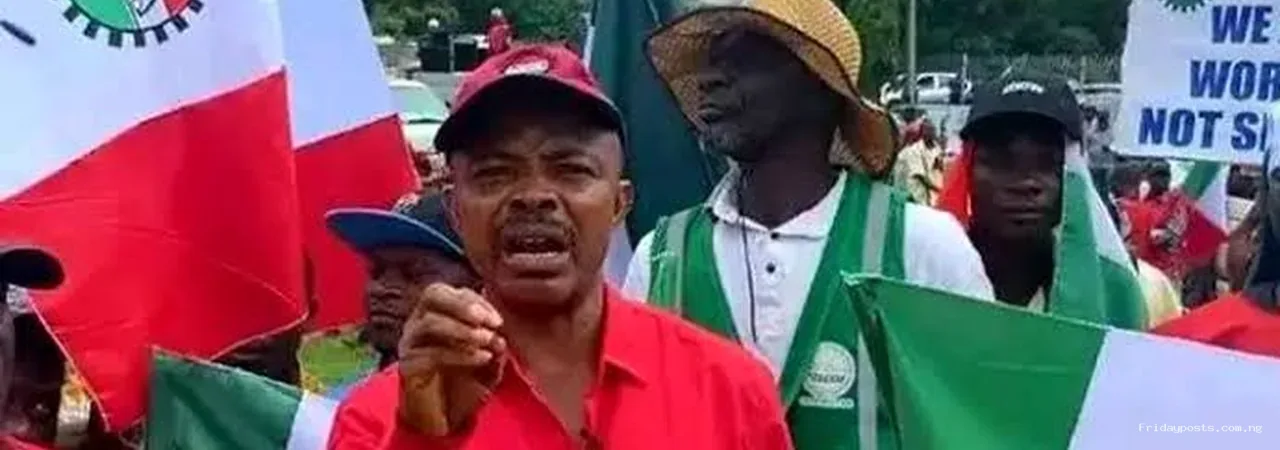
Nigeria's wage debate has become complicated because several different concepts are being discussed as though they mean the same thing.
The Nigeria Labour Congress has distanced its national leadership from the N40,000 consequential salary adjustment negotiated for federal workers in 2024.
The NLC says that adjustment was handled by public-sector unions through the relevant negotiating structure, not by the national leadership of the Congress.
At the same time, the NLC argues that negotiations on a new national minimum wage should already be under way because the current N70,000 minimum wage has lost substantial purchasing power.
This raises two separate questions.
Who is responsible for salary adjustments after a national minimum wage is set?
And when should the next statutory minimum-wage review actually begin?
The national minimum wage is a legal floor
The minimum wage is the lowest monthly wage that covered employers are legally required to pay eligible workers.
The 2024 amendment raised the national minimum wage to N70,000.
It also changed the periodic review cycle from five years to three years.
That does not mean every worker in Nigeria earns exactly N70,000.
Many employees earn more.
The wage is a floor, not a universal salary scale.
Consequential adjustment is different
When the minimum wage rises, existing salary structures may need adjustment.
Imagine a worker earning N65,000 and a supervisor earning N75,000.
If the legal floor becomes N70,000 and only the lower-paid worker moves, the gap between grades becomes very small.
Public-sector unions therefore negotiate consequential adjustments across salary levels.
This is not the same negotiation as setting the national minimum wage itself.
The NLC's clarification is important because responsibility differs.
Sectoral unions negotiate implementation
The national minimum wage is negotiated through a tripartite process involving labour, government and employers.
After the figure is set, sector-specific unions negotiate how it affects existing structures.
In the federal public service, the Joint Public Service Negotiating Council plays a major role.
In private industries, sector unions negotiate with employer associations.
This is why a single wage decision can produce different implementation arrangements across sectors.
Temporary allowances are different again
Governments sometimes introduce transport or cost-of-living allowances.
These can provide immediate relief.
They are not necessarily part of permanent base salary.
This matters because allowances may be easier to withdraw.
They may not count equally toward pensions or other benefits.
Workers should always ask whether an announced increase is permanent salary, consequential adjustment or temporary allowance.
The labels have financial consequences.
The N40,000 dispute is partly about responsibility
The NLC says workers should not blame its national leadership for the N40,000 federal public-sector adjustment.
Its position is that sectoral public-service unions negotiated that outcome.
This may sound like an internal labour issue.
It matters because workers need to know which institution to hold accountable.
Collective bargaining works only when roles are clear.
The next review date is contested
The 2024 amendment says the national minimum wage expires after three years and should be reviewed.
The NLC argues that negotiations should begin before the expiry point.
Its officials say the process should already be moving because collective bargaining needs time.
Government may interpret the timetable differently.
This is a legal and industrial-relations issue that deserves clarity.
The parties should publish their interpretations.
A three-year review cycle does not mean waiting until the last day
Wage negotiation is complex.
Data must be collected.
Government affordability assessed.
Employer groups consulted.
States considered.
Inflation projections made.
If the law requires review every three years, starting the process months before expiry is reasonable operationally.
Otherwise, workers can enter a new period without an agreed wage.
The dispute is about how early that process should begin.
Purchasing power is the strongest argument for review
The NLC says the N70,000 minimum wage has lost value.
The correct way to assess this is through real purchasing power.
What did N70,000 buy when agreed?
What does it buy now?
Food.
Transport.
Electricity.
Rent.
Cooking fuel.
Healthcare.
A wage can remain legally valid while becoming economically inadequate.
This is why inflation matters to wage policy.
But a higher nominal wage alone may not solve the problem
If wages rise sharply while food, transport and housing continue rising, workers may remain under pressure.
Employers may also increase prices to absorb higher payroll costs.
A strong wage policy therefore needs broader cost-of-living reform.
Power.
Transport.
Food supply.
Housing.
Tax.
Productivity.
Cash income is only one part of living standards.
Public-sector affordability remains difficult
Federal and state governments employ large numbers of workers.
A wage increase affects recurrent expenditure.
States have different revenue capacities.
Some depend heavily on federal allocations.
If a national wage rises faster than public revenue, governments may accumulate arrears or reduce hiring.
The solution is not to keep wages artificially low.
It is to negotiate with fiscal reality visible.
Private-sector employers also face pressure
A large company may absorb a wage increase.
A small manufacturer may struggle.
A restaurant with thin margins may raise prices.
A small school may increase fees.
A logistics firm may reduce hiring.
The tripartite process exists because wage policy affects workers and employers.
Ignoring either side creates instability.
Productivity should enter the conversation
Higher productivity makes higher wages more sustainable.
A worker using reliable electricity, better machinery and efficient transport can produce more per hour.
The employer earns more value.
Wages can rise without the same inflationary pressure.
Nigeria's long-term wage solution is therefore partly a productivity solution.
Tax relief can increase take-home pay
Workers care about net income.
If tax changes allow lower-income employees to keep more of their salary, disposable income improves.
This can complement wage increases.
Tax policy should therefore be part of labour discussions.
The benefit must be clear and automatic.
A relief measure buried in complex filing procedures may not help ordinary workers.
Transport may be the most immediate household cost after food
Many workers commute long distances.
Petrol price increases affect bus fares even for people without cars.
A worker earning N100,000 but spending N30,000 on transport has limited disposable income.
Public transport investment can function like a wage increase.
It reduces recurring expenditure.
This is why wage policy should connect with transport policy.
Salary compression creates morale problems
If lower grades rise while higher grades remain unchanged, salary differences compress.
A supervisor may earn only slightly more than a junior worker.
This can create dissatisfaction.
Consequential adjustment attempts to preserve reasonable structure.
The challenge is cost.
Every adjustment across the entire salary table multiplies the fiscal impact.
Workers should demand full tables, not headline numbers
A government can announce "N40,000 adjustment" without making the effect clear.
Workers should see:
Old salary.
New salary.
Grade level.
Allowance changes.
Pensionable components.
Effective date.
Arrears.
This reduces confusion.
Transparency is a labour-relations tool.
Arrears can turn a wage increase into a cash-flow problem
If a new wage takes effect retroactively, government may owe months of arrears.
Workers expect payment.
Employers face large one-time costs.
Negotiations should therefore include a realistic arrears schedule.
A wage agreement that cannot be implemented undermines trust.
States should not negotiate in isolation from fiscal data
State governments often argue that they cannot afford national wage decisions.
Some have stronger internally generated revenue than others.
The public should see the numbers.
Payroll.
Revenue.
Federal allocation.
Debt service.
Other recurrent spending.
Affordability claims should be evidence-based.
The federal structure complicates wage uniformity
The minimum wage is national.
Government finances are not uniform.
This creates recurring tension.
A worker doing similar work in two states may face different implementation speed.
Nigeria needs stronger fiscal planning before national wage adjustments are finalised.
States should participate early.
Organised labour also needs a unified message
Workers can become confused when the NLC, sector unions and negotiating councils appear to contradict one another.
Labour institutions should explain roles jointly.
Who negotiates the national floor?
Who negotiates salary structure?
Who handles private-sector implementation?
Who negotiates state-level consequences?
Clear communication strengthens collective bargaining.
The next wage talks should be data-led
FridayPosts would expect a serious negotiation to include:
Inflation since 2024.
Food inflation.
Transport costs.
Average household expenditure.
Productivity.
Government revenue.
Private-sector profitability.
Employment conditions.
Regional living costs.
The number should emerge from evidence.
Not only political pressure.
A wage formula may reduce repeated crises
Nigeria could consider whether some elements of wage review should be rules-based.
Not automatic indexation to inflation, which can create problems.
But a transparent review framework.
A basket of indicators.
A review timetable.
A technical committee.
This would make negotiations more predictable.
What should workers expect now?
First, more debate over the legal timing of the next review.
Second, negotiations between organised labour and government before a new national figure is agreed.
Third, separate consequential-adjustment negotiations after any new minimum wage.
Fourth, state and private-sector implementation discussions.
Fifth, political pressure because 2027 is an election year.
Workers should not assume one announcement settles every stage.
FridayPosts would track five indicators
The formal start date of the national wage review.
Government's legal interpretation of the timetable.
The economic data used by the negotiating committee.
The treatment of tax and transport relief.
The implementation framework after a new figure is reached.
These will show whether Nigeria is building a predictable wage system or repeating crisis bargaining.
The wage debate is really about living standards
N70,000 is a legal number.
N40,000 is a salary-adjustment figure.
Allowances are another category.
Workers ultimately care about something simpler.
Can income cover a reasonable life?
That is the standard.
The next wage negotiation will be more credible if everyone begins by defining the terms accurately.
Minimum wage.
Consequential adjustment.
Allowance.
Real wage.
Once the language is clear, Nigerians can have the harder conversation about what workers should earn and what employers and government can sustainably pay.
Nigeria also needs a better cost-of-living benchmark for wage talks
A national inflation rate is useful, but wage negotiations would benefit from a transparent worker-cost index.
The basket could track food, transport, rent, electricity and other unavoidable expenses for low-income households.
This would not automatically determine the final wage.
It would give negotiators a shared factual starting point.
At present, government and labour can enter talks with different descriptions of hardship.
A common benchmark would improve the quality of bargaining.
Wage institutions should preserve institutional memory
Every major negotiation should produce a public implementation report.
What was agreed?
What was implemented?
Which states complied?
Which private sectors negotiated consequential changes?
What disputes remained?
Without this record, each wage cycle begins with arguments about what happened previously.
Better institutional memory can reduce repeated confusion and make future negotiations faster.
Sources and further reading
- The Guardian, 9 November 2026: NLC rejects ₦40,000 wage adjustment
- National Minimum Wage (Amendment) Bill, 2024








Reader conversation
0 approved comments