
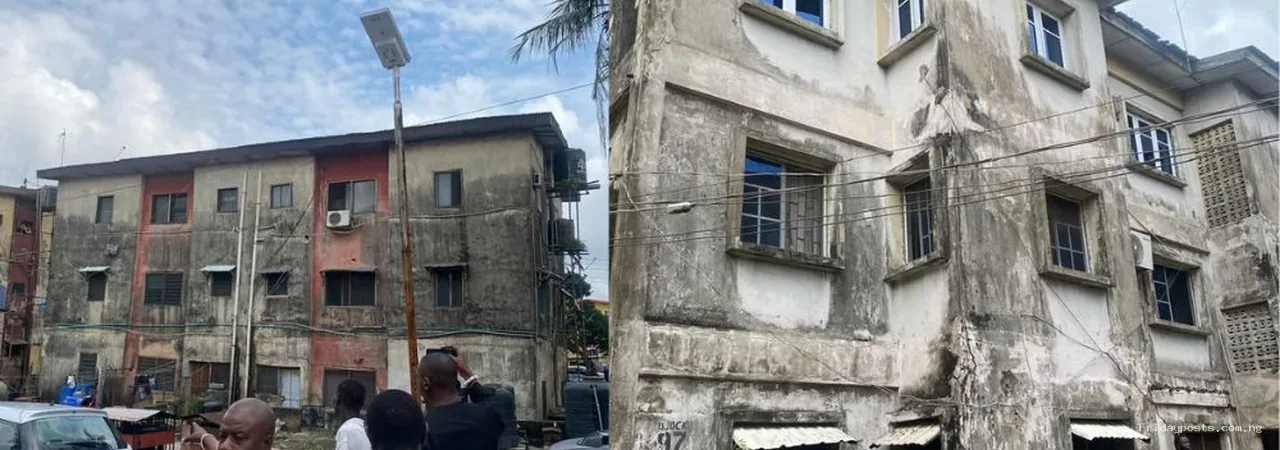
Lagos has identified about 360 buildings as distressed structures, according to the Lagos State Building Control Agency.
That figure should not be interpreted as 360 buildings that have collapsed.
It means the agency has identified structures that, in its assessment, require attention because of signs of distress or safety concerns.
For residents, the number creates an immediate practical question.
How do you know whether the building you live in is safe?
The answer cannot come from social media photographs or a landlord's reassurance alone.
Building safety is an engineering question.
"Distressed" is a warning category, not a single condition
A building can become distressed for different reasons.
Foundation movement.
Structural cracks.
Concrete spalling.
Corrosion of reinforcement.
Water damage.
Illegal alteration.
Overloading.
Poor materials.
Fire damage.
Age.
Drainage problems.
One building may be repairable.
Another may be unsafe for occupation.
The condition has to be assessed professionally.
Visible cracks are not all equal
Many buildings develop small cracks in plaster.
Not every crack is structural.
A hairline crack can be cosmetic.
A wide diagonal crack through a wall may indicate movement.
Cracks around columns, beams or foundations deserve particular attention.
Rapid change is also important.
A crack that grows visibly over weeks should not be ignored.
Residents should document changes and seek professional advice.
Concrete spalling is a serious sign
Spalling occurs when concrete breaks away from a structural element.
It can expose steel reinforcement.
Once steel is exposed to moisture, corrosion can expand and damage more concrete.
LASBCA's own distressed-building records frequently list concrete spalling and exposed reinforcement among defects.
This does not automatically mean collapse is imminent.
It means structural assessment is justified.
Settlement can affect foundations
If part of a building sinks or moves, walls and columns may crack.
Doors may stop closing properly.
Floors may slope.
LASBCA guidance notes that buildings showing settlement may require additional foundation investigation to understand soil conditions and foundation performance.
This is specialised work.
A mason should not be the final authority.
Water is one of the biggest long-term enemies of buildings
Persistent dampness can weaken finishes and contribute to corrosion.
Poor drainage can affect foundations.
Leaking roofs can damage structural elements.
Flooding can change soil conditions.
Residents often treat water stains as cosmetic.
Repeated moisture may indicate a deeper problem.
Maintenance should address the source, not only repaint the wall.
Illegal alterations can create new risk
A building designed for two floors may be extended upward.
A wall may be removed to create a larger shop.
Heavy equipment may be installed.
Balconies may be enclosed.
These changes can alter structural loads.
LASBCA has repeatedly linked unsafe structures to unapproved construction or renovation.
Before major alterations, owners should obtain professional structural advice and required approvals.
A building notice should be taken seriously
LASBCA serves different types of notices.
Contravention notices.
Stop-work orders.
Quit or evacuation notices.
Demolition notices.
Not every notice means the building will be demolished immediately.
But residents should verify the notice and understand what action is required.
LASBCA has introduced security features, including QR codes on notices, to reduce impersonation.
This matters because fake enforcement notices can be used for extortion.
Residents should verify official notices
If a notice appears on a building, do not simply remove it.
Do not pay an unofficial "agent" to make it disappear.
Verify the notice with the agency.
Check the district office.
Use official contact channels.
Ask the landlord for documentation.
A genuine notice creates legal and safety obligations.
An unclear notice should be investigated, not ignored.
Non-destructive testing is an important tool
LASBCA guidance refers to non-destructive integrity testing.
These tests examine structural elements without simply destroying them.
They can assess concrete strength and other conditions.
Where settlement is involved, foundation investigation may also be required.
The test result should be interpreted by qualified professionals.
A laboratory result without structural engineering interpretation is incomplete.
A COREN-registered structural engineer should assess the building
Engineering decisions should be made by qualified engineers.
LASBCA notices have required structural-stability reports certified by COREN-registered professionals.
This protects residents.
A landlord should not commission an unqualified person to produce a reassuring letter.
Professional registration creates accountability.
Who should pay for the integrity test?
This is one of the biggest practical disputes.
If the building is privately owned, the owner normally carries responsibility for maintaining a safe property.
Tenants should not be forced casually to finance structural obligations that belong to the landlord.
However, residents may choose to commission independent advice if they believe their safety is at risk.
The legal allocation of cost can depend on tenancy terms and regulatory orders.
Safety should come before the payment dispute.
Tenants have limited power but should document concerns
A tenant who sees serious structural warning signs should notify the landlord in writing.
Photographs should be dated.
Messages kept.
Other residents informed.
If the owner fails to act, the issue can be reported to the relevant agency.
Documentation matters if a dispute later arises.
Landlords should not hide a distressed classification
A prospective tenant should know if a building has been officially flagged.
Property transactions rely on information.
Concealing a safety notice can expose tenants to serious risk.
Lagos should consider a searchable public system for confirmed distressed-building notices, with appropriate safeguards.
This would allow residents to verify status.
Buyers need building due diligence
People often focus on title documents when buying property.
Structural condition is equally important.
A building can have valid ownership documents and still be unsafe.
Buyers should commission professional building inspections.
For older multi-storey properties, structural review may be worth the cost.
Buying cheaply can become expensive if major remediation is needed.
Insurance may not cover every failure
Property owners should understand insurance terms.
Structural defects, poor maintenance or illegal alteration may affect claims.
A building policy is not a substitute for maintenance.
Insurers may also require inspections for higher-risk properties.
Safety comes before compensation.
Evacuation orders are difficult but sometimes necessary
People resist evacuation for understandable reasons.
Where will they go?
Who pays rent elsewhere?
What happens to a business?
Can valuables remain inside?
These are serious social issues.
But if a building is judged unsafe, delay can cost lives.
Government should pair enforcement with clear timelines and humanitarian planning where large numbers of low-income residents are affected.
Enforcement must be transparent
Owners often complain about inconsistent building regulation.
Some unsafe buildings remain occupied.
Others are demolished.
Transparency can improve trust.
LASBCA should publish criteria.
What triggers sealing?
What triggers evacuation?
What can be repaired?
What requires demolition?
How can an owner appeal?
Clear rules reduce accusations of selective enforcement.
Lagos needs enough qualified inspectors
A city with millions of buildings requires substantial regulatory capacity.
Inspectors.
Engineers.
Material-testing laboratories.
District offices.
Digital records.
If enforcement teams are too small, dangerous structures can remain unnoticed.
The 360 figure may reflect identified cases, not the entire universe of risk.
This is why reporting by residents matters.
Residents should understand the warning signs
FridayPosts would advise residents to seek professional assessment where there are:
Large or expanding diagonal cracks.
Cracks through structural columns or beams.
Visible concrete spalling.
Exposed or heavily corroded steel reinforcement.
Noticeable leaning.
Sudden floor settlement.
Repeated partial collapses.
Sagging slabs.
Severe water damage around structural elements.
Unexplained loud cracking sounds.
These signs do not replace engineering assessment.
They justify urgent attention.
Tenants should not conduct destructive inspections themselves
A concerned resident should not chip concrete from columns or remove structural finishes to "check" the building.
This can worsen damage.
Assessment should be controlled.
Professionals know where and how to test.
Safety investigations should not create new safety problems.
Fire can create hidden structural damage
A building may look standing after a major fire.
Heat can weaken steel and concrete.
A post-fire structural assessment is important before full reoccupation.
Repairs should follow engineering recommendations.
Cosmetic repainting is not proof of restored safety.
Building maintenance is cheaper than structural rescue
Small problems become large problems when ignored.
Blocked drainage.
Roof leaks.
Concrete cracks.
Corroding pipes.
Broken expansion joints.
Owners often postpone maintenance because of cost.
The eventual structural repair can be far more expensive.
Preventive maintenance is a financial strategy as well as a safety strategy.
Lagos should digitise building safety records
A modern building-control system should record:
Planning approval.
Construction authorisation.
Inspection history.
Integrity tests.
Enforcement notices.
Renovation permits.
Demolition status.
This would help buyers, tenants, insurers and regulators.
It would also reduce reliance on paper files.
Professional responsibility needs enforcement too
Unsafe construction is not always caused only by owners.
Architects.
Engineers.
Builders.
Contractors.
Material suppliers.
Professionals who approve unsafe work should face consequences where evidence supports it.
The built environment is a chain of responsibility.
The public should report risk early
Residents often notice warning signs before agencies do.
Reporting should be simple.
A phone line.
Online form.
District office.
Photo upload.
The agency should acknowledge the report and provide a reference number.
Citizens are more likely to report when they can track what happens next.
360 distressed buildings should become a public-safety programme
The number is large enough to justify a structured response.
Which buildings have been assessed?
Which are occupied?
Which need testing?
Which require renovation?
Which require evacuation?
Which are under legal dispute?
Government should publish aggregate progress regularly.
The public should see whether the number is falling.
What should a resident do today?
If your building has serious visible defects, do not rely on reassurance alone.
Document them.
Notify the owner.
Ask whether any official notice has been served.
Verify notices directly with LASBCA.
Request professional structural assessment.
If authorities order evacuation, treat it seriously.
Safety decisions should be based on engineering evidence.
A home is only valuable if it is safe
Lagos has an enormous housing shortage.
That can make people tolerate conditions they would otherwise reject.
A distressed building may be cheaper.
An unsafe building is not affordable housing.
It is risk transferred to the tenant.
The 360-building figure should therefore lead to more than demolition headlines.
It should produce a citywide culture in which owners maintain buildings, professionals certify honestly, regulators act consistently and residents know how to recognise danger before a collapse turns warning signs into casualties.
Evacuation without relocation support can create another safety problem
When authorities order people out of an unsafe building, residents still need somewhere to go.
Low-income tenants may remain inside a dangerous structure because they cannot pay another rent immediately.
This creates a difficult policy issue.
Government does not have to become the landlord for every affected resident, but major evacuation exercises should include referral support, emergency shelter options where necessary and clear timelines.
A safety order is more likely to be obeyed when the practical consequences are acknowledged.
Tenancy documents should disclose major structural notices
Lagos could strengthen consumer protection by requiring landlords or agents to disclose active structural-safety notices before a new tenancy is signed.
A prospective tenant should not discover after paying rent that the property has already been served with an evacuation or integrity-test notice.
Disclosure would create market pressure on owners to resolve defects and would reduce the ability to transfer hidden risk to uninformed tenants.
Sources and further reading
- PUNCH, 9 November 2026: Lagos identifies 360 distressed buildings
- LASBCA Guide: Non-Destructive Tests and distressed-building procedures
- LASBCA: Final notice to conduct integrity tests on distressed structures







Reader conversation
0 approved comments