
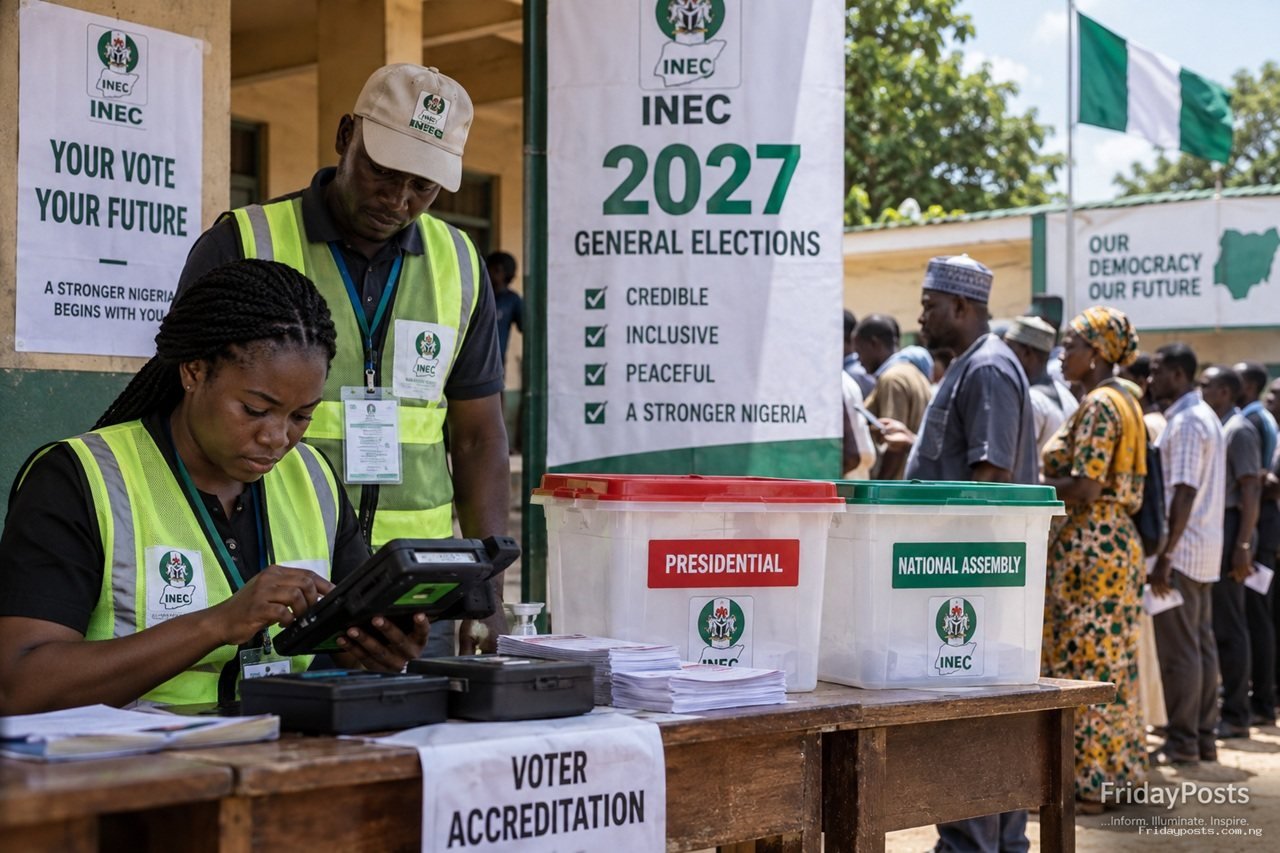
Nigeria's voter register is entering one of its most important tests before the 2027 general election.
On 4 November 2026, INEC Chairman Joash Amupitan disclosed that technology-enabled verification had identified approximately 1.5 million voter registration records containing irregularities.
The Commission says the records are being addressed through an ongoing register-cleaning exercise.
Nigeria's voter register contains approximately 103 million registrations, and the final register is scheduled for publication on 15 December 2026.
Some reports say more than 1.27 million records have already been removed, while INEC's public account describes approximately 1.5 million records identified for removal or further action.
Those two numbers should not be treated as interchangeable until the Commission publishes a reconciled breakdown.
There is another important distinction.
A questionable registration record is not automatically proof of electoral fraud.
Database irregularities can arise from duplicates, incomplete information, biometric mismatches, invalid photographs, data-entry problems or other issues.
The public-interest question is how INEC can clean the register aggressively without wrongly removing legitimate voters.
Register cleaning is necessary for election credibility
A voter register should contain eligible voters once and only once.
Duplicate records create suspicion.
Invalid records distort statistics.
Outdated records weaken confidence.
A person whose details are wrong may face difficulty at the polling unit.
This is why election management bodies regularly clean registers.
The process is not evidence that the register is inherently fraudulent.
It is part of maintaining integrity.
Scale matters because 1.5 million is not a small number
Against a register of roughly 103 million, 1.5 million represents a relatively small share of the total.
But in electoral politics, even a small percentage can be larger than the winning margin in a close contest.
The figure therefore deserves careful explanation.
Where are the affected records concentrated?
What types of irregularities were found?
How many are duplicates?
How many involve invalid biometrics?
How many are incomplete applications?
How many have already been conclusively removed?
These details would help the public interpret the number responsibly.
Duplicate registration is different from multiple voting
A person can appear more than once in a database because of repeated registration attempts or data problems.
That does not mean the person has successfully voted multiple times.
Biometric accreditation is designed to reduce that risk.
FridayPosts would therefore distinguish duplicate registration from proven voting fraud.
Both matter.
They are not the same offence or failure.
Technology can find anomalies, but people still make the final decisions
INEC uses biometric and database tools to identify potentially problematic records.
Automated systems can compare fingerprints, facial images and demographic data at scale.
But automated matching is not perfect.
Two legitimate people may have similar names.
A poor-quality fingerprint can create uncertainty.
A photograph can fail quality checks.
Data can be entered incorrectly.
Human review remains important.
The Commission should explain which decisions are automated and which require manual verification.
False positives are the biggest voter-protection risk
A strong cleaning exercise can still create harm if legitimate voters are wrongly deleted.
The most important safeguard is an appeal or correction process.
A citizen whose record is flagged should have a reasonable way to verify identity and restore the registration where appropriate.
That process should not require repeated expensive travel.
It should be clear, documented and time-bound.
Voters need to know whether they are affected
A citizen should not discover on election day that a registration was removed months earlier.
INEC should provide a secure self-service verification system.
A voter should be able to check registration status, polling unit and whether any correction is required.
Where digital access is limited, physical channels should remain available.
The Commission should publicise deadlines widely.
The final register deadline creates urgency
INEC plans to publish the final register on 15 December 2026.
That leaves a limited period to complete technical review, resolve objections and correct legitimate records.
The process must therefore be efficient.
Rushing can create mistakes.
Delaying can compress election preparation.
The Commission should publish a timetable for the cleaning exercise between now and 15 December.
The public needs a reconciled number
The difference between roughly 1.27 million records reportedly removed and 1.5 million records identified for removal or review should be resolved clearly.
The Commission could publish a simple status table.
Records flagged.
Records manually reviewed.
Records confirmed invalid.
Records removed.
Records restored after review.
Records still pending.
That would end confusion.
Youth registration makes accuracy especially important
INEC says young Nigerians aged 18 to 34 make up a substantial share of the register.
Young voters are highly mobile.
They change residence for education, work and family reasons.
This increases the importance of accurate transfers and polling-unit assignments.
A clean register should reflect legitimate mobility rather than treating change as suspicious.
Death records remain another challenge
Nigeria's civil-registration systems are still developing.
INEC may not receive complete, timely death information.
That means deceased persons can remain on voter rolls.
The presence of such a record does not automatically mean it will be used fraudulently.
But it weakens confidence.
Better integration between civil registration and electoral systems could improve long-term register quality.
Political parties will scrutinise the exercise closely
Every major party has an interest in the register.
That is legitimate.
But parties should avoid turning every technical anomaly into a conspiracy claim.
They should also avoid defending irregular records that appear politically convenient.
A clean register benefits all sides.
INEC should provide parties with enough data to scrutinise the process without exposing sensitive personal information.
Privacy must be protected
Register verification involves personal data.
Biometrics are particularly sensitive.
The Commission should not publish raw biometric information.
Online voter tools should expose only the information necessary for lawful public scrutiny.
Security controls should prevent unauthorised access or alteration.
Election transparency and data protection can coexist.
Biometric quality is central
A biometric system depends on good capture.
Poor fingerprint images.
Blurred photographs.
Incorrect demographic details.
These can produce false matches or unresolved records.
INEC should report the quality thresholds used and how citizens can correct poor data.
Technology is not only about sophisticated matching algorithms.
It begins with accurate enrolment.
Registration centres need accountability too
If large numbers of problematic records originate from particular registration centres, that deserves investigation.
Was equipment faulty?
Were staff poorly trained?
Were procedures ignored?
Were there attempts at deliberate multiple registration?
Pattern analysis can identify systemic problems.
The Commission should use cleaning not only to remove bad records but to improve future registration practice.
Database irregularity is not the same as voter suppression
Critics may describe mass removal as disenfranchisement.
That can be true if legitimate voters are deleted arbitrarily.
But removing proven duplicates or invalid registrations is not voter suppression.
The key is procedure.
Clear rules.
Evidence.
Notice where feasible.
Appeal.
Documentation.
That is how a legitimate cleaning exercise should work.
Nigeria should publish a register-cleaning methodology
INEC can strengthen trust by explaining its method in ordinary language.
What triggers a flag?
How are fingerprints compared?
How are photographs reviewed?
What happens when two records appear linked?
Who makes the final decision?
How can a citizen challenge the result?
This level of transparency would reduce misinformation.
Civil society can audit the process without accessing biometrics
Election-observation groups can track aggregate data.
State-by-state removals.
Correction volumes.
Complaint resolution.
Platform availability.
Public notices.
They do not need access to raw biometric data to perform useful oversight.
Independent monitoring can increase confidence.
Voters should check their registration twice
FridayPosts recommends two checks.
One during the current cleanup period.
Another after the final register is published on 15 December.
Voters should confirm name, status and polling unit.
Anyone who submitted a transfer or correction should verify that it appears.
People should use only official channels.
The 1.5 million figure should become a public accountability dataset
INEC should eventually report what happened to every category of flagged record in aggregate.
How many were duplicates?
How many were errors?
How many were restored?
How many were deleted?
This would turn a headline into evidence.
Election credibility depends on both inclusion and exclusion
A clean register has two responsibilities.
Include every eligible voter who has registered properly.
Exclude invalid or duplicate records.
Focusing only on one creates risk.
An over-inclusive register can contain errors.
An over-aggressive cleaning process can disenfranchise citizens.
The Commission has to balance both.
What Nigerians should watch before 15 December
The reconciled number of records removed.
The categories of irregularities.
The correction and appeal process.
State-level concentration of flagged records.
Availability of online verification.
Publication of the final register.
These are concrete indicators of whether the exercise is working.
Cleaning the register is not enough; INEC must make the process trustworthy
The discovery of 1.5 million questionable records can be interpreted in two opposite ways.
It can look alarming because the number is large.
It can also demonstrate that verification systems are identifying problems before election day.
The difference will depend on what INEC does next.
If the Commission publishes a clear methodology, protects legitimate voters, reconciles the numbers and produces a transparent final register, the exercise can strengthen confidence.
If voters are removed without explanation or the figures remain contradictory, suspicion will grow.
The test is not whether the database contains imperfections.
Large databases do.
The test is whether Nigeria can correct them fairly before citizens arrive at the polls.
Sources and further reading
- Leadership: INEC identifies 1.5 million questionable registrations
- The Frontier: INEC voter-register cleanup and UN engagement










Reader conversation
0 approved comments