

Nigeria's 2027 campaign season has produced another warning about political security.
The Cross River State Police Command has confirmed an attack on the convoy of Peter Obi in Calabar on 4 November 2026.
According to police, suspected attackers carrying machetes and sticks damaged vehicle windscreens around the Watt Market Roundabout as the convoy travelled from the palace of the Obong of Calabar towards a political town hall meeting.
Police later announced the arrest of a 27-year-old suspect and said investigations were continuing.
The command has not established the motive behind the attack or identified all those responsible.
The arrest does not establish the suspect's guilt.
The incident should also not be attributed to a political party without evidence.
Those cautions are essential because campaign violence can become even more dangerous when unverified claims turn a criminal investigation into partisan retaliation.
Campaign security is part of election integrity
Free elections require more than ballots.
Candidates must be able to move.
Parties must be able to organise.
Supporters must be able to attend events.
Journalists must be able to report.
Voters must be able to participate without fear.
An attack on a convoy therefore has electoral significance even if its motive later proves unrelated to party politics.
Police need to establish the motive carefully
The public wants quick answers.
Was the attack politically motivated?
Was it criminal opportunism?
Was it connected to a local dispute?
Did the attackers target the convoy specifically?
Investigators should follow evidence rather than political pressure.
Premature attribution can inflame tensions.
Every major campaign event needs a threat assessment
Candidates move through crowded urban areas.
Large convoys attract attention.
Routes can become congested.
Supporters and opponents may gather.
Security planning should consider route, crowd size, local tension, known threats and emergency access.
This does not mean every campaign should become militarised.
It means basic risk management should be professional.
Police protection should be politically neutral
A governing-party candidate and an opposition candidate should receive protection based on risk, not political favour.
This is one of the most important legitimacy tests for the police during an election.
Unequal protection creates both security and trust problems.
The Nigeria Police Force should publish the general principles it uses to allocate campaign security.
Political parties also have responsibilities
Parties control event planning, convoy size, marshals and supporter mobilisation.
They should coordinate routes with police.
They should discourage supporters from carrying weapons.
They should avoid provocative movements through hostile gatherings where alternatives exist.
They should report threats early.
Security is not only a police duty.
Convoys create their own safety risks
Long political convoys can disrupt traffic and create unpredictable movement.
Vehicles may become separated.
Crowds can press close.
Security personnel may struggle to distinguish supporters from threats.
Parties should consider smaller, more controlled movements where practical.
Visibility is politically valuable.
Safety is more important.
The 2027 election needs a campaign-violence database
Nigeria should not wait until after the election to count incidents.
FridayPosts recommends a 2027 Campaign Security Incident Tracker.
Date.
Location.
Candidate or party affected.
Type of incident.
Casualties.
Property damage.
Arrests.
Charges.
Prosecution status.
Official response.
This would make patterns visible.
Data can reveal unequal risk
If one state records repeated attacks, security can be increased.
If one party's events are repeatedly targeted, investigators can examine patterns.
If arrests rarely lead to prosecution, accountability gaps become visible.
Good election security requires more than responding to individual incidents.
It requires pattern analysis.
Political rhetoric can increase risk
Campaign language matters.
When leaders describe opponents as enemies or traitors, supporters may interpret politics as conflict.
Party leaders should discipline inflammatory rhetoric.
Strong disagreement is democratic.
Dehumanisation is dangerous.
The cost of reckless language is often paid by ordinary supporters rather than candidates.
Security agencies need rules for crowd control
Campaign events can become tense.
Police may need to separate groups or control access.
Use of force should remain proportionate.
Teargas, firearms and physical force should follow clear rules.
Officers need training specific to political events.
The objective is to keep the space open, not suppress lawful political activity.
Intelligence should be shared before events
Political parties often have information about threats.
Police and intelligence agencies may have separate information.
Local community leaders know local tensions.
These information streams should meet before high-risk events.
A simple pre-event security conference can prevent problems.
Candidates should not build private militias
When politicians lose confidence in official security, they may turn to informal armed groups.
That can escalate violence.
Nigeria should enforce rules against thuggery and unauthorised armed security.
Party marshals can organise crowds.
They should not become coercive forces.
Prosecution is the strongest deterrent
Arrests after political violence matter.
Convictions based on credible evidence matter more.
If perpetrators believe they will be protected by political patrons, violence becomes rational.
Police and prosecutors should follow cases to conclusion.
The public should know what happened after the arrest.
Media reporting should resist partisan certainty
An attack on a major politician immediately generates claims.
Supporters may accuse rivals.
Opponents may dismiss the incident.
Journalists should stay with verified facts.
Location.
Damage.
Police confirmation.
Arrest status.
Known injuries.
Motive under investigation.
This protects both public trust and the legal process.
Social media can escalate rumours quickly
A false claim can spread before police issue a statement.
Videos may be old or edited.
Images can be miscaptioned.
Campaign teams should have verified communication channels.
Police should respond quickly with confirmed facts.
Slow information creates a vacuum.
Candidate security should not become elite privilege
Nigeria naturally protects prominent candidates.
But campaign workers and ordinary supporters also face risk.
Event planning should include safe entry and exit.
Emergency medical support.
Crowd control.
Traffic management.
Clear evacuation routes.
Security should protect the political community, not only the politician.
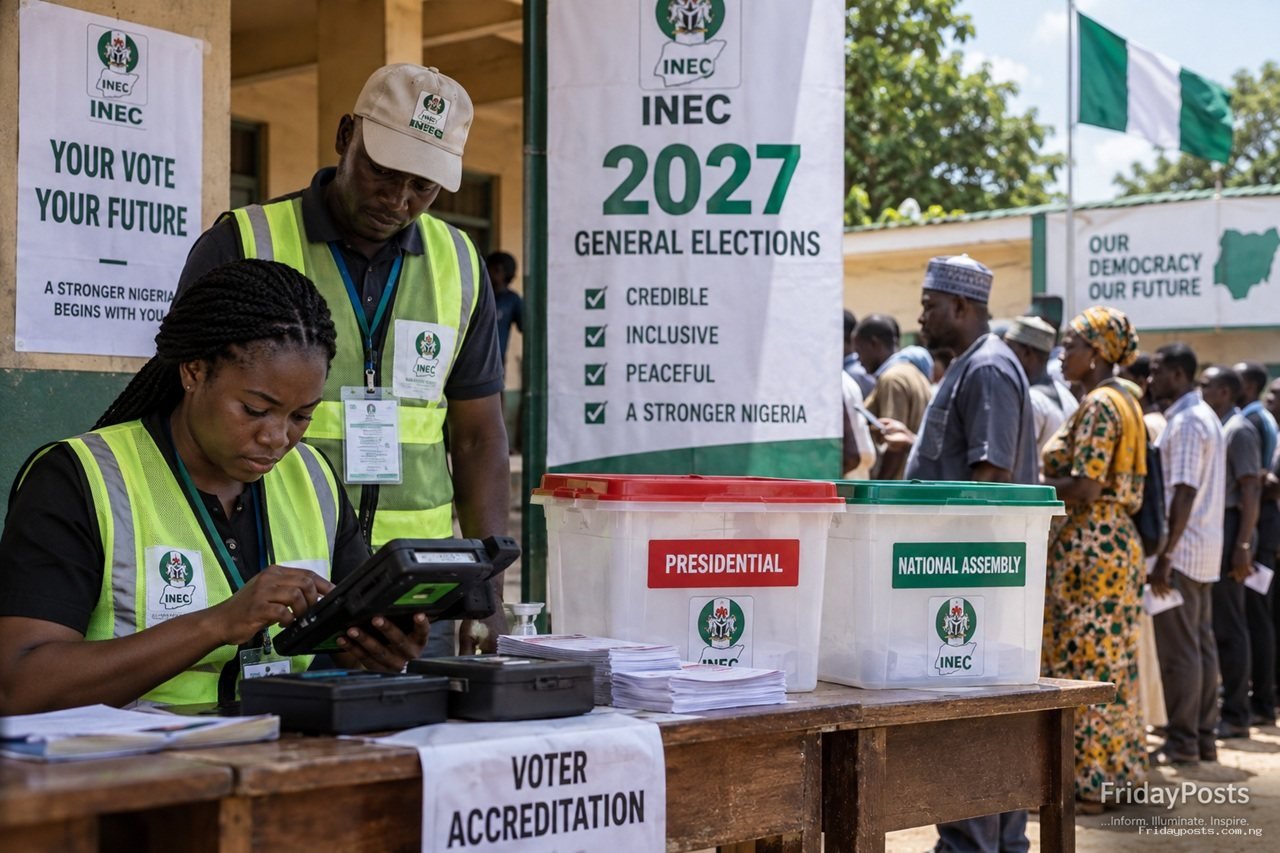
The electoral commission has an interest in campaign safety
INEC does not command the police.
But a violent campaign environment can affect electoral participation.
The Commission should document serious incidents and coordinate with security agencies through existing election-security structures.
Campaign violence can become an early-warning indicator for election-day risk.
Cross River authorities should publish the investigation outcome
The Calabar case should not disappear after the arrest announcement.
Police should eventually state whether charges were filed.
What evidence was found?
Were other suspects identified?
Was the motive established?
If the arrested person is cleared, that should be made public too.
Accountability includes correcting suspicion when evidence does not support it.
Parties should sign and enforce codes of conduct
Election codes often contain commitments against violence.
The problem is enforcement.
Parties should discipline members who organise thugs or make credible threats.
Sanctions should not depend only on criminal prosecution.
Internal party discipline can reduce escalation.
Security planning must account for regional differences
Campaign risk is not uniform across Nigeria.
Some areas face communal tension.
Others face kidnapping or insurgency.
Urban centres may face crowd-control risks.
Routes and venues should be planned according to local threat profiles.
A national template should allow local adaptation.
The public should judge police neutrality across parties
One incident cannot establish whether policing is fair nationally.
The 2027 campaign will create many opportunities to observe.
How quickly are attacks investigated?
Are opposition and governing-party events protected equally?
Do police impose restrictions consistently?
Are suspects prosecuted regardless of affiliation?
These are better measures than political statements.
The campaign period is a rehearsal for election day
If security agencies cannot protect political activity before voting, confidence in election-day security will fall.
Campaign incidents reveal coordination, neutrality and response capacity.
They should therefore be treated as operational tests.
Candidate movements should be planned with ordinary city life in mind
Campaign security cannot ignore the people who are not attending the campaign.
Markets, commuters, schools and businesses can be affected when a large convoy moves through a busy area.
Police and organisers should plan diversions, communicate road restrictions early and avoid unnecessarily paralysing commercial districts.
This is not only a convenience issue.
A chaotic traffic environment can create additional security vulnerabilities because stalled vehicles and frustrated crowds make movement harder to control.
Professional campaign planning should therefore balance political visibility with public safety and urban order.
Security briefings should continue after an incident, not stop at the first arrest
A common weakness in public-security reporting is that attention ends when police announce an arrest.
The Calabar case should be followed through investigation, charging decisions and, where appropriate, prosecution.
If evidence shows that more people were involved, that should be stated when it is safe to do so.
If the case turns out not to be politically motivated, the public should also be told clearly.
This follow-through matters because unresolved political incidents easily become raw material for conspiracy narratives during an election season.
A credible final account can reduce that risk and demonstrate that election-related violence receives the same professional investigative standard as other serious offences.
What the Calabar attack means now
It does not prove a coordinated political conspiracy.
It does not establish the guilt of the arrested suspect.
It does show that political movement can become physically vulnerable during the campaign season.
That is enough reason for serious preventive action.
Nigeria's 2027 election should be contested through ideas, records and votes.
Security agencies, parties and candidates all have a responsibility to make sure political competition does not become physical intimidation.
The most useful outcome from Calabar would be a transparent investigation and a stronger security protocol before the next convoy moves.







Reader conversation
0 approved comments