
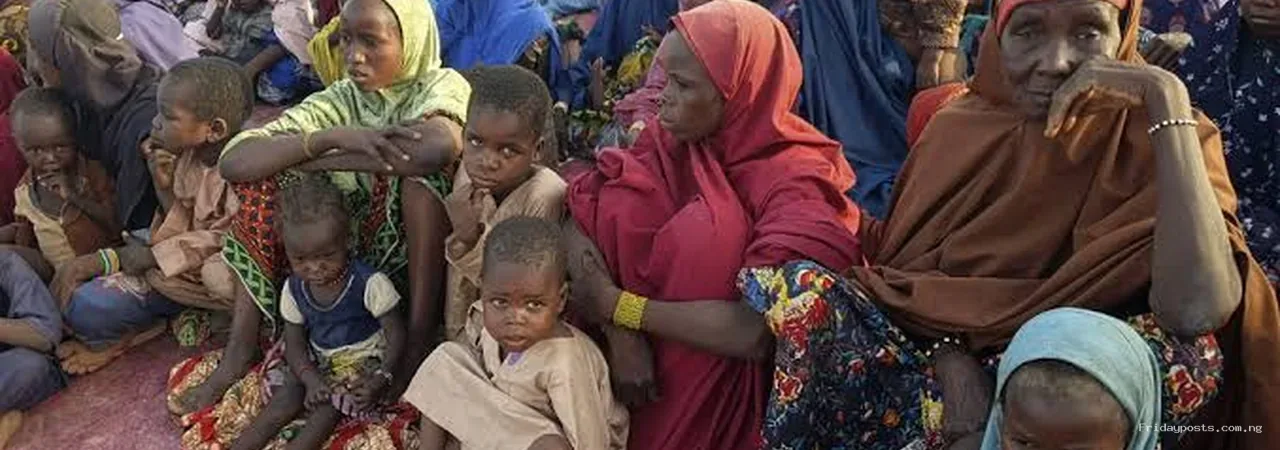
For the families of children abducted in Askira-Uba Local Government Area of Borno State, time has become its own form of suffering.
Reports published in September and October 2026 say dozens of children remain in captivity after separate attacks involving Mussa and Lassa communities. Several reports use a combined figure of 78: 42 pupils reportedly abducted in Mussa on 15 May and 36 students reportedly still held after the 29 June attack in Lassa.
Other reporting, including accounts citing local officials, has used different figures for the Mussa incident, including about 44 children still missing. These differences are important. FridayPosts would not present a single number as definitively verified without a reconciled government list.
What is not disputed is the central fact.
Children were abducted.
Many have reportedly remained away from their families for months.
Parents and community leaders continue to demand action.
The Ashlee Momoh Foundation has announced a 21-day peaceful campaign in Abuja to draw attention to the case.
The question is no longer only who took the children.
It is why a country that has faced school abductions for more than a decade still struggles to provide families with timely rescue, reliable information and sustained national attention.
The first accountability problem is the number itself
Nigeria should know exactly how many children are missing.
That sounds basic.
In a mass-abduction crisis, it can be surprisingly difficult.
Some children may be taken from a school, others from nearby homes.
Initial community lists may contain duplicates.
Some abductees may escape or be recovered later.
Families may relocate.
Government agencies, schools and community leaders can maintain separate records.
But after months, those records should be reconciled.
The Borno State Government, local education authorities, security agencies and affected communities should publish a single verified register for public accountability while withholding details that could endanger individual children.
Without a common baseline, even national attention begins from uncertainty.
Mussa and Lassa appear to be separate incidents
Several reports describe two major abductions in Askira-Uba.
The first occurred in Mussa in May.
The second occurred in Lassa in late June while students were reportedly involved in examination activities.
Combining the cases into one number may be useful for describing the scale of the crisis.
Operationally, the incidents may be very different.
Different attackers may have been involved.
Different routes may have been used.
Different intelligence may exist.
The rescue strategy should therefore treat each case separately even when advocacy groups discuss the children collectively.
Why rescue operations can take months
The public naturally asks why security agencies cannot simply locate and rescue abducted children.
The answer is difficult.
Hostages can be moved repeatedly.
Armed groups may use forests, mountains or areas with weak road access.
A poorly planned assault can kill the people it is supposed to rescue.
Security agencies may possess partial intelligence without enough certainty to act.
Negotiations may occur quietly.
Operations may be delayed to protect sources.
None of these realities means families should accept indefinite silence.
They mean rescue is complex.
The state still owes the public an accountable explanation of what it is doing, without disclosing operational details that would compromise the mission.
Families need information even when operations are secret
Security agencies often say they cannot reveal details because rescue operations are sensitive.
That is legitimate.
But secrecy should not become institutional silence.
Families can be briefed privately.
They can be assigned liaison officers.
They can be told that the case remains active, which agency is coordinating the response and when the next briefing will occur.
A parent should not have to learn about his or her child's case from social media.
Regular communication is part of humane crisis management.
The comparison with other rescues fuels anger
Parents in Borno have publicly compared their situation with other kidnapping cases in which victims were rescued more quickly.
That comparison can be emotionally powerful but operationally imperfect.
Every abduction differs in geography, intelligence, perpetrators and hostage condition.
Still, the comparison reveals a perception problem.
Families fear that some cases receive greater national urgency because they attract more media attention, political pressure or social mobilisation.
Government should counter that perception through consistent standards.
Every abducted child should trigger a defined national response protocol regardless of geography, religion, ethnicity or media visibility.
Nigeria needs a school-abduction command protocol
A school attack should activate an automatic chain.
The school or local authority reports the incident through a verified emergency line.
A unified command confirms the number missing.
Road and border alerts are issued where appropriate.
Telecommunications intelligence begins quickly under lawful authority.
Military, police, intelligence and local-security information are combined.
Families receive a liaison contact.
The education authority creates a verified register.
A public-information officer releases confirmed updates.
This should not depend on improvisation after every incident.
Nigeria has experienced enough school kidnappings to have a national standard operating procedure.
School security cannot begin when gunmen arrive
The Mussa and Lassa cases also raise questions about prevention.
Which schools are located in high-risk areas?
Which have perimeter security?
Which have nearby security posts?
Which have emergency communication?
How long would it take responders to arrive?
Which schools should be temporarily relocated when threat intelligence rises?
Local officials reportedly said insecurity had forced dozens of primary schools in the area to stop functioning.
That is not only a security problem.
It is an education emergency.
A child cannot benefit from a school that exists on paper but is too dangerous to attend.
Closing schools also creates long-term harm
When schools close because of insecurity, the immediate objective is safety.
The long-term cost can be severe.
Children fall behind.
Girls may be less likely to return.
Families may send children to work.
Early marriage risks can rise in some settings.
Teachers leave difficult communities.
Confidence in public education weakens.
This is how insecurity produces generational damage even beyond the abducted victims.
The government needs continuity plans for displaced pupils: safe temporary schools, transport, boarding arrangements where appropriate and psychosocial support.
Families themselves are absorbing the cost of national failure
Reports describe parents struggling with the cost of travelling to Abuja to protest.
That detail is revealing.
A poor family may lose a child to abduction and then have to finance transport, accommodation and advocacy simply to keep the case visible.
That is an additional injustice.
Victim-support systems should cover more than ransom or rescue.
Families may need counselling, legal assistance, travel support and financial help while a breadwinner suspends work to pursue the case.
Government should create a standard family-support package for major kidnapping incidents.
Ransom economics complicates every case
Kidnapping has become a business model in parts of Nigeria.
Ransom payments can fund further crime.
Families, however, face impossible choices when a loved one is in danger.
The state discourages ransom payment because it sustains the criminal market.
That policy becomes harder to defend when families believe rescue is not progressing.
The strongest anti-ransom strategy is credible state capability.
If citizens trust that security agencies can recover victims, they are less likely to depend on private negotiation.
The information environment can endanger hostages
Advocacy keeps cases visible.
It can also create risks if sensitive operational information is published carelessly.
Journalists and campaign groups should avoid releasing names, photographs, health details or intelligence that could endanger children.
Claims that a particular armed group is responsible should be based on evidence.
Rumours about rescue dates can create false hope and interfere with negotiations or operations.
FridayPosts supports sustained attention, but attention must be disciplined.
The government should publish an abducted-persons accountability dashboard
Nigeria needs a central public record of major mass-abduction cases.
The dashboard should not reveal operationally sensitive information.
It could show date, location, verified number abducted, number rescued or escaped, number still missing, coordinating agency and date of the most recent public update.
This would prevent cases from disappearing from public memory.
It would also reveal whether some regions experience consistently slower resolution.
Data can create accountability without compromising tactics.
Rescue is not complete when a child returns
Children who spend months in captivity may return with trauma, malnutrition, illness and interrupted education.
Some may have witnessed violence.
Some may feel guilt or fear.
Families may also be traumatised.
A rescue plan should therefore include reintegration.
Medical assessment.
Psychological care.
Education support.
Family counselling.
Protection from intrusive media exposure.
The country should not turn rescued children into public spectacles.
Their recovery may take far longer than the rescue operation.
Borno's long insurgency makes the problem harder, not less urgent
Borno has lived with insurgency and armed violence for many years.
That can create dangerous normalisation.
An abduction that would dominate national news in another state can become one more incident in a region already carrying too much tragedy.
This is precisely why sustained attention is necessary.
Repeated violence should increase state capacity, not reduce public sensitivity.
People living in high-risk areas do not deserve less protection because insecurity has become familiar.
What should be verified immediately
Government should reconcile the exact number of children still missing from Mussa and Lassa.
It should state which dates and schools are attached to each case.
It should confirm how many abductees have escaped, been rescued or remain unaccounted for.
It should identify the lead coordinating agency for each rescue effort.
It should provide families with a formal liaison structure.
It should publish the non-sensitive measures being taken to secure schools in Askira-Uba.
These are reasonable accountability requests.
They do not require disclosure of tactical operations.
Why has rescue taken so long?
The truthful answer may be that the state has not yet found a safe operational opportunity.
It may be that intelligence is incomplete.
It may be that the abductors are mobile.
It may be that quiet negotiations are occurring.
It may also be that coordination and attention have been inadequate.
The public cannot know which explanation is correct because too little verified information is available.
That uncertainty itself is part of the problem.
Children should not need a campaign to remain visible
The 21-day Abuja campaign announced by the Ashlee Momoh Foundation may help restore attention.
But a child in captivity should not depend on the persistence of an advocacy group to remain a national priority.
The state should create institutional memory stronger than the news cycle.
Every unresolved mass abduction should remain on a formal government accountability list until the final victim is accounted for.
The parents of Mussa and Lassa deserve more than sympathy.
They deserve verified information, sustained rescue effort, practical support and a security system that learns enough from these attacks to make the next school harder to abduct.
Nigeria has repeated the words "never again" after too many school kidnappings.
The measure of seriousness is not the statement made after the next attack.
It is whether the children already missing are brought home and whether the schools still open in vulnerable communities become safer before another family receives the same terrible call.
Sources and further reading
- Nigerian NewsDirect, 25 October 2026: foundation demands rescue of abducted Borno pupils
- Guardian Nigeria, 29 September 2026: CAN urges rescue of 78 abducted Borno schoolchildren
- Trust Radio, October 2026: parents discuss separate Mussa and Lassa abductions
- Al Jazeera, 8 October 2026: reporting notes differing figures in Mussa and Lassa cases







Reader conversation
0 approved comments