
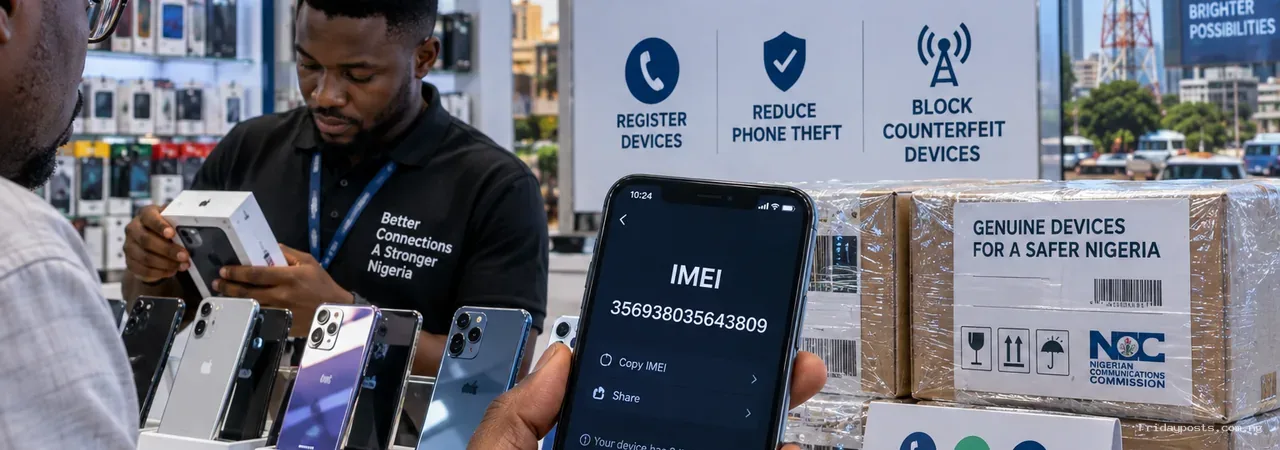
Nigeria's mobile-phone market is entering a new regulatory phase.
The Nigerian Communications Commission has strengthened enforcement of Type Approval and individual device verification for SIM-enabled devices. From 7 October 2026, new devices entering the Nigerian market through importers are expected to meet the enhanced verification requirements before sale.
The policy sounds technical.
Its effects could be very practical.
Phone traders and industry representatives have warned that compliance costs may push prices higher. The Guardian reported concerns about charges that could approach several thousand naira for some devices, although the precise amount and legal basis of all claimed per-device charges require careful separation from official Type Approval, licensing and verification requirements.
The NCC's position is that the regime is necessary to protect consumers, ensure that devices meet technical standards, improve network integrity and reduce problems involving counterfeit or cloned devices.
Both concerns deserve serious examination.
Nigeria needs safer devices.
Nigeria also has millions of consumers for whom a few thousand naira can determine whether a smartphone is affordable.
Type Approval is not a new idea
One of the most important clarifications is that the NCC is not suddenly inventing the concept of approving telecommunications equipment.
Type Approval already exists under Nigerian communications law and regulation.
The requirement is designed to ensure that devices connecting to Nigerian networks meet technical standards.
What has changed is the enforcement architecture.
The NCC is using technology to check not only whether a device model has been approved, but whether the individual device, identified through its International Mobile Equipment Identity, has been properly verified.
That moves regulation closer to the actual handset.
IMEI is the identity number of the device
Every cellular device has an IMEI, usually a 15-digit number.
Some dual-SIM devices have more than one.
The IMEI is different from the SIM card and the phone number.
A SIM identifies the subscription.
The IMEI identifies the handset or cellular device.
Consumers can usually display it by dialing *#06# or checking the device settings.
The NCC's enhanced verification system uses the IMEI to check whether a device corresponds with an approved model and has been cleared for use on Nigerian networks.
This is important because counterfeit or cloned devices can manipulate identity information.
Why counterfeit and cloned devices matter
A counterfeit phone is not simply a cheap phone.
It may imitate a legitimate brand or model without authorisation and may not meet safety or network standards.
A cloned device may use an IMEI that belongs to another legitimate device.
That creates problems.
Networks may struggle to distinguish devices.
Stolen phones can be harder to identify.
Fraud investigations become more complicated.
Poor-quality radio equipment can also interfere with network performance.
Consumers may buy a device that appears genuine and later discover that it cannot receive support, updates or reliable service.
Regulation therefore has a legitimate consumer-protection purpose.
The consumer should not be the person obtaining Type Approval
This is another important clarification.
The NCC says consumers buying devices within Nigeria are not expected to obtain Type Approval themselves.
Responsibility rests with manufacturers, importers, suppliers and sellers placing devices on the market.
A buyer's job is simpler: verify the device before paying.
The NCC provides a Device Checker through *315# and its official web portal.
This matters because misinformation can create new scams.
A seller should not tell a customer, “Pay me an NCC Type Approval fee so I can register your phone” without a clear official basis.
Consumers need to understand which charges belong to the supply chain and which do not.
Existing phones are not supposed to stop working suddenly
The NCC says devices already connected to Nigerian mobile networks before the enhanced system took effect were automatically verified, with no action required from ordinary users.
That reduces the risk of a sudden nationwide disruption.
The main compliance burden falls on new stock, imported devices and devices moving through the sales chain.
Second-hand buyers should still check before purchase.
A phone being used previously does not guarantee that every aspect of its status is clean.
Where the cost pressure could come from
Regulation creates several possible costs.
Businesses selling telecom equipment may need an NCC Sales and Installation licence.
Device models may require Type Approval.
Importers and sellers must submit or confirm device IMEIs through verification processes.
They may need staff, systems and documentation.
Existing inventory may require onboarding.
Large businesses can spread these costs across many devices.
Small importers and retailers may have less ability to absorb them.
If compliance becomes expensive or administratively slow, sellers may pass part of the cost to consumers.
That is the economic concern.
The headline ₦4,000 claim needs careful treatment
Industry reports have cited fears that charges could add close to ₦4,000 to some devices.
That figure should not be repeated as though every Nigerian buying a phone will automatically pay a new government levy of exactly ₦4,000.
The NCC publishes official fee schedules for Type Approval and licensing, and the structure varies by equipment category and business activity.
Type Approval is generally a model-level process, not a fresh approval fee for every handset purchased by an individual consumer.
There may also be commercial verification or administrative costs within the supply chain.
The correct policy question is therefore to publish the full cost stack clearly.
Which payment goes to the NCC?
Which applies per model?
Which applies per licence?
Which applies per device?
Which is a private service charge?
Without transparency, rumours will fill the gap.
Low-cost phones are especially sensitive to small charges
A ₦4,000 cost increase has a different meaning on a ₦1.5 million flagship phone than on an entry-level device.
Nigeria's digital inclusion depends heavily on affordable smartphones.
People use them for banking, education, job applications, transport, e-commerce, health information and government services.
A policy that unintentionally raises the floor price of compliant devices could slow digital access.
This is why regulators should assess distributional impact.
Consumer protection should not create a market where only wealthier consumers can afford fully compliant devices.
The informal market makes enforcement difficult
Nigeria has a huge phone market with formal retailers, open markets, online sellers, small importers and second-hand dealers.
That diversity supports affordability.
It also makes compliance harder.
A strict system can create two outcomes.
The formal market becomes safer and more expensive.
The informal market grows around unverified devices.
If that happens, the consumers most sensitive to price may move towards the riskiest sellers.
The policy therefore needs enforcement that reaches the entire market, not only large visible companies.
Small retailers need a realistic compliance path
The NCC guide recognises different categories of sellers and provides licensing options for smaller businesses.
That is important.
A small phone shop should not face the same administrative burden as a multinational device importer.
Compliance needs to be simple enough that legitimate small businesses can join the formal system.
If the process is confusing, slow or costly, informality becomes rational.
The regulator should publish short guides, local-language explanations and practical support for traders.
Device verification could improve the second-hand market
Nigeria has a large used-phone economy.
A strong verification system could benefit that market.
Buyers often worry about stolen, cloned or fake devices.
If a customer can check the device's approval and verification status before paying, trust improves.
That could raise the value of legitimate second-hand phones and reduce the market for stolen devices.
The NCC advises buyers to use *315# or the Device Checker website before purchase.
That is probably the most practical consumer benefit of the policy.
Verification should be fast enough not to disrupt business
A compliance system can be correct and still fail if it is too slow.
Importers operate with financing costs.
Phones held at a warehouse while paperwork is unresolved tie up capital.
Retailers need quick stock turnover.
The NCC should therefore publish service-level targets.
How long should device verification take?
How long should a rejected IMEI take to resolve?
What is the escalation channel?
How are bulk submissions handled?
Predictability reduces the cost that businesses eventually pass to customers.
Personal imports need special treatment
Nigerians travel.
People buy phones abroad for personal use.
The NCC says personal imports can follow a different process from commercial imports and may use travel-history information for verification.
This distinction is sensible.
A traveller bringing one phone for personal use is not the same as a business bringing hundreds of devices for sale.
The rules need to remain easy to understand.
Otherwise, legitimate travellers may face uncertainty at the point of network use.
The system also raises privacy questions
The NCC says Device Checker uses device identification information, including IMEI, and does not give the Commission access to personal content such as messages, photographs or files.
It also says the system does not track the user's physical location.
Those assurances are important.
Device identity is still sensitive data.
The system should collect only what is necessary.
Access should be logged.
Consumers should know what happens when a device is flagged.
Privacy protection strengthens trust in enforcement.
An unsuccessful check should not automatically mean “counterfeit”
This is one of the most useful points in the NCC guidance.
A device that cannot be verified immediately is not automatically confirmed to be fake.
The problem could be an incorrect IMEI submission, incomplete records or another compliance issue.
Consumers should avoid social-media conclusions.
If a device fails verification, the seller should resolve the issue before payment or continued sale.
For an already-owned device, the buyer should contact the seller, network provider or NCC support.
The policy should target bad devices, not legitimate low-income consumers
The strongest justification for verification is to clean up the device ecosystem.
That means counterfeit goods, cloned identifiers, unapproved equipment and dishonest supply chains should bear the pressure.
The policy becomes less defensible if ordinary consumers pay significant new costs while non-compliant traders continue operating.
Enforcement should therefore be upstream.
Manufacturers, importers and distributors are easier to regulate than millions of individual users.
Competition can prevent compliance costs from becoming excessive mark-ups
Even if genuine compliance costs rise, the final retail price increase is not automatic.
Competition matters.
If many compliant sellers compete, each has an incentive to absorb part of the cost rather than lose customers.
If supply becomes concentrated in a few approved channels, mark-ups can become larger.
The NCC and competition authorities should therefore monitor market structure.
Device security and affordability both benefit from a competitive formal market.
Government should publish a consumer price impact assessment
Before and after full enforcement, policymakers should track handset prices.
Compare entry-level devices, mid-range smartphones and premium models.
Separate exchange-rate effects from regulatory costs.
Monitor whether the share of unverified devices falls.
Measure consumer complaints.
This would show whether the policy is achieving protection at a reasonable cost.
Without data, both regulators and traders can make claims that are difficult to test.
What consumers should do before buying a phone
Check the IMEI by dialing *#06# on the device.
Use the NCC's official Device Checker through *315# or the official website.
Confirm that the model is Type Approved and that the individual device is verified.
Buy from a seller who can provide a receipt and clear return policy.
Be cautious if the price is far below the normal market price.
For a used phone, check the device before transferring money.
Do not give a seller a one-time verification code outside the official verification process.
And do not assume a device is compliant merely because it can temporarily connect to a network.
Will phones become more expensive?
Some compliance costs are likely to be passed through the supply chain.
That makes modest price pressure plausible, especially for smaller importers and lower-cost devices.
But it is too early to say that every smartphone will rise by a fixed amount.
Exchange rates, global handset prices, shipping, taxes, retailer margins and competition can have larger effects than one regulatory process.
The right test is proportionality.
If verification significantly reduces counterfeit and cloned devices at a small cost, consumers may gain more than they pay.
If the system creates large fees, delays and market concentration without visibly improving protection, the policy will need adjustment.
Nigeria needs both digital safety and digital affordability.
A good device-verification regime should make a legitimate phone easier to trust, not unnecessarily harder to buy.
Sources and further reading
- NCC: Device Checker and Type Approval FAQs
- NCC: Type Approval and Device Verification Guide for industry
- The Guardian, 21 October 2026: Price surge awaits phone market as NCC enforces device policy
- NCC: Type Approval fee schedule








Reader conversation
0 approved comments