
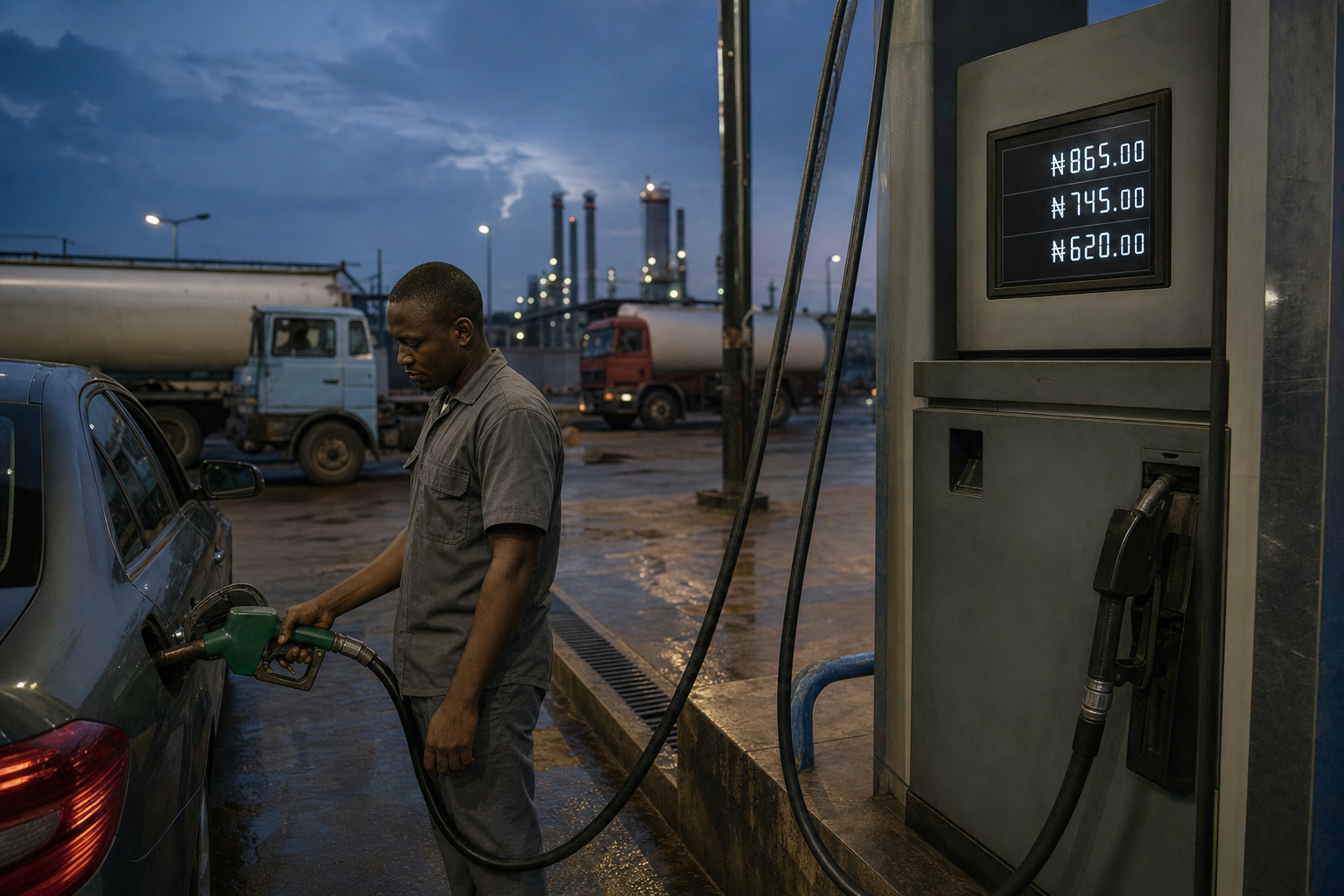
Nigeria’s petrol subsidy era was expensive enough when the country believed it knew how much fuel it was importing.
Now a Senate investigation is confronting a more basic problem.
The official numbers do not agree.
According to evidence discussed before the Senate Public Accounts Committee, the Nigerian Midstream and Downstream Petroleum Regulatory Authority recorded about 3.29 billion litres of Premium Motor Spirit imports in 2022, while the Nigerian National Petroleum Company Limited recorded about 6.27 billion litres.
For 2023, the pattern reversed.
NMDPRA cited approximately 6.02 billion litres, while NNPCL recorded about 3.88 billion litres.
These are not small differences.
The 2022 gap is close to three billion litres.
The 2023 gap exceeds two billion litres.
The Senate committee has therefore summoned the heads of NMDPRA, NNPCL and the Nigeria Extractive Industries Transparency Initiative to explain the discrepancies and reconcile the records.
The first thing Nigerians should resist is a sensational conclusion.
Different official figures do not automatically mean billions of litres of petrol disappeared.
They may reflect different definitions, reporting periods, import categories, data sources, reconciliation methods or timing.
But the differences are large enough that they cannot be dismissed as ordinary statistical noise.
Why petrol-import data mattered so much during subsidy
Before full subsidy removal, the amount of petrol imported into Nigeria affected public finance directly.
Government effectively absorbed part of the gap between regulated domestic prices and the economic cost of supply.
The volume of petrol therefore mattered to subsidy claims.
If imported or supplied volumes were overstated, public expenditure could be overstated.
If records were understated, supply and planning data would be unreliable.
If agencies used different definitions, decision-makers might be comparing numbers that were never truly comparable.
This is why reconciliation is not an accounting curiosity.
It is part of understanding what Nigeria paid for.
NNPCL and NMDPRA did not play the same role
The agencies involved had different functions.
NNPCL was a major participant in fuel importation and supply.
NMDPRA regulated the midstream and downstream petroleum sectors, including aspects of product supply and distribution.
NEITI audits the extractive sector to improve transparency and accountability.
It is therefore possible for each institution to hold different datasets.
The crucial question is whether the datasets should reconcile after agreed adjustments.
If they do not, government needs to know why.
The 2022 discrepancy is unusually large
NMDPRA reportedly recorded about 3.29 billion litres in 2022.
NNPCL recorded about 6.27 billion litres.
The numerical difference is roughly 2.98 billion litres.
That is nearly the size of the regulator's entire reported volume.
A difference of that scale demands an explanation.
Possible explanations include one dataset capturing imports by specific entities while another captures broader supply.
One may use cargo arrival dates while another uses discharge or accounting dates.
One may include volumes later transferred or reconciled differently.
The point is not to speculate which explanation is correct.
The point is that the institutions should already have a reconciliation framework capable of explaining the difference.
The 2023 figures reverse the direction
In 2023, NMDPRA reportedly recorded around 6.02 billion litres, while NNPCL recorded approximately 3.88 billion litres.
This matters because the pattern is not simply one agency always reporting more.
The direction changes.
That makes a simple explanation less satisfying.
If the discrepancy were caused by one agency consistently using a broader definition, we might expect its figures to remain higher across years.
The reversal suggests the committee needs to examine methodology, timing and transaction-level records carefully.
"Missing litres" is an attractive headline but a dangerous conclusion
Nigeria's petroleum history makes the public suspicious.
That suspicion is understandable.
Subsidy payments, opaque accounting, smuggling concerns and differing consumption figures have generated controversy for years.
But journalism should not convert a discrepancy into theft without evidence.
The correct headline asks why the records differ.
It does not claim physical fuel vanished.
The investigation should establish whether the problem is methodological, administrative, financial or criminal.
Accountability begins with precision.
The first task is to define "import"
The word seems obvious.
It may not be.
Does import volume mean cargo loaded abroad?
Cargo arriving in Nigerian waters?
Cargo cleared by customs?
Cargo discharged into depots?
Cargo received by NNPCL?
Cargo imported by all marketers?
Volumes recognised for subsidy accounting?
Volumes adjusted for losses?
Volumes delivered into domestic distribution?
Each definition can produce a different number.
The Senate committee should require every agency to provide its formal definition before comparing totals.
Reporting periods can create large differences
Petroleum cargoes do not respect calendar boundaries neatly.
A vessel may load in December, arrive in January and be accounted for in another period.
Documents may be amended.
Transactions may be reconciled after initial reporting.
If one agency records by arrival date and another by financial recognition, year-to-year differences can arise.
But timing differences should normally reconcile across a longer period.
The committee should therefore examine 2021 to 2023 as a continuous dataset, not only isolated annual totals.
Cargo-level reconciliation is the only convincing answer
Aggregate numbers will not resolve the dispute.
The agencies should reconcile cargo by cargo.
For each shipment: vessel, supplier, importer, bill of lading, volume, arrival date, discharge location, customs record, depot receipt and financial treatment.
If one dataset contains a cargo and another does not, investigators can ask why.
If volumes differ, the measurement basis can be examined.
This is slower than arguing over annual totals.
It is also how the truth is found.
Customs data should be part of the picture
Petrol imports cross a national border.
Customs records can therefore provide another source of evidence.
Port and terminal data may provide others.
Independent inspectors, depot records and financial payments can add further checks.
The goal is triangulation.
A public-finance system should not depend entirely on one institution's spreadsheet when multiple independent records exist.
Subsidy accounting makes the reconciliation financially important
During the subsidy era, NNPCL recorded substantial under-recovery or subsidy-related costs.
The exact financial treatment changed across periods.
Whatever accounting label is used, imported volume affects the underlying economics.
If two official volume datasets differ materially, auditors need to establish which volume supported financial claims.
This does not mean the higher number was necessarily used for subsidy payment.
That link must be proven.
But it is exactly the kind of question the audit should answer.
Daily consumption claims need to be separated from import data
Nigeria spent years debating how many litres of petrol the country consumed each day.
Import volume and consumption are related but not identical.
Domestic stock can rise or fall.
Petrol can be supplied from local refining.
Products can be lost, transferred or smuggled.
Imports can arrive before they are consumed.
A serious analysis should therefore avoid dividing an annual import figure by 365 and calling the result national consumption without adjusting for inventories and other supply sources.
Data categories must remain distinct.
Smuggling is relevant but should not become a catch-all explanation
Nigeria's historically lower regulated petrol prices created incentives for cross-border diversion.
That means some fuel intended for domestic consumers may have left the country unofficially.
But smuggling cannot be used to explain every statistical inconsistency.
It is a separate enforcement issue.
Investigators need evidence showing where product moved.
Otherwise, “smuggling” becomes a convenient word that hides poor accounting.
NEITI's audit role is central
NEITI exists precisely because extractive-sector opacity has large public consequences.
Its audit reports can identify inconsistencies that ordinary government reporting does not expose.
The current dispute shows why independent reconciliation matters.
But audit findings should lead to resolution.
A discrepancy repeated in public reports without correction becomes normalised uncertainty.
NEITI should explain the audit methodology, the source of each figure and the unresolved questions it referred to the relevant institutions.
Nigerians deserve a single reconciled historical dataset
Even though the subsidy regime has changed, the historical record still matters.
Government accounts should be correct.
Future investigations may depend on these figures.
Economic researchers need reliable data.
Citizens deserve to know how much petrol the country imported and what it cost.
The institutions should therefore publish a reconciled table for the relevant years.
Not only a statement saying “the issue has been resolved”.
The table should show the original figures, adjustments, final reconciled volumes and reasons for each major difference.
The Senate committee should ask ten direct questions
First, what precise definition of petrol import did each agency use?
Second, what source documents produced the totals?
Third, were the figures measured at loading, arrival, discharge or financial recognition?
Fourth, which importers were included?
Fifth, how were year-end cargoes treated?
Sixth, were domestic refinery supplies included anywhere?
Seventh, how were stock changes treated?
Eighth, which figures were used in subsidy or under-recovery calculations?
Ninth, what independent records can verify the shipments?
Tenth, why did existing inter-agency processes fail to reconcile the discrepancy earlier?
Those questions move the hearing from outrage to evidence.
The issue reveals a broader government data problem
Nigeria often has multiple official numbers for the same economic activity.
Oil production.
Employment.
Public debt.
Fuel consumption.
Beneficiary counts.
The reasons vary.
Agencies use different definitions.
Systems do not communicate.
Data are collected manually.
Political incentives may also shape reporting.
This weakens policy.
A government cannot manage what it cannot measure consistently.
The petrol discrepancy should therefore trigger wider reform around administrative data standards.
Petroleum data should become digitally interoperable
Cargo and supply records should not move mainly through disconnected spreadsheets.
A modern petroleum-data system should create a traceable digital chain.
Import licence.
Cargo documentation.
Customs clearance.
Vessel arrival.
Discharge.
Depot receipt.
Distribution.
Payment.
Each stage should produce records that can be reconciled automatically.
Technology cannot eliminate fraud or error.
It can make unexplained differences easier to detect.
Public transparency can improve market confidence
The petroleum sector has suffered from distrust partly because citizens see large financial claims without enough underlying data.
Publishing reconciled statistics can help.
Monthly or quarterly reports should show imports, domestic refinery supply, stock changes and distribution using clearly defined categories.
The public does not need commercially sensitive contract details.
It does need enough information to understand the national fuel balance.
Accountability should follow evidence
If the discrepancy turns out to be a reporting-method problem, agencies should standardise methodology.
If it reflects poor record keeping, responsible institutions should correct systems and staff accountability.
If it reveals financial misstatement or fraud, investigation and prosecution should follow.
The conclusion should come after reconciliation.
Nigeria has too much experience with investigations that begin with dramatic accusations and end without a clear public finding.
This one should be different.
The question is not only where the litres went
The more important question may be where the numbers came from.
If NMDPRA and NNPCL can report multi-billion-litre differences for the same market and period, policymakers need to know which dataset was used to make decisions.
Subsidies, supply planning and public accounts depend on accurate measurement.
The Senate inquiry has an opportunity to produce a useful result.
Not another hearing.
A reconciled record.
Nigeria cannot improve petroleum-sector accountability while government agencies disagree on the basic quantity of product that entered the country.
Before debating who profited, the country must first establish what actually happened.









Reader conversation
0 approved comments