
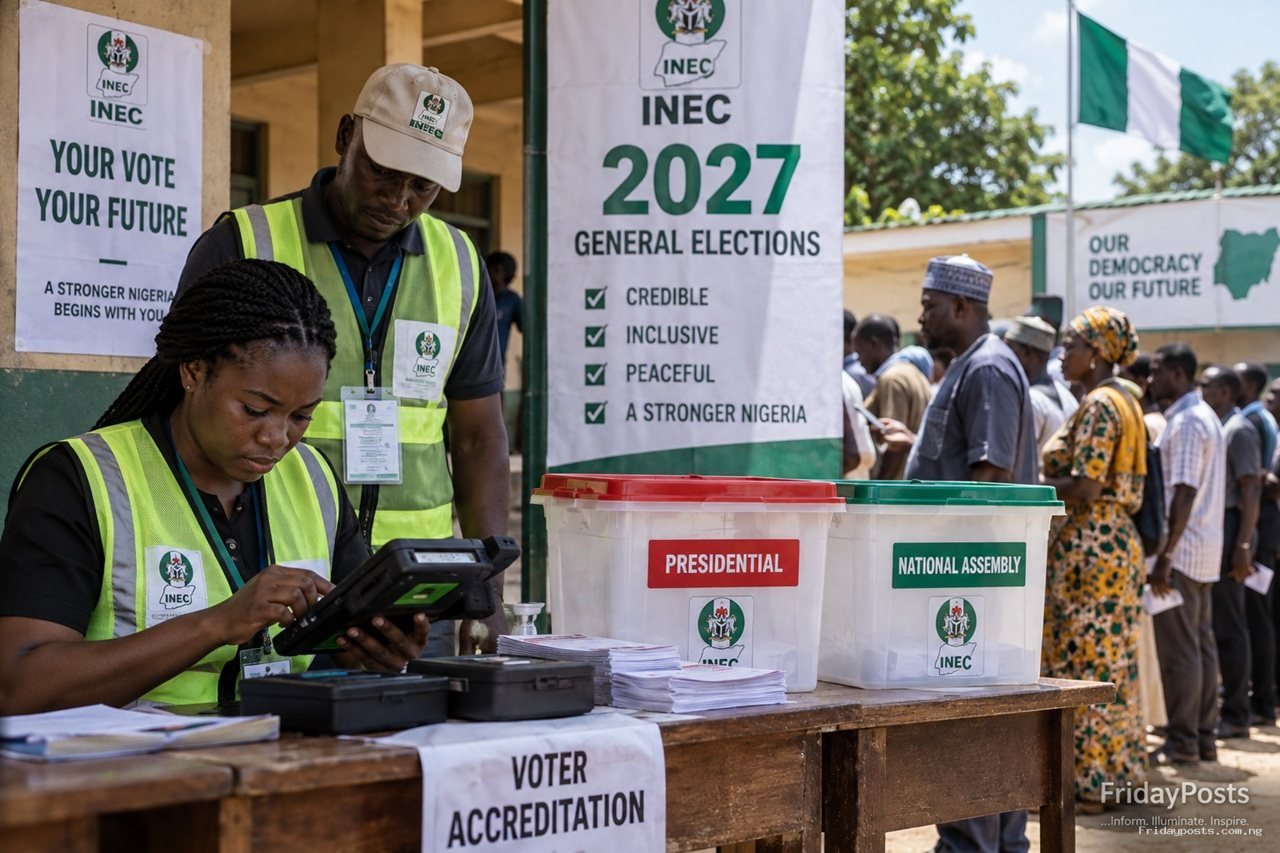
Nigeria’s 2027 general election is already being tested by something far less dramatic than ballot boxes, campaign rallies or collation disputes.
A deadline.
The Independent National Electoral Commission displayed the preliminary voters’ register physically at registration areas between 9 and 15 October 2026, allowing citizens to review names and make claims or objections. But an investigation published on 21 October found that the corresponding preliminary register had not been made available online within the period required by Section 19 of the Electoral Act 2026.
The distinction matters because the law does not appear to treat physical display and online publication as alternatives.
Section 19 requires the voters’ register to be displayed or published for public scrutiny at registration areas and on an official website within a defined period before the election.
INEC says it is processing claims and objections and preparing a cleaned register for publication by 15 December.
That may satisfy a later statutory stage.
It does not automatically answer the earlier question.
If the preliminary register was required online within the earlier window, what is the legal consequence of missing that requirement?
More importantly, what does the episode tell Nigerians about electoral readiness?
The voters' register is the foundation of the election
Every election begins before voting day.
It begins with the register.
A voter whose name is missing cannot vote simply because a polling unit is well organised.
A deceased person who remains on the register can create suspicion.
Duplicate registrations distort confidence.
Incorrect polling-unit assignment can disenfranchise a voter practically even if the voter exists legally.
This is why public scrutiny matters.
The preliminary register is not merely a database for INEC.
It is a public document subject to correction before it becomes the operational foundation for the election.
Online publication expands who can scrutinise the register
Physical display has value.
Communities can inspect lists at registration areas.
Local residents may identify names that should not be there.
People without reliable internet access can participate.
But physical display also has limits.
A voter may live in Lagos while registered in Enugu.
Another may be working abroad temporarily.
Civil-society organisations may want to analyse patterns across multiple locations.
Journalists may want to examine whether names appear correctly.
An online register expands reach.
The law's inclusion of online publication recognises that electoral scrutiny should not depend entirely on being physically present at one location during one short period.
What Section 19 requires
The Electoral Act 2026 is now the relevant statutory framework.
Section 19 addresses display of copies of the voters’ list.
The law requires INEC, not later than the prescribed period before a general election, to appoint seven days during which copies of the voters’ register are made available for public scrutiny at registration areas and on its official website or another website established for that purpose.
The provision also creates a claims-and-objections process.
Registered voters can raise issues around omitted names, errors and people who may be improperly included.
This makes publication part of election quality assurance.
A missed deadline is not automatically a cancelled election
Public debate often jumps from a legal breach to the conclusion that an entire election has become invalid.
That is not how legal analysis should work.
The failure to meet one statutory duty may create consequences, but those consequences depend on the text of the law, available remedies, timing, who has standing to challenge the issue and how a court interprets the provision.
The Electoral Act provides penalties in relation to failure to display or publish the register as required.
But that does not mean a court has already determined that INEC or a particular official committed an offence.
Nor does it mean the general election is automatically void.
The appropriate approach is to distinguish an apparent compliance problem from its final legal consequence.
The more immediate harm is lost scrutiny time
Even before a court becomes involved, the practical issue matters.
A preliminary register is published so errors can be identified early.
If online access is delayed, voters and watchdog organisations lose part of the period in which they could have reviewed the register.
That time cannot always be restored by simply uploading a cleaned copy later.
The cleaned register is the product of the scrutiny process.
If fewer people could participate in the preliminary stage, the process may lose some corrective value.
INEC should therefore explain how it will ensure voters who were unable to inspect the physical register still have a meaningful opportunity to identify errors.
INEC's response needs to address the online obligation directly
The Commission's public explanation has focused on the physical display and on the later publication of a cleaned register.
Those are relevant facts.
But the central allegation concerns a separate online publication requirement.
INEC should answer it directly.
Was the preliminary register supposed to be online during 9 to 15 October?
If yes, why was it unavailable?
Was there a technical problem?
Was the Commission interpreting the law differently?
Will another online claims-and-objections window be provided?
Has legal advice been obtained on curing the omission?
Direct answers would reduce speculation.
Election credibility depends on procedural obedience
Electoral management bodies ask political parties, candidates and voters to obey rules.
That gives INEC a special responsibility to demonstrate its own compliance.
Some election rules may appear administrative.
Deadlines, publication formats, notices and forms can sound less important than counting votes.
But democracy depends on predictable procedure.
A candidate cannot choose which nomination deadline is convenient.
A party cannot ignore campaign-finance rules because it intends to comply later.
The electoral commission should be held to the same principle.
Rules are most credible when the institution administering them treats them as binding.
Nigeria should distinguish capacity failure from deliberate disregard
Not every missed deadline has the same meaning.
A technical failure on an overloaded website is different from a deliberate decision not to publish.
A legal ambiguity is different from administrative neglect.
A cybersecurity problem is different from poor planning.
The remedy should be informed by the cause.
This is why a transparent incident report would be useful.
If the problem was technical, what failed?
If it was legal interpretation, what interpretation did INEC rely on?
If it was operational, how will recurrence be prevented?
Institutional trust grows when problems are explained, not hidden.
The 2027 election calendar leaves little room for cascading delay
Elections involve interdependent activities.
Register publication affects claims and objections.
Claims affect cleaning.
The cleaned register affects final certification and polling-unit planning.
Candidate processes, logistics, training, ballot production and technology readiness continue simultaneously.
One delay does not necessarily derail the entire calendar.
But repeated slippage can create compression.
Tasks that should be completed sequentially begin overlapping.
Staff face greater pressure.
Public scrutiny becomes shorter.
The risk of mistakes rises.
That is why seemingly small deadlines matter months before election day.
Voters should check their records now
The legal controversy should not distract citizens from practical action.
Voters should confirm their registration details through official INEC channels and physical locations where relevant.
They should check names, polling units and status.
People who submitted corrections or transfers should verify that the changes were processed.
Citizens should avoid unofficial websites that request sensitive information.
The best defence against register errors is early verification.
Civil society can create independent accountability
Election-observation organisations should not wait until voting day.
A 2027 compliance tracker could record every statutory activity and deadline.
For each requirement, the tracker could show the legal provision, deadline, evidence of completion, INEC's explanation where delayed and any legal challenge.
This would improve public understanding.
It would also reduce partisan manipulation.
Rather than every political party declaring that a delay proves conspiracy, citizens could see a documented record of what happened.
Political parties should avoid selective outrage
Parties tend to become defenders of electoral institutions when they benefit and critics when they fear disadvantage.
That weakens reform.
The requirement to publish a voter register should matter regardless of which party expects to win.
Opposition parties should ask legitimate questions without inventing consequences the law does not provide.
The ruling party should not dismiss compliance concerns as ordinary opposition politics.
Electoral rules belong to the public, not to one side.
Courts may become important, but litigation should not replace correction
A person or organisation may seek judicial interpretation of Section 19.
That is part of constitutional democracy.
But litigation can be slow.
The immediate institutional goal should be to correct any remediable problem before it affects voters.
If INEC can provide an additional online review window consistent with the law, it should explain whether it intends to do so.
If the Commission believes the physical display satisfied its obligation, it should publish the legal basis for that view.
The best electoral dispute is the one resolved before voting day.
Digital publication itself must be usable
Putting a PDF or data dump online does not automatically create meaningful scrutiny.
The register should be searchable or organised in a way ordinary voters can navigate.
Files should load on mobile devices.
The system should protect personal data while allowing the legally required level of review.
It should be resilient under heavy traffic.
Voters should be able to report problems through clear channels.
Digital compliance should be designed for actual use, not formal box-ticking.
Privacy and transparency have to coexist
A voters’ register contains personal information.
Publishing it online creates legitimate privacy concerns.
The law nevertheless requires public scrutiny because electoral integrity depends on verifying who is registered.
INEC has to balance both purposes.
It should disclose only what the law requires.
The register should not unnecessarily expose phone numbers or other sensitive data.
Download and scraping risks should be considered.
Security controls should prevent alteration.
Transparency does not require careless data handling.
The December deadline is not a substitute for the October process
INEC's plan to publish a cleaned register by 15 December is important.
A final or cleaned register is necessary for the election.
But a later publication performs a different function.
The October preliminary stage allows errors to be identified before cleaning is completed.
The December stage reflects the outcome of that process.
The Commission should therefore resist framing the later deadline as though it makes the earlier online requirement irrelevant.
If the earlier step was missed, the proper response is to acknowledge and cure the gap where possible.
Electoral readiness should be measured by compliance, not confidence statements
INEC officials can say they are ready.
Political actors can say they are not.
Neither statement is enough.
Readiness should be measured.
Are statutory deadlines being met?
Is the register clean?
Are BVAS devices available and tested?
Are election personnel trained?
Are ballot and result materials secured?
Are polling units accessible?
Is the IReV infrastructure tested?
Are logistics contracts in place?
Are security plans coordinated?
This creates a more useful national conversation than general declarations of confidence or suspicion.
FridayPosts proposes a 2027 Electoral Compliance Tracker
Nigeria needs a simple public dashboard from now to election day.
The tracker should list major legal and operational milestones.
For each one: legal basis, deadline, status, evidence, INEC explanation and any unresolved issue.
The preliminary register would be one entry.
Candidate publication would be another.
Polling-unit information, technology testing, observer accreditation and results-transmission preparations could follow.
A tracker would make electoral accountability continuous.
What should happen now
INEC should publish a detailed explanation of the missed or disputed online publication stage.
It should state whether an additional online scrutiny opportunity will be provided.
It should publish the cleaned register on time and in a usable format.
Civil-society organisations should monitor compliance with future deadlines.
Political parties should use formal processes to raise objections rather than weaponise uncertainty.
Voters should verify their records early.
And lawmakers should resist changing electoral rules so late that implementation becomes another source of confusion.
The credibility test begins before the ballot
Nigeria often begins worrying about election integrity on election day.
By then, many decisive processes are already complete.
The register is one of them.
A transparent, accurate register does not guarantee a credible election.
A flawed or inaccessible register can undermine one before voting begins.
The current dispute over online publication should therefore be treated seriously, but precisely.
It is not proof that the 2027 election will fail.
It is a reminder that credibility is built through hundreds of small acts of compliance.
INEC's next actions will matter because the institution is not merely enforcing the Electoral Act.
It is also expected to obey it.
Sources and further reading
- National Assembly: Electoral Act 2026
- Premium Times, 21 October 2026: INEC fails to publish preliminary register online
- INEC: Regulations and Guidelines for the Conduct of Elections








Reader conversation
0 approved comments