
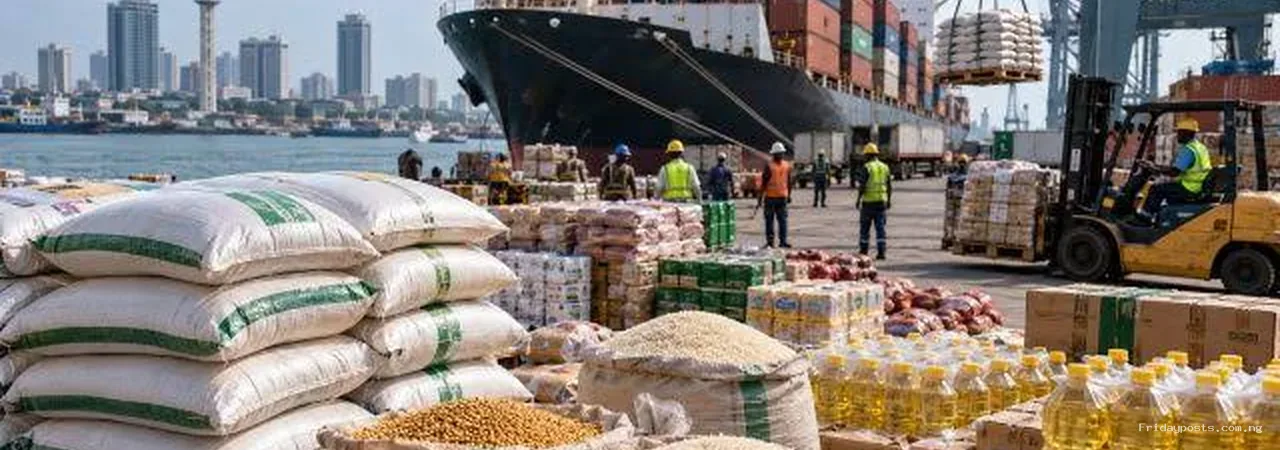
Nigeria is one of those countries that can sound agriculturally rich and food insecure in the same sentence.
It has vast arable land, millions of farmers, several climate zones and enormous domestic demand. Yet the country continues to spend scarce foreign exchange importing food and food-related products.
Central Bank of Nigeria data analysed for the first half of 2026 show about $1.19 billion in foreign exchange utilisation for food imports between January and June, up 11.41 per cent from the same period in 2025.
National Bureau of Statistics trade data tell the story in another currency and with a different classification. Analyses of the first and second quarter reports put food and beverage imports at roughly ₦3.30 trillion for the first half of the year.
These figures should not be treated as identical because the CBN measure and the NBS trade measure capture different things. But they point in the same direction: Nigeria still relies heavily on foreign supply to feed households and industries.
The obvious reaction is to say, “Why can’t Nigerian farmers grow enough food?”
The answer is that the problem is much larger than the farmer.
Nigeria does not have one food-import problem
Food imports include different categories with different economic logic.
Some products are raw agricultural commodities consumed directly by households.
Others are processed foods.
Some are industrial inputs used by Nigerian manufacturers.
Some products can be produced locally with relatively modest investment.
Others require climate conditions, technologies or scale that make imports economically rational.
The goal should therefore not be to eliminate every food import.
It should be to identify where dependence is unnecessary and where local production can compete.
Farming output is not the same as food available in the market
Nigeria can produce a large crop and still have a supply problem.
Why?
Because food has to move from farm to market.
Harvested tomatoes spoil.
Grains are damaged in storage.
Milk collection systems are weak.
Fish is lost because cold storage is inadequate.
Road conditions increase transport time.
Middlemen and fragmented markets add costs.
This means agricultural policy cannot stop at tonnage produced.
The relevant measure is how much quality food reaches consumers and processors at a competitive price.
Post-harvest losses are a hidden import driver
The Nigerian Investment Promotion Commission notes that large shares of agricultural output are lost after harvest because of weak storage, cold chain and processing infrastructure.
This is one of the most expensive contradictions in Nigerian agriculture.
The country imports processed food while local raw produce sometimes rots.
A farmer can produce more and still lose money if there is no storage or reliable buyer.
That weakens the incentive to expand the next season.
Cold rooms, packhouses, silos, warehouses and refrigerated transport are therefore food-security infrastructure.
They deserve the same policy attention as fertiliser and seeds.
Insecurity has become an agricultural input cost
Farming depends on land.
When farmers are afraid to enter farms, production falls.
Insecurity in parts of the North-Central, North-West and other regions has disrupted farming, livestock movement and rural markets.
The effect is not limited to the attacked community.
Reduced supply travels through the entire food system.
Traders pay more.
Transporters change routes.
Consumers pay higher prices.
Food-security policy is therefore also security policy.
Nigeria cannot sustainably reduce food imports while productive farming areas remain vulnerable to banditry, kidnapping and conflict.
Climate risk is becoming less predictable
Many Nigerian farmers still depend heavily on rain-fed agriculture.
That exposes output to changing rainfall patterns, floods, drought and heat.
One bad season can reduce supply across a major crop belt.
Irrigation changes this equation.
Nigeria has significant irrigation potential, yet only a fraction is developed.
Year-round production can raise output, stabilise supply and reduce seasonal price spikes.
The country needs to move agriculture from a weather-dependent activity towards a managed production system.
Yields are often too low
Nigeria can have more farmers than another country and still produce less per hectare.
Productivity depends on improved seed, fertiliser, mechanisation, soil management, extension advice and pest control.
A smallholder using low-yield seed and manual tools may cultivate land but produce too little to compete with imported supply.
This is why simply asking young people to “go back to farming” is not an agricultural strategy.
Modern agriculture is a technology and productivity business.
The farmer needs better inputs and better information.
Mechanisation is still too limited
Land preparation, planting and harvesting become difficult at scale when labour is mostly manual.
Mechanisation does not mean every farmer must own a tractor.
Equipment-leasing and service companies can allow farmers to pay for mechanised operations when needed.
This model can be more efficient than distributing tractors politically.
Nigeria should build a market for agricultural services rather than treat machinery as government gifts.
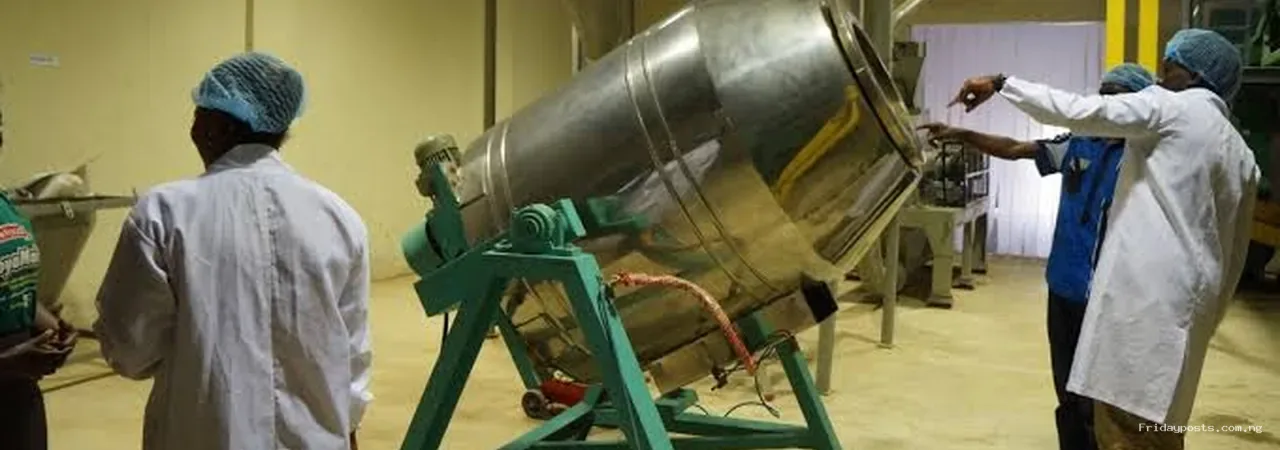
The country has a processing gap
Nigeria exports some agricultural commodities raw and imports processed products.
That is a value-chain failure.
Cassava can become starch, sweeteners and industrial flour.
Tomatoes can become paste.
Fruit can become concentrate.
Milk can become yoghurt and powdered products.
Cocoa can be processed further before export.
The goal is not only to grow more.
It is to convert agricultural output into products households and industry actually buy.
Food manufacturers also need reliable local inputs
A Nigerian food company cannot use patriotism as a raw material.
It needs consistent quality, quantity and delivery.
If local wheat, maize, sugar, milk powder, oils or other inputs are unreliable or more expensive, the company will seek imports where regulation allows.
This is an important part of the import story.
Industrial users need contract farming, aggregation, standards and predictable supply.
Agricultural policy should therefore connect farmers to processors before planting begins, not after harvest.
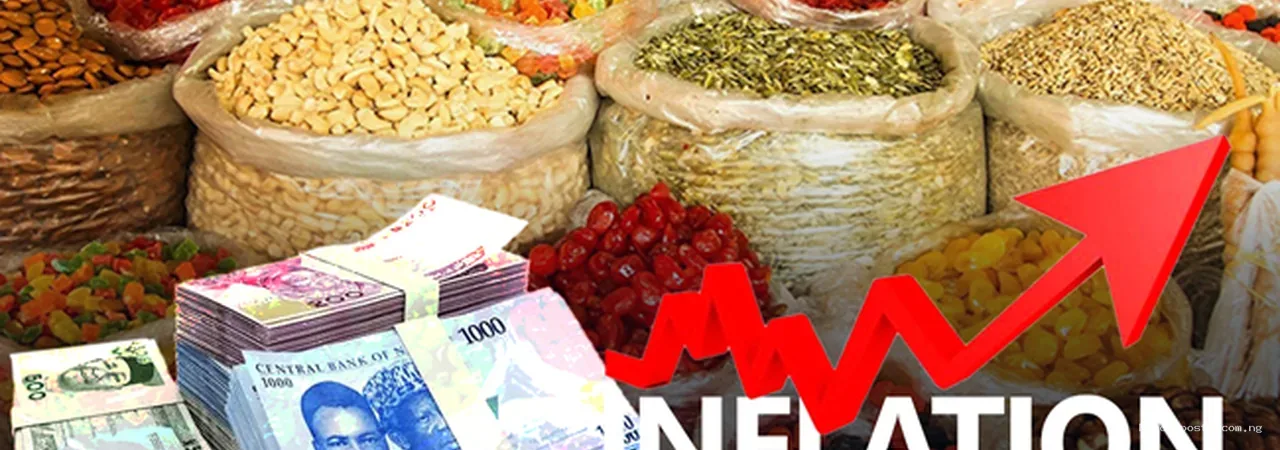
The foreign-exchange effect is circular
Food imports require foreign exchange.
High import demand puts pressure on the currency.
A weaker currency makes imports more expensive.
More expensive imports raise food prices and increase the incentive for local production.
But local producers may also rely on imported machinery, chemicals, packaging or fuel, so their costs rise too.
This is why devaluation alone does not automatically create agricultural self-sufficiency.
Competitiveness requires productivity.
Why food imports can rise even when agriculture is growing
Nigeria’s population is large and still growing.
Urbanisation changes diets.
More households demand packaged foods, dairy, processed products and convenience.
Food processors expand.
Demand can therefore grow faster than local supply even when domestic output is rising.
This is a crucial point.
The country does not merely need more production than last year.
It needs production growth that outpaces population and changing consumption.
The food-import bill needs product-level transparency
The headline $1.19 billion figure is useful, but policymakers need to go deeper.
Which products consumed the most foreign exchange?
Which are finished foods?
Which are industrial raw materials?
Which are essential because Nigeria cannot produce them efficiently?
Which could be substituted within three years?
Government should publish a product-level food import dashboard linked to domestic production targets.
That would make import-substitution policy measurable.
Wheat deserves a separate strategy
Nigeria’s climate is not naturally suited to producing all the wheat the country consumes at current yields and scale.
Yet wheat demand is enormous because of bread, noodles and other products.
The solution is not to pretend imports can disappear overnight.
Nigeria can raise domestic wheat production in suitable areas, improve varieties and irrigation, while also encouraging flour blends using cassava and other local inputs where commercially viable.
The target should be lower dependence and higher resilience, not a slogan of instant self-sufficiency.
Fish is another major opportunity
Nigeria has significant fisheries resources and a large aquaculture industry, yet the domestic fish deficit remains substantial.
Investment in hatcheries, feed, ponds, recirculating systems, cold storage and processing can reduce imports.
The opportunity is particularly attractive because fish demand is strong and production cycles can be shorter than many crops.
But feed costs and disease management matter.
Aquaculture is not automatically easy money.
Dairy requires a long-term productivity model
Milk production is constrained by low yields, animal health, feed, collection infrastructure and conflict around grazing systems.
Large dairy companies need reliable volumes and quality.
The answer is not only to ban imports.
Nigeria needs improved breeds, ranching, veterinary systems, feed production, cold collection points and contracts between farmers and processors.
Dairy development is a ten-year system-building project, not a one-season intervention.
Rice shows that policy can change behaviour but not eliminate trade pressures
Nigeria has invested heavily in rice production and milling.
Local capacity expanded significantly.
Yet consumer preferences, smuggling, production costs and supply gaps remain important.
The lesson is useful.
Import substitution can work, but it requires consistent policy, competitive quality and efficient distribution.
Protection alone is not enough.
Food policy needs to move from programmes to value chains
Nigeria has had many agricultural programmes.
The more useful organising unit is the value chain.
Take tomatoes.
Seed matters.
Irrigation matters.
Extension matters.
Harvest crates matter.
Roads matter.
Cold storage matters.
Processing matters.
Retail distribution matters.
If one link fails, the farmer can still lose money.
Government should therefore design interventions around the entire chain rather than isolated input distribution.
States have a bigger role than federal policy often admits
Agriculture is local.
Soil, climate, security and market access differ by state.
Kaduna’s priorities are not the same as Cross River’s.
Oyo’s strengths differ from Plateau’s.
States should identify two or three value chains where they have real comparative advantage and build infrastructure around them.
Trying to promote every crop everywhere wastes resources.
The private sector should lead commercial agriculture
Government has a role in roads, irrigation, research, security, standards and risk-sharing.
But commercial farming and processing should be commercially driven.
Private investors respond to prices, demand and returns.
That discipline matters.
State-owned farms and politically allocated schemes have a history of weak sustainability.
The strongest government role is to make productive investment easier.
Reducing imports should not raise food prices
This is the consumer test.
If Nigeria replaces an imported product with a local product that costs 50 per cent more, the policy may help a producer while hurting millions of households.
Local production needs a path to competitive pricing.
That means better yields, lower logistics costs, stable energy and scale.
Import substitution should not become forced consumption of expensive goods.
Nigeria should choose its battles
Some food imports are more realistic to replace than others.
Tomato products, fish, poultry inputs, vegetable oils, cassava derivatives, fruit concentrates and selected grains may offer strong opportunities depending on local conditions.
Other products may remain partly imported for a long time.
The strategic objective is to reduce vulnerability and build competitive domestic supply where Nigeria has an advantage.
The farmer is only one part of the answer
The $1.19 billion headline may tempt Nigerians to blame farmers.
That would be unfair and unproductive.
Farmers operate inside a system shaped by roads, security, credit, inputs, storage, markets, weather, processing and policy.
If the system wastes output and raises costs, the farmer cannot solve the national import bill alone.
Nigeria has enough agricultural potential to reduce its dependence on imported food substantially.
But potential is not production, and production is not supply.
The country will make progress when it builds value chains that move food efficiently from land to factory to market.
Until then, the paradox will continue: a nation with enormous farming potential spending billions to fill the gaps its own food system leaves behind.
Agricultural data also needs to become more coherent
Nigeria currently measures the food system through several data sources: CBN foreign-exchange utilisation, NBS trade statistics, crop-production estimates, market-price surveys and food-security assessments. These datasets answer different questions, which is why the dollar figure for forex used on food imports can appear to move differently from the naira value of food and beverage imports in the trade statistics.
That is not necessarily a contradiction. But policymakers and the public need a clearer bridge between the datasets.
A quarterly Food Balance and Import Substitution Report could show domestic production, estimated consumption, imports, exports, storage losses and the supply gap for major commodities. It should separate food imported directly for households from raw materials imported by processors.
This would help investors see where the real opportunities are and stop public debate from treating every import as the same problem.
Nigeria also needs to make farming investable for young people
Calls for young Nigerians to enter agriculture often sound like appeals to patriotism. Commercial farming must be financially attractive.
A young person deciding between a small logistics business, a digital service and a farm will compare risk, cash flow and return. Agriculture carries weather risk, price risk, security risk and long production cycles.
Land access, insurance, contract farming, extension services and reliable offtake can reduce those risks. So can digital records that help farmers establish credit histories.
The objective should be to make farming and agro-processing investable businesses, not social programmes for unemployed people. When agriculture generates competitive returns, talent and capital will enter without being begged.
Sources and further reading
- PUNCH, 18 October 2026: Nigeria spends $1.19bn on food imports in six months
- NBS Foreign Trade in Goods Statistics Q1 and Q2 2026
- Nigerian Investment Promotion Commission: Agriculture

A. Joshua Adedeji
A. Joshua Adedeji is a leadership strategist, organisational development consultant, author, teacher and values-driven transformation leader. He writes on leadership, strategy, governance, organisational effectiveness, business, personal development and Nigeria’s social and economic transformation, connecting ideas and current realities to practical implications for leaders, institutions, entrepreneurs and citizens. His work is shaped by a commitment to clear thinking, responsible leadership, stronger institutions and the development of people and systems capable of producing lasting impact.





Reader conversation
0 approved comments