

Nigeria has spent years talking about how many children are in school.
The more difficult question is what happens after they enter the classroom.
UNICEF has repeatedly highlighted a severe foundational-learning crisis: roughly three in four Nigerian children aged 7 to 14 do not have basic literacy and numeracy skills. The National Assessment of Learning Achievement in Basic Education, conducted by UBEC with UNICEF, also found large proportions of pupils below minimum proficiency in core subjects.
That is the national picture.
Some recent headlines have presented the figure specifically as a crisis among girls. The evidence needs careful interpretation. The “three in four” statistic applies broadly to Nigerian children, not only girls. But girls face additional barriers in many parts of the country, especially where poverty, early marriage, insecurity, domestic responsibilities and social norms reduce attendance or time available for learning.
The more accurate FridayPosts question is therefore not only, “Why are Nigerian girls failing to learn?”
It is, “Why are so many Nigerian children failing to learn, and why are girls still more vulnerable in many communities?”
School attendance is not the same as learning
Education systems often celebrate enrolment.
A child is registered.
A classroom exists.
A teacher is posted.
A school year is completed.
Those are necessary achievements.
But they do not prove that learning occurred.
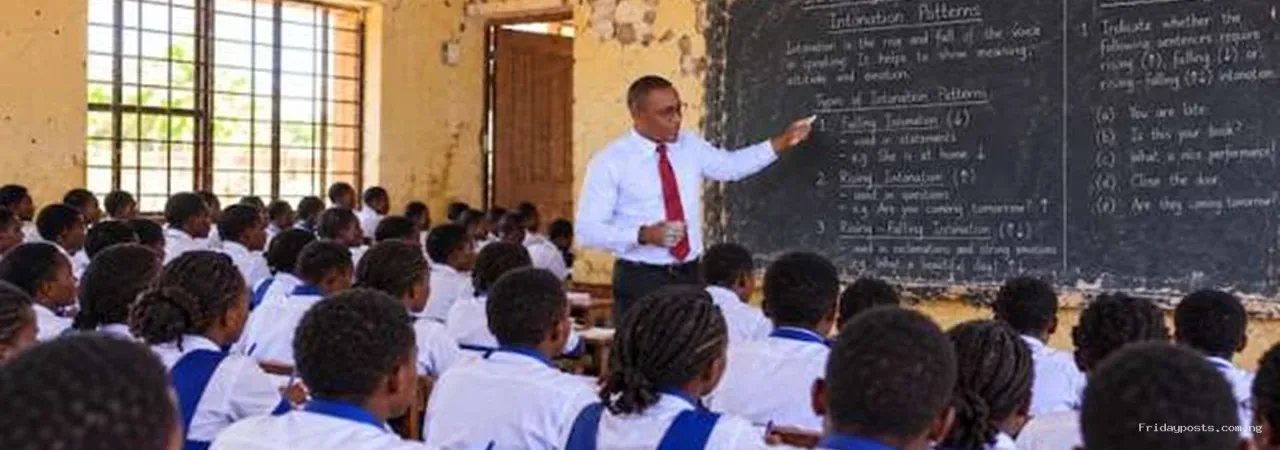
A child can spend six years in primary school and still struggle to read a short passage with understanding.
A pupil can advance from one class to another without mastering basic arithmetic.
This is the difference between schooling and learning.
Nigeria has made progress in expanding access in many places, but the learning crisis shows that access alone is not enough.
Foundational skills determine everything that comes later
Reading is not simply another subject.
It is the tool through which children learn science, social studies, history and eventually more advanced mathematics.
A child who cannot read confidently by the later primary years begins to fall behind across the curriculum.
Numeracy works the same way.
Without basic number sense, addition, subtraction, multiplication and division, later mathematics becomes much harder.
This is why foundational literacy and numeracy should be treated as emergency educational infrastructure.
If the foundation is weak, additional years of schooling can become years of accumulated confusion.
The national assessment shows a system problem
The NALABE 2022 assessment, published by UBEC and UNICEF, tested nationally representative samples of Primary 3, Primary 5 and Junior Secondary 2 learners.
The findings showed large shares of pupils failing to reach minimum proficiency in mathematics and other subjects.
UNICEF’s 2026 public-finance analysis for basic education notes that 49 per cent of Primary 3 learners, 67 per cent of Primary 5 learners and 86 per cent of Junior Secondary 2 learners did not reach minimum mathematics proficiency in the assessment.
Those numbers reveal something important.
The problem is not confined to children who never entered school.
Many enrolled children are progressing through the system without mastering what the curriculum expects.
Why girls deserve special attention
National learning poverty affects boys and girls.
But gender interacts with geography and poverty.
UNICEF has documented lower literacy rates among young women in parts of the North-West and North-East, with the poorest girls facing especially severe disadvantages.
A girl may be enrolled but miss classes because of domestic work.
She may leave school early because of marriage.
Her family may prioritise a brother’s education when money is scarce.
She may face insecurity on the journey to school.
She may lack menstrual-health support or safe sanitation.
These barriers reduce not only access, but learning time.
That is why gender-sensitive policy remains necessary even though the foundational-learning crisis is national.
Nigeria is trying to teach children who start from very different places
Two children can sit in the same Primary 1 classroom and have completely different levels of readiness.
One attended preschool, has books at home and has parents who read with her.
Another is seeing a printed storybook for the first time.
One speaks the language used by the teacher.
Another is learning in a second or third language.
One had adequate nutrition and early stimulation.
Another experienced chronic illness or undernutrition.
A single classroom curriculum often assumes these children start together.
They do not.
Teachers need methods that identify actual learning levels rather than simply teach according to age or class.
Teaching at the Right Level offers one practical lesson
Approaches such as Teaching at the Right Level group children by current learning ability for part of the day rather than assuming grade level equals skill level.
A child who cannot recognise letters receives different support from a child already reading sentences.
This sounds obvious.
In practice, many classrooms are structured around covering a syllabus, not ensuring mastery.
The teacher may move to the next topic because the timetable requires it even when half the class did not understand the previous one.
Targeted instruction can help break that pattern.
Nigeria should scale approaches with evidence of learning improvement while continuing to evaluate them rigorously.
Teacher capacity is at the centre of the crisis
It is difficult to improve learning without improving teaching.
UNICEF has pointed to weaknesses in both pre-service and in-service teacher development.
A teacher may know subject content but struggle with classroom practice.
Another may teach a subject outside his or her specialisation.
Large classes make individual attention difficult.
Training workshops can become one-off events with little follow-up.
The solution is professional development that is continuous and close to the classroom.
Teachers need coaching, demonstration lessons, peer learning, materials and feedback.
Training should change what happens with children, not merely produce certificates.
The language of instruction matters
Children learn concepts more easily when early instruction connects with a language they understand.
Nigeria’s linguistic diversity makes this complex.
English is important for national communication and later education, but forcing children to learn basic concepts entirely through an unfamiliar language can slow comprehension.
Mother-tongue or familiar-language instruction in the early years can help build understanding before children transition more fully to English.
The challenge is implementation.
Schools need materials.
Teachers need language competence.
Communities may contain several languages.
Policy therefore needs local flexibility rather than one rigid national solution.
Textbooks are still a technology
Education debates increasingly focus on tablets, AI and digital learning.
Those tools can help.
But millions of children still need something more basic: a good book they can take home.
UNICEF has reported that very few young children have multiple children’s books at home.
A child who sees print only during a crowded school day receives fewer opportunities to practise.
Nigeria needs affordable, high-quality reading materials in English and local languages.
Libraries, classroom book corners and take-home readers are not old-fashioned.
They are foundational technology.
Assessment should be used to improve teaching, not only rank children
Nigeria has many examinations.
The question is whether teachers receive useful information early enough to change instruction.
A Primary 2 teacher should know which children cannot recognise sounds, which can read words and which can understand short passages.
A mathematics teacher should know whether a learner’s problem is number recognition, place value or operations.
Simple formative assessment can provide this information.
The purpose is not to create more high-stakes tests.
It is to find learning gaps before they become permanent.
Automatic promotion can hide failure
A child who moves from class to class can create the impression of progress.
If the child’s skills are not measured, the system may discover the problem too late.
This does not mean repeating large numbers of children is the answer.
Grade repetition can be expensive and discouraging.
The better solution is targeted remediation inside the school year.
Children should receive extra support based on specific skills rather than simply being labelled “weak”.
Education financing is part of the problem
UNICEF’s 2026 analysis of public finance for basic education argues that the sector has been chronically underfunded relative to international benchmarks.
But money alone will not solve learning.
Nigeria has also struggled with utilisation, counterpart funding, procurement and the distribution of resources.
A state can increase an education budget without improving classroom results if spending goes mainly to administration or poorly targeted projects.
The critical question is how much reaches the learner.
Teacher support, books, safe classrooms, school leadership and data systems should be visible in the budget.
Poor children face a double disadvantage
Poverty affects attendance and learning.
Children may work before or after school.
They may arrive hungry.
They may lack a quiet place to study.
Parents may not afford books or transport.
When fees or informal charges rise, attendance suffers.
This is why education cannot be separated from social protection.
Cash transfers, school meals and targeted support can improve attendance and concentration when well designed.
For girls, these interventions can also reduce pressure for early withdrawal from school.
Insecurity destroys more than school buildings
Attacks on schools and insecurity across parts of northern Nigeria have closed schools, displaced families and created fear.
The educational effect continues long after an attack ends.
Teachers may leave.
Parents may keep children at home.
Learning calendars become irregular.
Girls may be withdrawn permanently because families perceive the risk as too high.
Safe-school investment is therefore a learning intervention.
A child cannot build foundational skills in a classroom she is afraid to attend.
The school day itself must be protected
Even where schools are open, learning time can be lost.
Teacher absence, late arrival, administrative interruptions, ceremonies and weak timetables reduce the number of effective instructional hours.
A country with a learning crisis cannot afford to waste classroom time.
States should measure time-on-task, not only school opening days.
School leaders need the authority and support to protect instructional time.
Parents need simple tools too
Education reform often treats parents as spectators.
They are not.
A parent who reads with a child, asks about schoolwork and encourages attendance can improve learning.
Not every parent is literate, but even oral storytelling, counting household objects and asking children to explain what they learned can help.
Public campaigns should teach families simple learning practices.
Nigeria has used radio and community networks for public-health messages.
The same infrastructure can support literacy and numeracy.
Technology should solve a learning problem, not create a procurement project
Digital tools can provide adaptive exercises, teacher support and content where books are scarce.
But devices alone do not improve learning.
A tablet without electricity, connectivity, teacher integration and maintenance can become an expensive object in a cupboard.
Every education-technology project should begin with a learning problem and a clear theory of how the tool solves it.
If the problem is teacher feedback, design for that.
If the problem is access to reading materials, design for that.
Technology should support pedagogy.
Nigeria needs state-by-state learning scorecards
National averages can hide enormous differences.
FridayPosts would support an annual public dashboard for every state showing foundational reading, numeracy, attendance, teacher qualification, pupil-teacher ratios, textbook availability and gender gaps.
The point is not to shame states.
It is to create accountability and learning.
If one state improves rapidly, others should understand what changed.
Education policy should become more empirical.
Girls’ education needs practical, local solutions
Where girls face specific barriers, interventions must be specific.
Safe transport.
Separate sanitation facilities.
Menstrual-health support.
Female teachers and mentors.
Community engagement around early marriage.
Scholarships or cash transfers for vulnerable families.
Flexible programmes for displaced children.
These solutions are less dramatic than national declarations, but they respond to real reasons girls leave or underperform.
The target should be mastery, not attendance alone
Nigeria should set a simple national promise.
Every child should be able to read with understanding and perform basic arithmetic by the end of the foundational primary years.
That target should be measured publicly.
It is more meaningful than celebrating enrolment without learning.
The country’s long-term productivity depends on it.
A young person who cannot read confidently will struggle to learn a trade, use technology, understand health information or participate fully in modern work.
Foundational learning is economic policy.
The crisis is serious, but it is not impossible to solve
Children can catch up.
Evidence from targeted instruction programmes shows that learning can improve when teaching is matched to actual skill levels.
Teachers can improve with coaching.
Parents can support learning.
Books can be distributed.
School time can be protected.
The challenge is scale and consistency.
Nigeria does not need another decade of conferences describing the same problem.
It needs a national implementation culture focused on whether children can actually read and count.
The headline should therefore be understood correctly.
Three in four Nigerian children lacking foundational skills is already a national emergency.
Girls deserve special attention where gender deepens the disadvantage.
But the ultimate objective is universal: a school system in which attendance leads to learning.
If Nigeria cannot guarantee that basic promise, every higher education and skills policy begins on a weak foundation.
Sources and further reading
- UNICEF Nigeria: National Assessment of Learning Achievement in Basic Education
- UNICEF Nigeria, September 2026: Public Finance for Basic Education in Nigeria
- UNICEF Nigeria: Foundational Literacy and Numeracy









Reader conversation
0 approved comments