
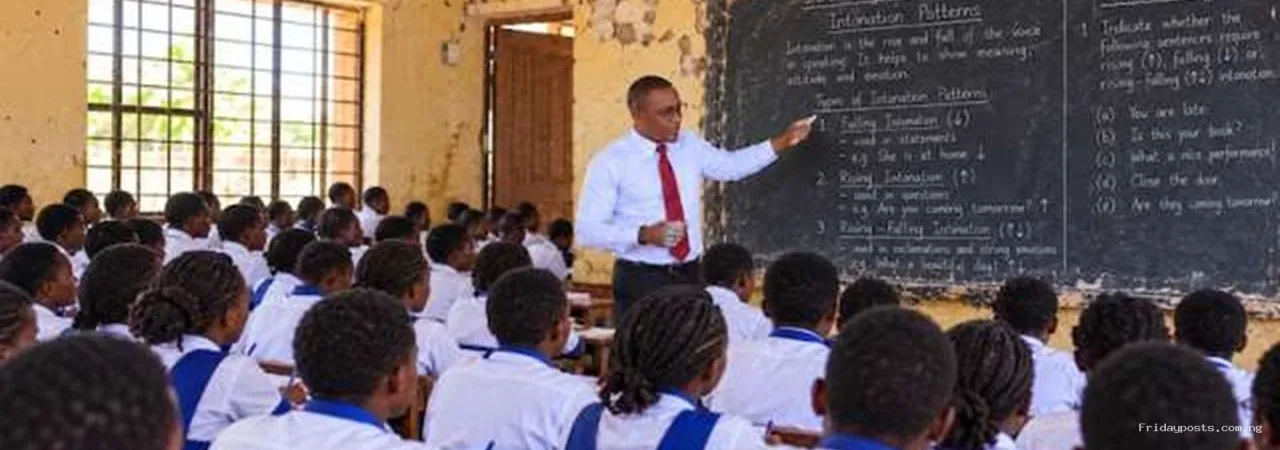
Every World Teachers’ Day, Nigeria produces the right words.
Teachers are described as nation builders. Governors hold ceremonies. Awards are presented. Some states declare work-free days. Public officials speak about the importance of education and the sacrifices teachers make.
All of this is appropriate.
But there is a harder question behind the celebration: if a bright Nigerian graduate has several realistic career options, how many still choose teaching first?
That question matters because a country cannot sustainably improve education while the profession responsible for delivering learning becomes less attractive to capable young people.
UNESCO says the world needs another 44 million teachers by 2030 to achieve universal primary and secondary education. In Nigeria, the problem is not only the number of teachers. It is also deployment, training, motivation, subject expertise, working conditions and whether teachers receive the support needed to help children learn.
World Teachers’ Day should therefore be more than a ceremony. It should be an annual audit of the profession.
Nigeria’s learning problem is also a teacher problem
A school system can have buildings, curricula and examinations, but learning still happens through the interaction between a teacher and a learner.
UNICEF has repeatedly highlighted Nigeria’s foundational learning crisis. Large numbers of children move through school without mastering basic literacy and numeracy.
There are many causes.
Some children miss school. Some classrooms are overcrowded. Learning materials are inadequate. Language can be a barrier. Poverty and insecurity disrupt attendance. School leadership may be weak.
But teacher capacity is central.
A teacher who has not mastered the subject cannot teach it confidently. A teacher who was poorly trained may struggle to diagnose why a child is not learning. A teacher responsible for an extremely large class may have little time for individual feedback. A demoralised teacher may simply survive the day rather than improve instruction.
Improving education therefore requires improving the teacher as a professional.
Teaching has a status problem
Nigeria still respects the idea of the teacher.
The problem is that respect in speech does not always become respect in economic or professional life.
In many families, a child who performs exceptionally well is encouraged towards medicine, engineering, law, technology, finance or other occupations perceived as more prestigious and better paid.
Teaching is sometimes treated as a fallback.
This perception matters because professions compete for talent.
If strong graduates consistently choose other careers, schools eventually recruit from a narrower pool. The effect may not be immediate, but over time it weakens the quality of the profession.
The answer is not to romanticise the past or suggest that every teacher decades ago was better. The answer is to make teaching a career ambitious people can choose without feeling they have accepted economic defeat.
Salary matters, but salary is not the whole profession
Teacher pay is an unavoidable part of the discussion.
A professional expected to shape children’s intellectual development should be able to live with dignity.
Where salaries are low or delayed, teachers may take second jobs, leave the profession or reduce the energy they can give to the classroom.
But raising salaries alone will not solve the problem.
A strong profession also needs clear entry standards, serious training, mentoring, promotion based on competence, access to professional development, good school leadership, safe workplaces and public respect.
Medicine is not respected only because doctors earn income. It has a professional identity, licensing, specialised training and clear advancement pathways.
Teaching needs the same seriousness.
Nigeria must improve who enters teacher training
One of the uncomfortable questions in education is the quality of candidates entering teacher-training institutions.
If teaching is treated as a low-status course, colleges of education and education faculties may struggle to attract some of the strongest school leavers.
That creates a cycle.
Lower status attracts weaker demand. Weak demand makes the profession easier to neglect. Neglect further lowers status.
Nigeria needs to break that cycle by making teacher education selective and attractive.
Scholarships can help. So can guaranteed induction programmes, structured career paths and incentives for high-demand subjects such as mathematics, physics, chemistry, computing and special education.
A country that says teachers are important should compete actively for talented future teachers.
Pre-service training must become more practical
Many teacher-training programmes still struggle to connect educational theory with the reality of Nigerian classrooms.
A trainee may study educational psychology, curriculum theory and teaching methods without enough supervised practice in diverse schools.
The result is a graduate who knows terminology but may not be prepared to manage a class, teach foundational reading, support a struggling child or use assessment to adjust instruction.
Teacher education should therefore place more emphasis on clinical practice.
Future teachers need sustained classroom placements under capable mentors. They should observe strong teaching, practise lessons, receive feedback and improve over time.
Graduation should indicate readiness to teach, not merely completion of coursework.
Existing teachers need continuous development
Training does not end when a teacher receives a certificate.
Curricula change. Technology changes. Children’s needs change. New teaching methods emerge.
Professional development should therefore be continuous.
UNICEF’s work in Nigeria has emphasised standardised teacher professional development and practical support rather than one-off workshops where information is passed down through several layers until little remains.
Good professional development should be close to the classroom.
Teachers need coaching, peer learning, subject communities, lesson observation and access to materials they can use immediately.
Digital platforms can extend this support, particularly in places where travelling for training is difficult.
Technology should support teachers, not replace them
Artificial intelligence, digital learning platforms and smart classrooms are changing education.
This can create a false debate: will technology replace teachers?
The more useful question is whether technology can make good teachers more effective.
A teacher can use digital content to demonstrate a concept, access better lesson materials, track student progress and continue learning professionally.
But technology cannot fully replace the human work of motivating a child, noticing confusion, managing relationships, building confidence and adapting to a classroom’s emotional reality.
The strongest school systems will probably combine capable teachers with useful technology.
Nigeria should therefore invest in both.
Rural and difficult postings require stronger incentives
Teacher distribution is as important as teacher numbers.
A state may have enough teachers overall while rural schools remain understaffed.
Qualified teachers often prefer urban centres where housing, healthcare, transportation and family opportunities are better.
Government cannot solve this by issuing posting letters alone.
Difficult locations need incentives.
These can include rural allowances, housing support, faster promotion, transport assistance, professional-development opportunities and defined service periods after which teachers can request transfers.
Without incentives, the schools with the greatest needs may continue to receive the fewest qualified teachers.
Subject shortages need targeted policy
Not every teacher shortage is the same.
A school may have several teachers and still lack qualified mathematics, science, technology or special-needs teachers.
Teacher planning should therefore be based on subjects and geography.
States need accurate data.
How many qualified teachers are active? What subjects do they teach? Where are vacancies concentrated? How many will retire in the next five years? How many new teachers are in training?
Education policy becomes reactive when these questions are answered only during recruitment crises.
A modern teacher-management system should make workforce planning routine.
Promotion should reward competence, not only years served
Teachers need career progression.
But promotion systems that rely heavily on seniority can discourage excellence.
Nigeria should develop pathways that allow strong classroom teachers to advance without necessarily leaving teaching for administration.
A teacher should be able to become a master teacher, mentor, subject specialist or instructional coach and receive higher professional recognition and pay.
This matters because one of the unintended weaknesses in many systems is that talented teachers are promoted out of the classroom.
The career structure should allow expertise to remain close to learners.
School leaders matter more than we admit
A teacher works inside a school organisation.
A good principal can create a culture of preparation, punctuality, collaboration and learning.
A poor principal can make even motivated teachers tired.
School leadership should therefore be treated as a specialised competence.
Principals need training in instructional leadership, staff management, data use, safeguarding, budgeting and community relationships.
Nigeria often appoints school leaders based mainly on years of service. Experience matters, but leadership requires more than seniority.
Improving principals may be one of the fastest ways to improve the working environment of teachers already in the system.
Teacher welfare affects student learning
Discussions about teacher welfare are sometimes dismissed as union matters.
That is a mistake.
A teacher worried about unpaid salary, unsafe transport, accommodation or medical bills carries those pressures into the classroom.
This does not excuse poor performance. Professionals still have obligations.
But education policy should recognise that working conditions influence performance.
If Nigeria wants teachers to prepare lessons, mark work carefully, support struggling pupils and develop professionally, the system must create conditions in which those expectations are realistic.
Accountability must accompany better conditions
Improving teacher welfare does not mean abandoning accountability.
Parents have a right to expect punctuality, subject competence, professional conduct and serious attention to children.
Government should therefore combine better support with clearer performance expectations.
Attendance systems can improve. Classroom observation can become more constructive. Professional misconduct should have consequences. Promotion should consider evidence of competence.
But accountability should not become a punitive inspection culture.
The objective is to improve teaching, not to create fear.
Private schools reveal both opportunity and inequality
Nigeria’s private-school sector employs large numbers of teachers.
Some private schools provide excellent professional environments. Others pay very low salaries, offer little job security and employ unqualified staff.
This makes national teacher policy more complicated.
Regulation must cover quality without destroying low-cost schools that serve communities government schools do not adequately reach.
Teacher development programmes should include private-school teachers where possible.
A child’s right to competent teaching should not depend entirely on whether the school is publicly or privately owned.
World Teachers’ Day should become a national scorecard
Instead of limiting 5 October to speeches, Nigeria could publish an annual Teacher Profession Scorecard.
The scorecard should include teacher vacancies, pupil-teacher ratios, share of qualified teachers, subject shortages, rural staffing gaps, average training hours, promotion delays, salary-payment performance and teacher attrition.
States could be compared.
This would create healthy pressure.
A state that celebrates teachers publicly while owing salaries or leaving rural classrooms empty would have to explain the gap.
Recognition becomes more meaningful when connected to evidence.
The profession needs a stronger public story
Nigeria also needs to change how teaching is presented to young people.
Teaching should be seen as intellectually demanding work with national importance.
Schools and media can profile excellent teachers, not only celebrities and politicians. Scholarships can target top students. Teacher fellowships can create prestige. Professional associations can strengthen identity.
Young people are influenced by what society celebrates.
If teaching is constantly described as sacrifice without professional reward, fewer ambitious people will choose it.
A country should not ask its brightest graduates to enter teaching because of pity. It should make teaching worth choosing.
The question is not whether we appreciate teachers
Nigeria knows how to appreciate teachers symbolically.
The deeper question is whether the system is designed to attract, develop and retain excellent people.
World Teachers’ Day should therefore end with more than congratulations.
It should force government to answer practical questions.
Are teachers paid on time?
Are the strongest graduates entering the profession?
Do teachers receive useful training?
Are rural schools adequately staffed?
Can a classroom teacher build a respected career without leaving the classroom?
Are poor performers supported to improve and held accountable when they do not?
If Nigeria cannot answer those questions well, the annual celebrations will continue while the learning crisis remains.
A country’s future is not built by praising teachers once a year.
It is built by making teaching strong enough that talented people want to spend their working lives doing it.
Sources and further reading
- UNESCO Teachers: 44 million additional teachers needed globally by 2030
- PUNCH, 5 October 2026: Kwara, Ekiti and Oyo work-free day for teachers
- UNICEF Nigeria: Enabling teachers, educating children

A. Joshua Adedeji
A. Joshua Adedeji is a leadership strategist, organisational development consultant, author, teacher and values-driven transformation leader. He writes on leadership, strategy, governance, organisational effectiveness, business, personal development and Nigeria’s social and economic transformation, connecting ideas and current realities to practical implications for leaders, institutions, entrepreneurs and citizens. His work is shaped by a commitment to clear thinking, responsible leadership, stronger institutions and the development of people and systems capable of producing lasting impact.









Reader conversation
0 approved comments