
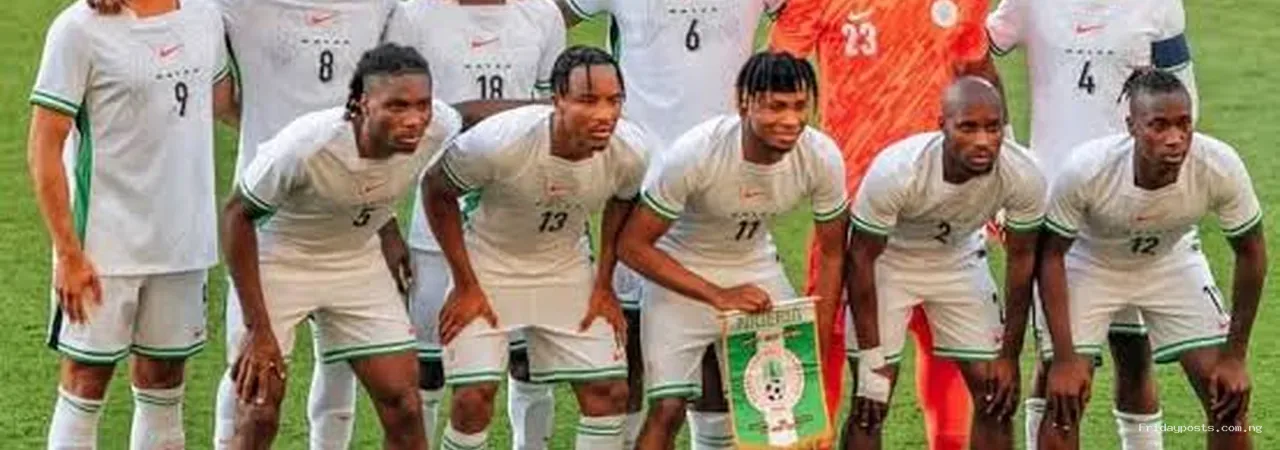
International friendlies are often described as meaningless when there are no qualifying points at stake.
For Nigeria’s match against Russia, that description would be wrong.
The Super Eagles arrive in Russia only days after a damaging 3-0 defeat to Guinea-Bissau in the 2027 Africa Cup of Nations qualifying campaign. Injuries and club restrictions have also affected the travelling squad. Several players are entering the senior national-team environment for the first time or remain on the fringes of the first eleven.
Reports suggest that as many as 13 players in the squad could be considered rookies or relatively unestablished at senior international level.
For coach Eric Chelle, this creates a rare opportunity.
The match can be treated as an audition rather than an exhibition.
Nigeria needs to know which players can handle international pressure before a competitive crisis forces the question.
The defeat in Bissau changes the context
A friendly played after a comfortable qualifying window would feel different.
Nigeria’s loss to Guinea-Bissau has increased scrutiny around the team.
The defeat should not lead to panic, but it has exposed the need for stronger competition across several positions.
One of the dangers in national-team football is allowing reputation to become automatic selection.
Players who have served Nigeria well still need competition.
The strongest teams build depth so that injuries, poor form or tactical changes do not create emergencies.
Russia therefore offers Chelle an opportunity to test alternatives without risking AFCON points.
A national-team place should be earned repeatedly
International football has limited training time.
Coaches often rely on familiar players because they already understand the system.
That is reasonable.
But familiarity can become stagnation.
A player should not remain in the national team only because he has been there before.
Club form, fitness, tactical usefulness and attitude should matter.
Friendlies are where coaches can widen the pool.
If a newcomer performs well, an established player feels pressure.
That competition can improve the entire squad.
Umar Abubakar represents the development pathway Nigeria needs
One of the interesting newcomers is Umar Abubakar.
Premium Times highlighted the 20-year-old striker after a strong development season in Belgium, where he scored heavily for Jong Gent before moving to Famalicão in Portugal.
The important part of his story is not simply the goal total.
It is progression.
A young player moves from youth development to competitive football, earns a transfer and enters senior national-team consideration.
Nigeria needs more of these pathways.
The country often identifies talent early but loses track of players between youth football and senior professional competition.
A national-team friendly can show whether a promising club record translates to senior international football.
Chibuzo Nwoko offers a different type of opportunity
Another player attracting attention is Chibuzo Nwoko, a Fulham midfielder who previously represented England at youth level before accepting Nigeria’s senior invitation.
His case illustrates the growing importance of diaspora recruitment.
Nigeria has a large pool of eligible players developed in European academy systems.
These players can add technical quality and tactical education.
But invitation alone is not enough.
The national team must integrate them into a clear football identity.
A dual-national player choosing Nigeria should enter a competitive environment, not receive a permanent place because of where he was trained.
Russia gives Nwoko a chance to show what his versatility can add.
The midfield needs succession planning
Nigeria has experienced midfield debates for years.
Some supporters focus on creativity. Others want ball winners, press-resistant players or deeper playmakers.
The truth is that modern international teams need different profiles.
One match may require control of possession.
Another may require defensive discipline.
A third may require transitions and running power.
Nigeria needs enough midfielders that the coach can choose based on the opponent rather than simply the names available.
This is why experimenting with younger midfielders matters.
Succession planning should begin before established players decline.
Home-based players deserve meaningful tests
Reports around the Russia squad have also drawn attention to home-based players.
This is important because the Nigeria Premier Football League should be part of the national-team pathway.
The argument should not be that a player deserves selection simply because he plays locally.
Selection should be based on performance.
But if domestic players never receive meaningful opportunities, the league loses one of its strongest incentives.
A credible route from NPFL performance to Super Eagles selection can raise the value of the league, attract sponsors and encourage players to take domestic competition seriously.
Friendlies are appropriate places to test that route.
Goalkeeping competition should remain open
Nigeria’s goalkeeping position has received intense scrutiny over different cycles.
When one goalkeeper becomes established, the temptation is to stop searching.
That is risky.
Goalkeepers can lose form, suffer injuries or struggle in specific tactical systems.
The national team needs at least three credible options.
A friendly should therefore test not only the first-choice keeper but also the communication, distribution and decision-making of alternatives.
Modern goalkeeping is more than shot stopping.
How a goalkeeper starts attacks and manages space behind the defence can influence the entire team.
Defence needs new partnerships, not only new names
Calling up new defenders is easy.
Building defensive understanding is harder.
Centre-backs and full-backs must coordinate positioning, pressing, covering and set pieces.
A newcomer may look excellent at club level but need time to understand national-team partners.
This is another reason friendlies matter.
The coaching staff can test partnerships under match pressure.
Nigeria should avoid judging a defender only by one mistake.
The more useful question is whether the player understands the defensive structure and improves as the match develops.
The friendly should test tactical flexibility
A new squad gives Chelle an opportunity to experiment with formation and roles.
Nigeria has often switched between back fours and back threes, different midfield structures and several attacking combinations.
Tactical flexibility is valuable, but it should not become tactical confusion.
The team needs a clear base identity.
Players should know how Nigeria wants to defend, progress the ball and create chances.
A friendly can test variations around that identity.
If every international window introduces an entirely new idea, players spend too much time learning and too little time refining.
Young players should be judged on decisions, not excitement
Supporters naturally become excited about new names.
A few dribbles or one goal can create immediate calls for a player to become a starter.
That is not always fair to the player.
The coaching staff should evaluate decisions.
Does the player understand when to press?
Does he protect the ball?
Does he track runners?
Does he make the correct pass under pressure?
Does he maintain concentration after a mistake?
International football punishes poor decisions more quickly than youth or reserve football.
The objective is to identify players who can repeat good actions, not only produce highlights.
Club restrictions are a reminder that friendlies compete with employers
Several players have reportedly been unavailable because clubs did not release them or because of injuries.
This is a recurring problem in international football, especially around non-competitive matches.
Clubs pay players’ salaries and worry about injury risk.
National teams need preparation and squad development.
The calendar creates tension.
Nigeria should therefore use every available friendly intelligently.
If a first-choice player cannot travel, the match becomes an opportunity rather than a crisis.
A deep player pool turns absence into experimentation.
The result still matters, but it is not the only result
No coach wants to lose.
Nigeria should approach Russia seriously.
A poor performance would add pressure after the Guinea-Bissau defeat.
But the scoreboard should not be the only measure.
If Nigeria discovers two or three players capable of competing for future selection, the friendly creates long-term value.
If a new tactical combination works, that matters.
If a fringe player shows he is not ready, that is useful information too.
Experimentation is valuable only when coaches learn from it.
Players need a pathway after the friendly
One weakness in national-team experimentation is what happens next.
A player may receive one call-up, play 20 minutes and disappear from the system.
Nigeria needs a better monitoring process.
New players should remain on a wider national-team database.
Their club minutes, injuries, form and development should be tracked.
The coaching staff should communicate what they need to improve.
This creates continuity.
A national team should not rediscover the same player every two years.
The diaspora pool should be managed strategically
Nigeria’s global population creates a competitive advantage.
Players developed in England, Germany, Netherlands, Belgium and elsewhere may be eligible for Nigeria.
But international recruitment has become competitive.
Other national teams also court dual nationals.
Nigeria therefore needs early relationship building.
The goal is not to pressure teenagers into premature decisions.
It is to make sure eligible players understand Nigeria’s football project and know they are being monitored.
A strong national team becomes more attractive when selection is professional and development is clear.
The NPFL should produce more national-team candidates
Nigeria cannot build the entire senior national team abroad.
A healthy domestic football system should consistently produce players ready for international consideration.
This requires better coaching, pitches, sports science and competition standards in the NPFL.
The national team can reinforce that system by giving genuine opportunities to outstanding domestic players.
But the standard must remain high.
Selection should not become a quota.
The most persuasive argument for the NPFL is a home-based player performing well enough that supporters stop describing him as “home-based” and start describing him simply as a Super Eagle.
Competition can protect Nigeria from form crises
National teams often suffer when too many positions have automatic starters.
A player in poor club form may still be selected because the coach does not trust the alternative.
That is dangerous.
The solution is not constant rotation.
It is credible competition.
Every important position should have at least two players the coach is comfortable starting.
Friendlies help build that depth.
The Russia match is therefore part of a larger insurance policy.
Nigeria is testing whether the next man can actually step in.
The Russia match should become a development report
After the game, the NFF and coaching staff do not need to publish private tactical evaluations.
But supporters should be able to see a broader development logic.
Which newcomers are likely to remain in the pool?
Which positions still need more competition?
What did the coaching staff learn?
Nigeria’s football conversation is often driven by speculation because official communication is limited.
Clearer technical communication can build trust without revealing competitive secrets.
Rebuilding does not mean abandoning experience
A new generation should not be created by removing every established player.
Experienced internationals provide leadership, game management and institutional memory.
The goal is balance.
A strong squad combines players at different career stages.
Veterans set standards.
Prime-age players carry performance.
Younger players create competition and future depth.
The Russia squad should therefore be seen as an expansion of options, not a rejection of the established group.
One friendly will not answer every question
A player can perform brilliantly in a friendly and struggle later.
Another can have a nervous debut and still become an excellent international.
Selection should be based on a body of evidence.
Russia is one test.
Club football remains another.
Future camps provide more information.
The danger is drawing permanent conclusions from one evening.
But one evening can open a door.
Nigeria should use the opportunity before the next crisis
The Super Eagles have enough talent to compete strongly in Africa.
The persistent problem is turning that talent into a stable, deep and well-prepared squad.
That requires competition.
It requires succession planning.
It requires giving emerging players opportunities before injury or poor form makes experimentation unavoidable.
Tuesday’s friendly offers that chance.
For some of the rookies, it may be the biggest match of their careers so far.
For Nigeria, the objective is larger.
The country needs to leave Russia knowing more about its future than it knew when the squad arrived.
If that happens, the friendly will have achieved something no qualifying point can measure.
Sources and further reading
- Premium Times, 3 October 2026: players who could force their way into Nigeria’s plans
- Reuters, 1 October 2026: African national teams and friendly assignments
- Realnews Magazine, 5 October 2026: injuries and club restrictions








Reader conversation
0 approved comments