
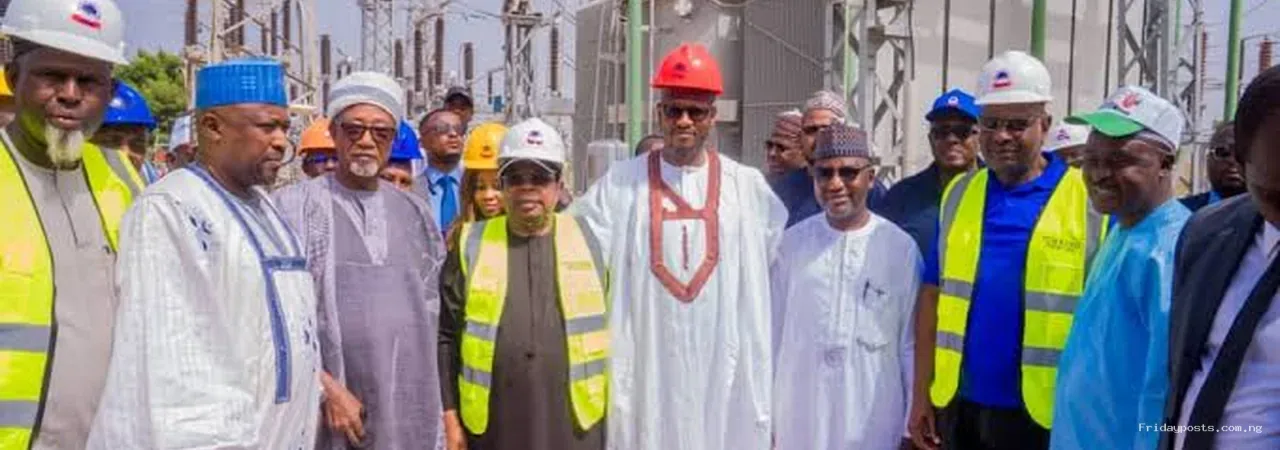
Nigeria has commissioned a new set of electricity transmission projects in Kano and Katsina, and the headline numbers sound impressive.
Reports published between 22 and 24 October 2026 say the projects added hundreds of megawatts of transmission capacity across substations in Walalambe, Kumbotso, Dakata, Dan-Agundi and Kankia.
There is, however, a numerical discrepancy that should be made clear.
Tribune reported that four Kano projects added 544MW and the Kankia project in Katsina added another 96MW, producing a combined 640MW figure.
A report quoting a Transmission Company of Nigeria statement described 240MW added at the 330kV level and 376MW at the 132kV level, giving 616MW of commissioned capacity, while also mentioning other planned projects.
Until TCN publishes or confirms a single reconciled public figure for the exact projects being counted, FridayPosts would treat the safest conclusion as this: substantial new transmission capacity has been commissioned in Kano and Katsina, but the public should distinguish the infrastructure rating from electricity actually delivered.
That distinction is the heart of the story.
A new transformer does not generate electricity.
A larger substation does not guarantee a household will receive more hours of supply.
Transmission capacity is one part of a chain.
Generation, transmission and distribution are different businesses
Nigeria's electricity system can be simplified into three main stages.
Generating companies produce electricity.
Transmission infrastructure moves large blocks of electricity over high-voltage lines from power plants towards major load centres.
Distribution companies take that electricity from transmission substations and deliver it through lower-voltage networks to homes and businesses.
A transmission upgrade therefore solves a specific problem.
It allows more power to move through a location safely.
If the old substation was overloaded, the upgrade can reduce bottlenecks and improve voltage stability.
But the extra capacity becomes useful only when enough generation is available and the distribution network can carry the power to paying customers.
Why Kano needed stronger transmission infrastructure
Kano is one of Nigeria's largest commercial and industrial centres.
Its electricity demand includes households, markets, small businesses, factories, hospitals, schools and large industrial users.
Older transmission assets can become overloaded as demand grows.
An overloaded transformer creates operational risk.
Operators may have to restrict supply even when electricity is available elsewhere on the grid.
New capacity can create room for additional load and improve reliability.
The Walalambe project is especially important because reports say it creates a new supply point with outgoing feeders serving industrial and residential corridors.
TCN-linked reporting also said Lee Group of Companies had been reconnected to the grid after operating off-grid for decades.
If sustained, that could have significant economic value.
An industrial company returning to the grid is a powerful test
Large Nigerian manufacturers often build private power systems because public supply is unreliable.
That is expensive.
The factory pays for generators, fuel, maintenance and technical staff.
Those costs enter the price of products.
If a major industrial company can return to the grid because transmission capacity and supply quality have improved, that is more meaningful than the commissioning ceremony itself.
FridayPosts would therefore track the Lee Group example.
How many megawatts does the company receive from the grid?
How much self-generation has it reduced?
Has production cost changed?
Does the supply remain stable over several months?
Those numbers would show whether infrastructure investment is creating economic value.
More transmission capacity can reduce congestion
Electricity networks operate within technical limits.
A transformer can safely carry only a certain load.
When demand approaches or exceeds that limit, operators may redistribute load, shed supply or risk equipment failure.
Adding transformers provides headroom.
It can also create redundancy.
If one unit is under maintenance, another may carry more of the load.
This improves resilience.
But redundancy must be designed deliberately.
Nigeria has repeatedly suffered from a grid that operates with narrow margins.
Every project should therefore be assessed not only by the megawatts added, but by how much system risk it removes.
The Dan-Agundi restoration shows why maintenance matters
Reports say the Dan-Agundi substation had suffered fire damage and has now regained substantial capacity.
This illustrates another electricity challenge.
Nigeria needs new infrastructure, but it also has to protect and maintain existing assets.
A transformer fire can remove critical capacity suddenly.
Replacement may take months because large power transformers are expensive and difficult to source.
Maintenance, fire protection, spare-equipment planning and security are therefore as important as commissioning new substations.
A country that builds faster than it maintains can remain unreliable.
Katsina's Kankia project expands the northern network
The Kankia transmission substation is intended to improve bulk power supply in Katsina and surrounding areas.
Reports describe new transformer capacity and additional projects under development.
For residents, the useful questions are local.
Which distribution feeders will receive more supply?
Which communities were previously constrained?
How many hours of electricity are expected to improve?
Will voltage quality become more stable?
Will businesses that rely on diesel reduce generator use?
TCN and the relevant distribution company should answer these questions together.
Transmission projects are easier for the public to understand when they are linked to actual service areas.
Why a substation can be ready while homes remain dark
Suppose a new transmission substation can carry an extra 100MW.
If the national grid has no additional generation available at that moment, the capacity may remain underused.
If the distribution network downstream has weak feeders or overloaded local transformers, the power may not reach homes reliably.
If the distribution company cannot recover enough revenue, it may struggle to invest in its network.
This is why electricity reform cannot be judged one project at a time.
The chain must work together.
The North needs more generation close to demand
Much of Nigeria's large grid-connected generation is located far from northern load centres.
Long-distance transmission increases dependence on major corridors.
A stronger future system will need more generation located closer to demand, including gas where viable, hydro, solar, embedded generation and storage.
Northern Nigeria has strong solar potential.
That does not mean solar alone can replace the grid.
It means regional generation can reduce pressure on long-distance transmission and improve resilience when combined with storage and flexible supply.
Distribution companies now face their own test
Once TCN increases capacity at interface points, the local distribution company must be able to take the power.
This requires healthy 33kV and 11kV networks, working transformers, meters and commercial systems.
If a DisCo cannot absorb the additional energy, transmission capacity can become stranded.
This is an important accountability point.
Government should publish the amount of capacity offered at each interface and the amount actually taken by the distribution company over time.
That would reveal whether the bottleneck has moved downstream.
Metering matters because investment needs revenue
A stronger network costs money to operate and maintain.
Electricity markets cannot remain healthy if large amounts of energy are unmetered, incorrectly billed or unpaid.
Kano and Katsina therefore need metering improvements alongside infrastructure upgrades.
Customers are more willing to pay when billing is accurate and service improves.
Utilities have a stronger business case for investment when collection improves.
The relationship should be reciprocal.
Better service for better payment.
The public needs before-and-after performance data
The most useful next step would be to publish baseline data for communities served by the projects.
Average supply hours before commissioning.
Average voltage quality.
Number of overload incidents.
Transformer loading levels.
Industrial customers connected.
Energy delivered.
Then publish the same data after three, six and twelve months.
This would convert infrastructure commissioning into performance accountability.
Without a baseline, almost any later claim of improvement becomes difficult to test.
The 616MW-versus-640MW discrepancy should be resolved
The difference between 616MW and 640MW is not enormous relative to the scale of the projects, but it matters for public reporting.
It may come from different conversion assumptions, which assets are included or whether planned capacity is counted alongside commissioned equipment.
The solution is simple.
TCN should publish a project table listing each transformer, its MVA rating, voltage level, operational date and calculated transfer capacity.
That would eliminate ambiguity.
Infrastructure reporting should not require journalists to reconstruct engineering totals from speeches.
Transmission capacity is not the same as energy
Megawatts measure power at a point in time.
Energy consumed over time is measured in megawatt-hours or kilowatt-hours.
A 100MW-capacity substation does not mean residents receive 100MW every hour of every day.
Actual energy depends on generation, demand, outages and operating decisions.
This is why the most meaningful consumer indicator is not installed capacity alone.
It is how many additional kilowatt-hours are delivered reliably to homes and businesses.
Electricity reform should be judged through economic outcomes
A stronger grid should make something cheaper or more productive.
Factories should use less diesel.
Businesses should stay open longer.
Cold storage should become more reliable.
Hospitals should spend less on backup power.
Households should charge fewer batteries and generators.
If those outcomes do not occur, the infrastructure may be technically useful but economically incomplete.
The government should therefore attach economic indicators to major power projects.
State electricity reform creates another opportunity
Nigeria's evolving electricity law allows states greater involvement in intrastate electricity markets.
Kano and Katsina can use improved transmission infrastructure as a platform for local generation, embedded power and industrial clusters.
The objective should not be to create isolated systems that conflict with the national grid.
It should be to use local markets to solve local distribution and generation gaps while benefiting from a stronger national backbone.
Maintenance funding must be protected
Large transformers have long service lives when maintained properly.
They are expensive to replace.
Nigeria should therefore publish maintenance plans for newly commissioned assets.
Who is responsible?
What spare parts are held?
How frequently are inspections conducted?
Are protection systems tested?
What is the expected asset life?
Infrastructure is an investment only if it remains functional.
What residents should watch over the next six months
The first indicator is supply duration.
Do communities receive more hours of electricity?
The second is voltage stability.
Do businesses experience fewer damaging fluctuations?
The third is industrial reconnection.
Are companies reducing self-generation?
The fourth is feeder performance.
Are local distribution bottlenecks preventing the new capacity from reaching customers?
The fifth is outage frequency.
Do the substations reduce interruptions caused by overload?
These are the measures that should determine whether the projects succeeded.
Commissioning is the beginning of the accountability period
Nigeria has no shortage of infrastructure ceremonies.
The stronger governance culture begins after the ribbon is cut.
The Kano and Katsina projects appear to add meaningful transmission capacity to a part of the country that needs stronger electricity infrastructure.
That is worth recognising.
But residents do not consume transmission capacity.
They consume electricity.
Factories do not become competitive because a transformer has been commissioned.
They become competitive when dependable power reaches their machines at a cost lower than self-generation.
The true success of these projects will therefore be measured in homes with longer supply, businesses using less diesel, factories producing more and a northern grid that is less vulnerable to overload.
That is the test FridayPosts will be watching.
Sources and further reading
- Tribune, 24 October 2026: FG reports 640MW additional transmission capacity
- The Authority, 24 October 2026: TCN statement describes commissioned assets totalling 616MW
- Tribune, 22 October 2026: four Kano substations add 544MW







Reader conversation
0 approved comments