

A graduate CV does not have to pretend that you have managed a department or spent five years in an office. Its purpose is simpler: to show an employer what you know, what you have done, what you can learn and why you deserve consideration for a particular role.
Many first-time applicants make one of two mistakes. They either submit a nearly empty document containing only school details, or they fill several pages with generic phrases such as “hardworking,” “obedient” and “able to work under pressure.” Neither approach gives a recruiter much evidence.
A useful CV connects your actual experience to the responsibilities of a vacancy. NYSC work, school projects, student leadership, responsible volunteering and verified freelance assignments can contribute to that picture. The key is to describe each activity honestly and specifically.
Before writing, read the job advert like a checklist
Imagine an employer needs an administrative assistant who can maintain records, prepare spreadsheets, organise appointments and communicate with customers. Your CV should make it easy to see which of those tasks you can handle.
Open the vacancy and highlight the skills, qualifications, software, duties and location requirements. Then create two columns: employer needs and my evidence. Under record-keeping, you might put “maintained classroom attendance sheet during NYSC.” Under spreadsheets, you might put “built a sample stock tracker using Excel.” Under communication, you might put “answered parent enquiries and prepared weekly class updates.”
If you lack a key skill, do not claim it. You can either begin learning it or prioritise roles where you already meet the requirements. Tailoring is not dishonesty; it means placing genuinely relevant information first.
The seven sections of a strong entry-level CV
For many graduate applications, a clean one-page CV is a sensible starting point. A second page may be appropriate if you have meaningful projects, placements or certifications. The employer's own instructions take priority over any generic page-count rule.
1. Name and contact information
Put your full name at the top in readable type. Follow with one working phone number, a professional email address and your city/state when relevant to the role. Add a LinkedIn profile or portfolio link only if it is current and supports your application.
Avoid publishing your full home address, BVN, NIN or copies of identification documents in a CV circulated widely. Recruiters can request necessary records through appropriate, verified stages of recruitment. A photograph, age, marital status and religion normally do not explain whether you can do the job; include personal particulars only when legitimately required by an employer or a relevant application process.
2. A two- or three-line professional summary
A summary should specify your direction and evidence. Compare these examples:
Weak: “A dedicated and hardworking young graduate seeking a challenging position in a reputable organisation where I can utilise my abilities.”
Stronger: “Business Administration graduate with NYSC experience maintaining attendance records and coordinating office correspondence. Confident in Excel reporting, document organisation and customer communication. Seeking an entry-level operations or administrative role.”
The second example makes no grand claim. It tells a recruiter what to examine further.
3. Relevant skills
Choose six to eight skills you can demonstrate, not every ability you have ever heard of. For an operations role, appropriate items might include Excel formulas, document filing, meeting coordination, email communication, stock records and basic customer support. For a content role, writing, editing, research, content calendars and relevant design tools may fit better.
Avoid rating yourself “95% skilled” unless an employer has requested a specific validated assessment. State tools accurately: there is a difference between knowing how to enter numbers into a spreadsheet and knowing how to build a functioning report with formulas and checks.
4. Education
List the qualification, institution and completion period. Include your discipline and any relevant project or coursework where it helps. You do not need to reproduce every course you took. If the employer asks for a specific class of degree, include it accurately. If you attended additional professional training, distinguish a completion certificate from a professional licence.
5. NYSC, internships, volunteer work or other experience
Use the actual organisation, role, location and dates. State your main contribution and relevant output. For example:
Teaching Assistant / Corps Member | Community Secondary School | 2025–2026
• Prepared weekly lesson plans and maintained attendance records for assigned classes.
• Organised learning materials and supported periodic assessments.
• Communicated student progress information to the supervising teacher using agreed procedures.
If you can verify a number, add it. If you cannot, leave it out. A recruiter may ask follow-up questions, so every bullet should be something you can explain.
One verified Nigerian example is the NYSC Skills Acquisition and Entrepreneurship Development programme, which the scheme describes as supporting skills training, mentoring and entrepreneurship. If you genuinely completed SAED training, you may record the provider, relevant skill, dates and a completed exercise under training or projects. Do not describe attendance alone as paid employment, and do not list a certificate you never earned.
6. Selected projects
Projects are especially important when you do not have long employment history. A fictional business inventory dashboard, a campus event plan, a small survey analysis or a sample customer-service handbook can demonstrate useful skills.
Use a format such as Project / Tools / Your action / Output. A title alone, such as “Final Year Project,” tells the reader little. Write what problem it addressed and the part you completed yourself. Share a portfolio link where appropriate and remove confidential data from any project.
7. Certifications and additional information
Include relevant training with its provider and completion date. Mention languages only if useful to the role, and represent your proficiency accurately. References can be supplied when legitimately requested; you do not need to list multiple people's private contact details in every widely circulated CV.
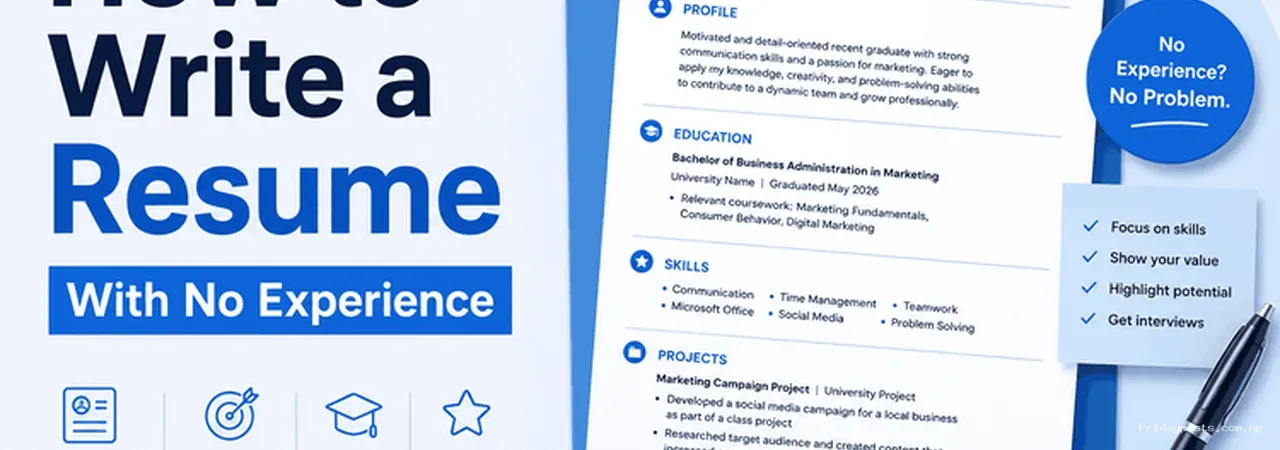
A complete sample CV for an entry-level Nigerian applicant
The following is a fictional illustration. The identity, school, projects and experience are invented for teaching purposes. Replace every detail with your verified information; do not copy the achievements as though they are yours.
ADA OKAFOR Enugu, Nigeria | +234 [your number] | [professional email] | [portfolio link]
PROFILE Business Administration graduate with practical experience in classroom record-keeping, event coordination and spreadsheet-based reporting through NYSC and personal projects. Seeking an entry-level administrative or operations support position.
CORE SKILLS Spreadsheet reporting | Document management | Scheduling | Written communication | Customer enquiries | Basic stock tracking
EDUCATION B.Sc. Business Administration | [University name] | [Completion year]
RELEVANT EXPERIENCE Corps Member, Administrative Support | [Organisation] | [Dates]
• Maintained routine attendance and correspondence records under supervisor guidance.
• Prepared weekly activity updates using spreadsheet templates.
• Supported scheduling for meetings and follow-up actions.
Volunteer Event Coordinator | [Student or community group] | [Dates]
• Created participant registration forms and a follow-up list for an outreach event.
• Coordinated the distribution of event information to volunteers.
SELECTED PROJECTS Sample Inventory Tracker | Microsoft Excel
• Created a fictional 40-item stock register with opening balance, purchases, issues and closing balance.
• Added formulas to flag low-stock items and summarised the results in a one-page report.
TRAINING [Course title, verified provider and completion date]
This sample works because it makes the candidate's contribution visible. It does not invent revenue growth, a managerial title or impressive but unverifiable statistics.
Write stronger achievement bullets using a simple formula
Use action + task + method + outcome where possible.
Too vague: “Responsible for social media.”
Better: “Prepared a weekly content calendar and scheduled posts for a student organisation's event announcements.”
Better with verified evidence: “Prepared and published 12 event updates over four weeks, using the group's approved content calendar.”
Too vague: “Worked with customers.”
Better: “Recorded customer enquiries, identified missing order details and referred unresolved issues to the supervisor.”
Too vague: “Good at Microsoft Excel.”
Better: “Built an expense tracker with SUMIF formulas and a monthly summary using sample transactions.”
Harvard's resume guidance recommends fact-based language, active verbs, easy-to-scan structure and evidence of results. You do not need to manufacture figures. A clear description of the output is stronger than a fake 80% improvement claim.
Make the document easy for people and software to read
Use a simple layout with clear headings and consistent spacing. One standard column is often the safest choice for automated application systems, although employers use different systems and no formatting rule guarantees passage through them.
A practical baseline is readable 10.5–12-point body text, restrained bold headings and conventional fonts. Avoid placing your most important information only in elaborate text boxes, icons or graphics. Do not use decorative progress bars for language skills or software expertise. Recruiters should be able to find your qualifications quickly on a phone or computer.
If an employer requests PDF, send PDF. If it requests Word, send Word. If it provides its own application form, complete it as instructed. Before submitting, open the saved document to make sure line breaks, bullets and links render properly.
Name your file professionally: Ada_Okafor_Admin_Assistant_CV.pdf is clearer than my_cv_final_new2.pdf.
Tailor the CV without rewriting your life history
Maintain a master document containing all genuine education, projects and work history. For each vacancy, create a tailored version. You can adjust the summary, the ordering of skills and the most relevant bullets while keeping the underlying facts unchanged.
For example, the same graduate may apply for an operations assistant role and a customer-service role. The operations version can lead with spreadsheet reports and record-keeping; the customer-service version can lead with enquiry handling, communication and resolution. Both CVs describe the same real person.
Use the language of the vacancy where it matches your experience. If the employer asks for “data entry,” do not conceal a relevant data-entry project behind an obscure title. But never insert keywords for systems you have never used or duties you did not perform.
Five mistakes that weaken a beginner's CV
First, including an enormous career objective filled with promises but no evidence. Replace it with a short, targeted summary.
Second, listing unrelated personal details. An employer needs to assess fit for the job, not receive sensitive information without a legitimate reason.
Third, copying impressive achievements from an internet template. Recruiters can ask how a result was measured. Fabricated achievements can cost you an opportunity.
Fourth, burying useful projects beneath a long list of school qualifications. If projects are your strongest evidence, place them where they can be seen.
Fifth, using the same CV for accounting, teaching, marketing, logistics and software roles. Some information stays the same, but a CV must be tailored to the work for which you are applying.
A 30-minute CV quality check
Read the job description again. In the first ten minutes, check that your summary and top skills address its main requirements. In the next ten, verify each institution, date, role, tool and outcome. In the final ten, check spelling, phone number, email, link functionality, file format and readability on a second device if possible.
Ask a trusted professional to answer one question after reading the CV: “What role do you think this person is prepared to do?” If the answer is unrelated to your target job, your document needs sharper prioritisation.
Frequently asked questions
Should a fresh graduate's CV be one page?
One page is often enough when you have limited relevant experience. Two pages may be justified if you have substantial placements, projects or publications relevant to the vacancy. Follow the employer's instructions and prioritise relevance over arbitrary length.
Can I include my NYSC place of primary assignment?
Yes. Identify the organisation and describe the tasks you actually carried out. Do not pretend the role was a permanent appointment or claim results you cannot verify.
Should I put my passport photograph on the CV?
Do not add it by default simply because an old template includes it. Provide a photograph where the employer legitimately requires one, and judge whether the request belongs to a verified recruitment process.
What if my degree is unrelated to the vacancy?
Show transferable skills and evidence from projects, volunteering, work or training. Some fields require specific regulated qualifications, so check the essential criteria rather than assuming that every role is open to any degree.
Is an online CV builder necessary?
No. A clean document created with ordinary word-processing software can be effective. What matters most is accurate content, clear structure, relevance and correct submission format.
The final test
Your CV should answer three questions within seconds: What work are you seeking? What proof do you have that you can contribute? How can an employer contact you? If it does those things clearly and truthfully, you have a stronger starting point than a document packed with empty adjectives.

A. Joshua Adedeji
A. Joshua Adedeji is a leadership strategist, organisational development consultant, author, teacher and values-driven transformation leader. He writes on leadership, strategy, governance, organisational effectiveness, business, personal development and Nigeria’s social and economic transformation, connecting ideas and current realities to practical implications for leaders, institutions, entrepreneurs and citizens. His work is shaped by a commitment to clear thinking, responsible leadership, stronger institutions and the development of people and systems capable of producing lasting impact.








Reader conversation
0 approved comments