

“Two years of experience required.” Those words can discourage someone who has just graduated, especially when the advert is labelled entry level. You cannot claim experience you do not have. But you can improve how you look for work, explain what you have already done and demonstrate that you can perform tasks employers need completed.
A first job search is rarely won by sending the same CV everywhere. It involves understanding which vacancies genuinely welcome beginners, gathering evidence from school and other settings, contacting the right people and learning from each application.
If you have recently finished university, a polytechnic or NYSC, this guide will help you build a credible route into employment without pretending that an internship, class project or volunteer role was a full-time job.
Understand what “no experience” usually means
A person may have no paid employment history and still have relevant practical exposure. Perhaps you assisted with customer records in a family shop, supervised a class during NYSC, managed an association's event budget, documented an engineering project or helped organise deliveries for a small business.
The correct distinction is between no previous formal job and no evidence of workplace-relevant skills. You may be in the first category without belonging in the second.
Employers need different things. A regulated technical role may require licences or supervised experience. A junior administrative role may chiefly require accurate records, communication, punctuality and basic software competence. An entry-level sales role may place more emphasis on handling objections, following up professionally and learning product details.
Read each vacancy carefully rather than assuming that all experience requirements mean the same thing. If a role has a firm professional licence or mandatory experience threshold, respect it. If it lists experience as preferred and you meet the underlying responsibilities, a truthful, targeted application may still be appropriate.
1. Choose a job family instead of applying for everything
Begin with three related job titles that use overlapping skills. For example:
• Operations track: administrative assistant, operations support officer, inventory assistant.
• Customer track: customer-service representative, client support assistant, sales support associate.
• Digital track: junior content assistant, social-media coordinator, digital marketing assistant.
• Research track: research assistant, monitoring assistant, data collection officer.
The names vary across Nigerian employers and industries, so study actual descriptions. A university graduate should not dismiss a legitimate trainee role if it offers responsible supervision and a path to develop skills. Equally, an advertised “graduate trainee” programme is not automatically the right fit; examine duties, pay, location and selection conditions.
Create a shortlist of 15 to 20 roles. Identify the five skills that appear most often. Those skills should influence what you learn, what projects you create and what achievements you place near the top of your CV.
2. Translate NYSC, volunteering and school projects into work evidence
An employer does not need your life story. They need a concrete example of what you did. Try this structure: action + responsibility + tool or method + result.
Instead of “Participated in NYSC community service,” write: “Coordinated volunteer registration and prepared attendance records for a community outreach event.” If accurate and documented, add scope: “for 35 participants.”
Instead of “Was a class representative,” write: “Collected student questions, coordinated timetable updates and communicated changes between lecturers and classmates.”
Instead of “Did a final-year project,” write: “Analysed survey responses using spreadsheets and presented recommendations in a final-year research report.”
These are examples of honest wording, not facts about a particular graduate. Never invent participant numbers, improvement percentages or management authority. If you only observed a process, do not describe yourself as the person who led it.
For a family business, you can name it as informal or part-time experience if you genuinely performed the work. For volunteer activity, label it accordingly. The credibility of a first CV depends on precision.
3. Build one convincing sample of the job you want
If you want to work in customer support, prepare three sample responses to realistic enquiries: a late delivery, a refund request and an unclear payment. Explain how you would document, escalate and resolve each case.
If you want an administrative job, create a fictitious office expense tracker, meeting minutes and a stock register. If you want a research role, design a small public-information review, explain where the data came from and show a clear chart. If you want an entry-level design role, show a before-and-after redesign and describe your choices.
Keep samples professional. Remove personal data. Use fabricated names and transactions or legitimately public information. Label a sample as a demonstration project so readers do not mistake it for client work.
A short portfolio can separate a candidate who lists “Microsoft Excel” from one who shows a clean workbook with formulas, validation and understandable output. It will not replace qualifications a role legally requires, but it helps a recruiter judge what you can actually do.
4. Write a CV that matches the vacancy
Your CV should help a busy recruiter locate your relevant information quickly. Begin with your name, reachable phone number, professional email, location at city/state level if useful, and an appropriate portfolio or LinkedIn URL.
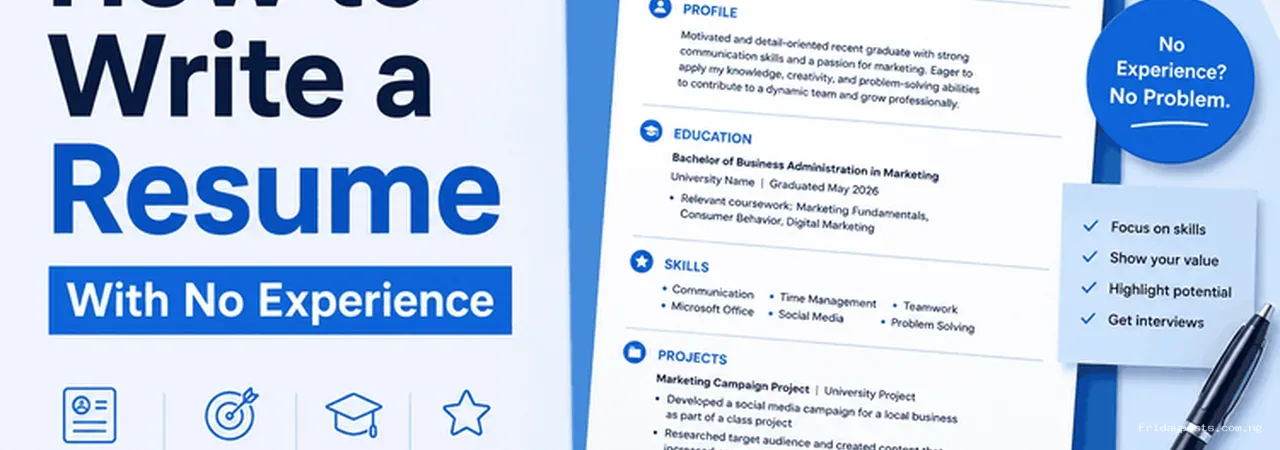
After that, choose the order that best proves your fit: a brief professional summary, relevant skills, education, projects and experience. A graduate with strong project work can place projects ahead of unrelated temporary jobs. Keep the structure clean, use clear headings and give examples under each role or project.
Harvard's guide to creating a strong resume recommends specific, active, factual language and warns against unclear formatting, spelling mistakes and descriptions that fail to show results. Adapt its principles to the employer and country: the main idea is clarity and evidence, not copying a foreign template without thought.
Do not include unnecessary sensitive information merely because an old template contains fields for it. Photos, date of birth, marital status and identity numbers are usually unrelated to performance; provide particulars only where legitimately required by the application process. Save the file under an intelligible name such as Ada_Okafor_Operations_Assistant_CV.pdf.
5. Look beyond crowded public job adverts
Job boards are one channel, not your entire strategy. Check legitimate employers' careers pages, professional associations, alumni networks, university placement offices, graduate programmes and local business groups.
The Nigerian government's National Electronic Labour Exchange (NELEX) offers job-search and matching functions. The LEEP Jobs portal describes itself as an official federal labour platform. These are verified examples of channels graduates can inspect, not endorsements of any specific vacancy or promises of employment. Check application dates and validate the employing organisation.
Also look at organisations that may not regularly advertise nationally: established schools, distribution companies, professional service firms, clinics, manufacturing businesses, logistics providers and social enterprises. A smaller organisation may offer useful early responsibility, provided the role is safe, fairly described and properly supervised.
6. Make a short, specific introduction
Not every professional contact is a job vacancy. The first purpose of an introduction is often information. You might send this message to an alumnus or a professional who has publicly welcomed career questions:
“Good afternoon. I recently completed NYSC and am pursuing entry-level operations roles. I've worked with stock records and built a sample inventory tracker. May I ask what skills or tasks are most important for beginners in your field? I'd appreciate one or two pointers.”
This is more respectful than forwarding a large CV with “Please find work for me.” If someone offers to review your CV, send the version relevant to their sector and thank them. Do not repeatedly message people who do not respond.
Where a vacancy is publicly advertised, follow the specified recruitment process. A personal connection should inform or support a legitimate application, not bypass safeguards or demand special treatment.
7. Apply with a repeatable weekly system
Try dividing your search week into research, applications, skill development and reflection. For example:
ActivityIllustrative weekly plan Review targeted vacancies12–15 adverts Send carefully matched applications6–8 applications Produce or improve a work sample1 project session Request career information3–5 respectful contacts Practise an interview or assessment2 sessions Update application tracker1 review These are manageable example targets, not recruitment statistics or guarantees. A technical assignment may take hours, while a simple office application may take less time. Quality matters more than an impressive count.
For each application, note where you found the vacancy, which qualifications match, what you submitted and when to follow up. If a recruiter specifies no follow-up, respect that instruction. If the deadline passes without an answer, do not assume you have been rejected immediately; recruitment timelines vary.
8. Consider internships, apprenticeships and contract work carefully
A legitimate short-term role can provide supervision, experience and a clearer career direction. Before accepting, ask what tasks you will perform, who will supervise you, whether there is remuneration, what your working hours are and whether written terms will be provided.
An apprenticeship in a small accounting office might teach invoice processing and reconciliations. A short contract helping an NGO organise participant records might develop documentation skills. A retail support role could improve customer communication and inventory discipline.
However, do not confuse “exposure” with an open-ended demand for free labour. An unpaid role that requires full-time output, offers no mentorship and makes vague promises of future employment deserves close scrutiny. Balance the opportunity against transport, feeding, rent and the income you would forgo.
9. Show the skills employers can observe
An employer cannot assess “hardworking” from a CV adjective. They can assess how clearly you write, whether you arrive prepared, whether your sample is accurate and how you respond to feedback.
The National Association of Colleges and Employers identifies communication, critical thinking, teamwork, professionalism and technology among career-readiness competencies. Its framework is international rather than a Nigeria-only hiring study, but these are useful areas in which any applicant can produce visible evidence.
In an interview, describe a time you noticed a problem, gathered information, chose an action and learned from the result. Prepare honest examples from classes, personal projects and service responsibilities. Where your experience is limited, show curiosity and a credible learning plan rather than claiming expert status.
10. Protect your money and identity
Desperation makes jobseekers vulnerable to fraud. The Nigerian Federal Ministry of Information's employment warning cautions against fraudulent government recruitment messages and payment demands. Use the authorised agency or employer's official website to verify announcements.
Avoid sending bank credentials, verification codes, passport data or identity numbers to an unverified recruiter. Do not pay a person to “activate” an interview or “reserve” a job slot. A recruitment advert that exists only as a forwarded flyer should trigger independent verification.
When a first job is not immediate
Sometimes the problem is not effort. Opportunities may be limited in your area or your chosen field may require a longer development period. Consider nearby roles where your skills transfer, explore remote opportunities only after confirming the employer, and build income around a service you can perform safely and reliably. Keep assessing which route produces genuine progress.
Do not disguise months of learning as employment. You can describe the period plainly: “Completed training in spreadsheet reporting and developed three practical projects while applying for operations roles.” That is more convincing than an invented appointment.
Frequently asked questions
Can I apply when the advert asks for one year of experience?
If the requirement is described as preferred and you satisfy most essential duties, a truthful application may be worthwhile. If it is legally mandatory or clearly non-negotiable, focus on trainee or junior alternatives.
Does NYSC count as work experience?
Relevant tasks performed during NYSC can be described as experience, with the placement and dates labelled accurately. Whether an employer counts it towards a formal experience requirement depends on its policy and the work involved.
Must I know someone before I can get a job in Nigeria?
No. Professional connections can help you discover information and opportunities, but many employers use open recruitment processes. Build legitimate relationships and submit credible applications through authorised channels.
Should I work for free to gain experience?
Not automatically. Consider whether the arrangement is lawful, financially sustainable, time-limited and genuinely educational. Favour structured opportunities with defined supervision and reasonable terms.
How long should I keep applying before changing strategy?
Review your evidence every few weeks. No responses may indicate a targeting or CV problem; interviews without offers may indicate a preparation gap. Change the part of the process that the evidence points to, rather than abandoning your goal solely because progress is slow.
Start this week
Select three related job titles, analyse ten adverts, rewrite two truthful project descriptions and create one small work sample. Apply to roles you can explain clearly. Your first job search becomes more effective when an employer can see what you can contribute, even before you have a long employment history.

A. Joshua Adedeji
A. Joshua Adedeji is a leadership strategist, organisational development consultant, author, teacher and values-driven transformation leader. He writes on leadership, strategy, governance, organisational effectiveness, business, personal development and Nigeria’s social and economic transformation, connecting ideas and current realities to practical implications for leaders, institutions, entrepreneurs and citizens. His work is shaped by a commitment to clear thinking, responsible leadership, stronger institutions and the development of people and systems capable of producing lasting impact.










Reader conversation
0 approved comments