
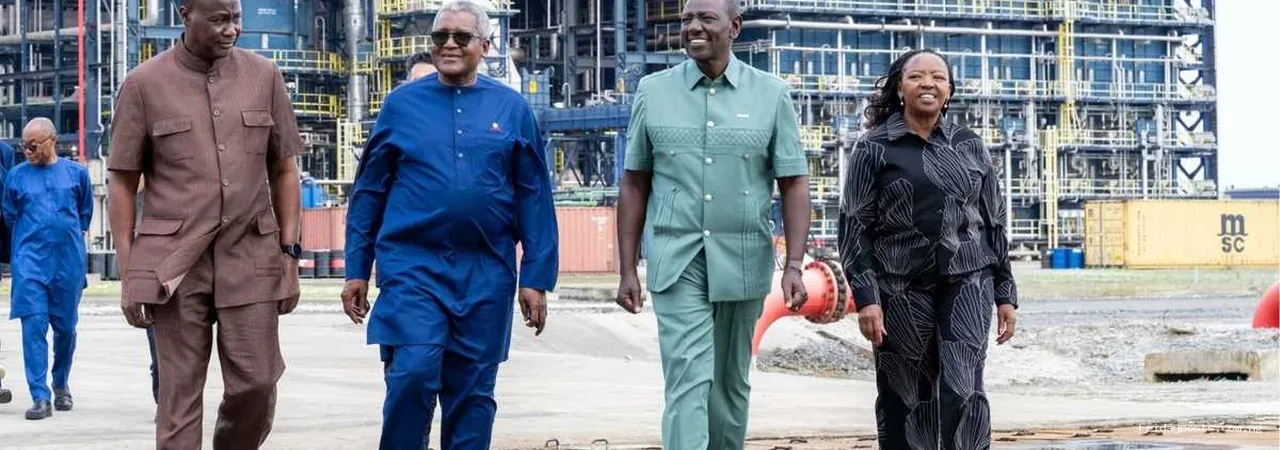
For much of Nigeria’s economic history, the dominant continental story has been about foreign capital coming into Nigeria.
Today, another story deserves attention: Nigerian capital going out.
Dangote Group has broken ground on a planned $16 billion refinery in Lamu, Kenya. Reuters reports that the project is designed for about 700,000 barrels of crude oil per day and is intended to serve East African demand for petrol, diesel, jet fuel and related products. The project is planned for completion around 2030, although financing, crude supply, infrastructure, environmental approvals and a legal dispute over land remain material risks.
Those details matter. Yet the more interesting question for FridayPosts is bigger than the refinery.
What does it mean when a Nigerian industrial group attempts one of the largest private industrial investments ever proposed in East Africa? Can Nigerian capital become as comfortable building across Africa as South African banks, European consumer companies or Chinese infrastructure firms have been? And what would have to change for Dangote to become less of an exception and more of a pattern?
The project is enormous even by refinery standards
A $16 billion project is not an ordinary foreign investment.
A refinery designed to process 700,000 barrels a day would be larger than the current capacity of most individual African refineries. Dangote’s Lagos facility, which began operations after years of construction, has already changed regional fuel flows and is itself being expanded.
The Kenya project is intended to build on some of the same engineering and operating experience. Reuters reported that Honeywell would provide technologies, equipment and services, while Engineers India Limited has a major engineering contract. Regional governments have been offered a collective equity stake, and Reuters and Associated Press reported that countries in East Africa are being invited to participate.
This creates several layers of significance.
For Kenya, it is an industrial and energy-security project. For East Africa, it could alter petroleum-product trade. For Dangote Group, it is an expansion beyond its home market at extraordinary scale. For Nigeria, it is evidence that some domestic firms now possess the ambition and organisational capacity to attempt investments previously associated mainly with global multinationals.
Nigerian companies have been expanding across Africa for years
The idea of Nigerian business becoming Pan-African is not new.
Nigerian banks have operated across multiple African markets. Cement businesses have built plants outside the country. Telecoms, fintechs, entertainment companies and professional-service firms serve customers beyond Nigeria. Nigerian films and music already travel far more easily than physical goods.
What is different about the Lamu project is the capital intensity.
Opening a bank subsidiary or digital service in another African country can require substantial money and regulatory work, but a refinery creates a different level of commitment. It involves land, ports, pipelines, storage, utilities, engineering, financing, environmental approvals, community relations and decades of operation.
It is difficult to move if circumstances change.
That makes the project an important case study in what long-term Nigerian industrial capital could look like outside Nigeria.
Africa’s biggest market is not one national market
Nigerian entrepreneurs often begin with a natural advantage: a huge domestic population.
That advantage can also become a trap.
A company capable of selling to millions of Nigerians may postpone the more difficult work of entering other markets. Each African country has different regulators, tax rules, consumer habits, currencies, logistics systems and political risks.
The African Continental Free Trade Area is intended to reduce some barriers, but it does not eliminate national borders or local business realities.
A genuinely Pan-African company must therefore learn to think differently. It needs regional strategy, local management, cross-border financing, risk management and the patience to build relationships with governments and communities.
The Dangote model has often followed that logic through cement plants and industrial assets in multiple countries. The Kenya refinery takes the approach to a larger scale.
The refinery is also a test of regional demand
A large refinery only makes economic sense if there is a large and reliable market for its products.
East Africa imports significant quantities of refined petroleum products. Kenya is a major logistics hub for the region, while landlocked neighbours depend on corridors to access fuel.
A refinery at Lamu could therefore serve more than Kenya. It could supply regional markets if pricing, logistics and crude supply are competitive.
But the word “could” matters.
A refinery is not automatically profitable because a region imports fuel. The plant must compete with existing global suppliers. It must source crude efficiently. It needs ports and pipelines. It must operate at high utilisation rates. Regional demand can change as electric mobility, efficiency and energy policy evolve.
The business case should therefore be judged on execution, not the size of the announcement.
The land dispute is not a side issue
The project already faces a legal challenge.
Residents have gone to court over land rights and the environmental process. A Kenyan court ordered the status quo to be maintained on disputed areas pending further proceedings, even as the ceremonial groundbreaking went ahead.
This is not merely an obstacle for lawyers to remove.
Large infrastructure projects create winners and losers. They affect land, livelihoods, ecosystems, communities and local expectations. A project that is economically impressive can still fail socially if affected people believe they were ignored.
African industrialisation will require faster approvals and more investment, but speed cannot become an excuse for weak consultation or unclear land rights.
The Lamu project will therefore test not only Dangote’s engineering capacity but also its ability to manage community legitimacy in another country.
Environmental questions will become harder, not easier
A refinery is a long-lived fossil-fuel asset being built at a time when the world is also trying to reduce carbon emissions.
Supporters will argue that East Africa still needs reliable transport fuels, aviation fuel and petrochemicals, and that local refining can reduce import dependence and keep more value within Africa.
Critics will question whether $16 billion should be committed to petroleum infrastructure as electric vehicles and climate policy advance globally. They will also focus on local emissions, marine risks and the proximity of Lamu’s cultural and environmental assets.
Both arguments deserve serious treatment.
Africa has a legitimate development need for energy and industrial capacity. It also faces climate vulnerability and cannot ignore the direction of global technology.
The commercial answer may depend on whether the facility can remain competitive under tighter environmental standards and whether it is designed with cleaner technologies and future flexibility.
Nigerian capital abroad should not be confused with Nigerian national policy
It is tempting to celebrate every Nigerian-owned investment abroad as though it were automatically a national achievement.
The distinction matters.
Dangote Group is a private corporate group making a commercial investment. Its shareholders, lenders and partners bear risk. Kenya will host the asset and collect much of the direct employment, tax and industrial spillover.
Nigeria may still benefit through corporate expertise, supply chains, professional services, reputation and potentially financial returns, but the project is not the same thing as a Nigerian government investment.
This distinction makes the story more interesting, not less.
A mature economy produces companies capable of investing abroad for commercial reasons. Their success expands the country’s business influence without requiring government ownership.
What does Nigeria gain when its companies internationalise?
The gains can take several forms.
First is knowledge. Managers who build and operate across different markets develop capabilities that can later improve domestic businesses.
Second is revenue. Profitable foreign subsidiaries can generate dividends and foreign-currency earnings.
Third is professional opportunity. Nigerian engineers, lawyers, bankers, consultants, project managers and technology providers can participate in cross-border projects.
Fourth is reputation. Successful companies can make it easier for other Nigerian firms to be taken seriously by investors and governments.
Fifth is resilience. A company earning from several countries is less exposed to one national economic cycle.
These benefits are not automatic. A foreign expansion can also lose money and weaken the parent business. Internationalisation is valuable only when management discipline travels with ambition.
Nigeria should learn from its banks
Banking offers one of the clearest examples of Nigerian business expansion across Africa.
Several Nigerian banks built subsidiaries in West, East and Southern Africa, often following Nigerian corporate clients and seeking new retail markets.
The experience has been mixed. Some subsidiaries became important businesses. Others required restructuring or faced difficult regulatory environments.
The lesson is that geographic expansion is not a strategy by itself.
A company must understand why it has an advantage in another market. Is it lower cost? Better technology? Stronger distribution? Sector expertise? Access to capital? A brand that travels?
Dangote’s advantage in Kenya would have to come from scale, refinery operating knowledge, procurement power and the ability to organise capital-intensive projects.
Other Nigerian firms need to identify their own transferable advantages.
AfCFTA creates opportunity, but companies still have to execute
AfCFTA has raised expectations that African companies will trade more with one another.
That is necessary, but trade agreements alone do not create continental champions.
Companies need ports that work, roads, interoperable payments, access to trade finance, predictable customs procedures and standards that are recognised across borders. They also need information about markets.
Nigeria should treat the success of its outward-investing companies as an argument for improving these systems.
A Nigerian manufacturer that wants to sell in Ghana, Kenya or Rwanda should not need the resources of a billionaire to understand rules, move goods or receive payment.
If continental expansion remains feasible only for the largest groups, AfCFTA will not fulfil its broadest promise.
Nigeria needs more outward foreign direct investment data
Public discussion usually focuses on foreign direct investment coming into Nigeria.
Government should pay equal attention to outward investment.
How much are Nigerian companies investing abroad each year? In which sectors? Which countries attract them? What returns do they earn? How many professional jobs and supply-chain opportunities are linked to those investments?
Better data would help Nigeria understand whether its firms are truly internationalising or whether a small number of large groups dominate the story.
It would also allow policymakers to identify barriers that smaller companies face when expanding.
The next Pan-African champions may be digital
The Dangote refinery is a physical symbol of expansion because it is large and visible.
But some of Nigeria’s most scalable continental companies may require far less concrete.
Fintechs can enter markets digitally. Software companies can sell across borders. Creative businesses can distribute music and film globally. Education platforms, logistics technology, professional services and business outsourcing can earn foreign currency without building billion-dollar plants.
Nigeria should therefore avoid defining Pan-African capital only through heavy industry.
The broader objective is to create companies whose markets, revenues and capabilities extend beyond Nigeria.
Some will build refineries. Others will build payment rails, entertainment catalogues or cloud software.
Government’s role is to make Nigerian companies credible abroad
Government should not choose corporate winners.
It can, however, improve the environment in which companies internationalise.
Diplomatic missions can provide commercial intelligence. Export-credit and development-finance institutions can support viable cross-border projects under transparent rules. Regulators can negotiate recognition frameworks with other African countries. Trade agencies can help firms understand standards and market access.
Most importantly, Nigeria must improve governance at home.
A company’s international reputation is affected by the reputation of its home business environment. Stable rules, credible courts, transparent regulation and reliable financial systems make Nigerian firms easier to finance abroad.
National competitiveness travels with companies.
Dangote’s scale should inspire ambition, not dependency
There is a recurring tendency in Nigeria to look to a small number of wealthy industrialists whenever the country discusses manufacturing.
That is understandable because large projects attract attention.
But an economy is stronger when it continually produces new companies capable of becoming large.
Nigeria needs hundreds of medium-sized manufacturers that can become regional companies, not only a few conglomerates that do everything.
This requires access to long-term finance, management capability, reliable energy, export support and markets that reward formal growth.
The success of one group should therefore be used to ask what system would allow the next fifty Nigerian companies to expand across Africa.
The Lamu refinery will ultimately be judged by execution
Groundbreaking ceremonies are beginnings, not achievements.
The project still faces financing, construction, legal, environmental, infrastructure and market risks. Its planned capacity is enormous. Its timetable is ambitious. Court proceedings over land must be resolved. Crude-supply arrangements will need to work. The economics of refining may change before 2030.
Those uncertainties should remain visible in any serious coverage.
If the refinery is completed and operates successfully, it could become a major part of East Africa’s industrial system and one of the clearest examples of Nigerian capital building at continental scale.
If it struggles, the lesson will be equally important about the risks of megaproject expansion.
The bigger question is what kind of economy Nigeria wants to produce
Countries do not become economically influential only by exporting commodities.
They become influential by producing institutions and companies that can organise capital, technology, people and markets beyond their borders.
Nigeria already exports culture. It exports professional talent. Its banks, cement companies and fintechs have travelled. The Kenya refinery suggests that industrial capital is attempting to travel at a larger scale too.
That is worth paying attention to.
The goal should not be to celebrate Nigerian ownership for its own sake. The goal should be to build an economy capable of producing competitive companies that solve real problems wherever they operate.
If more Nigerian companies learn to think in continental markets, Nigerian business will become less dependent on the size of Nigeria alone.
Dangote’s $16 billion bet in Kenya is therefore about more than one refinery.
It is a test of whether Nigerian corporate ambition can increasingly become African corporate capacity.
Sources and further reading
- Reuters, 30 September 2026: Dangote breaks ground on $16bn East African refinery in Kenya (https://www.reuters.com/business/energy/dangote-begin-construction-16-billion-east-africa-refinery-kenya-2026-09-30/)
- Reuters, 30 September 2026: Honeywell to help build Dangote’s Kenyan refinery (https://www.reuters.com/business/energy/honeywell-help-build-dangotes-new-kenyan-mega-refinery-2026-09-30/)
- Reuters, 29 September 2026: Kenya court ruling and Lamu site activities (https://www.reuters.com/business/energy/dangote-says-kenya-court-ruling-wont-halt-refinery-launch-may-affect-site-2026-09-29/)
- Associated Press, 30 September 2026: African-led investment and regional equity participation (https://apnews.com/article/a349155eae5beb15ab17813ae835ba83)
- Financial Times, 30 September 2026: land dispute and court order (https://www.ft.com/content/5bb621fa-2c18-4384-80ab-4a72e51b139a)

A. Joshua Adedeji
A. Joshua Adedeji is a leadership strategist, organisational development consultant, author, teacher and values-driven transformation leader. He writes on leadership, strategy, governance, organisational effectiveness, business, personal development and Nigeria’s social and economic transformation, connecting ideas and current realities to practical implications for leaders, institutions, entrepreneurs and citizens. His work is shaped by a commitment to clear thinking, responsible leadership, stronger institutions and the development of people and systems capable of producing lasting impact.










Reader conversation
0 approved comments