
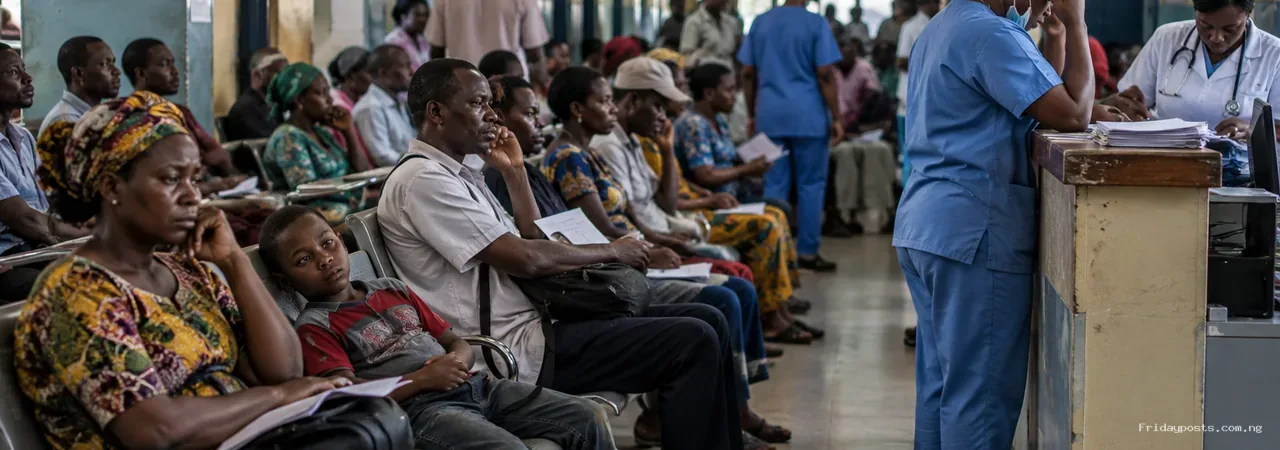
A long hospital queue is a workforce equation made visible
A patient who waits several hours to see a doctor experiences the health system as a queue. Behind that queue is an arithmetic problem: too many people needing care, too few professionals available at the same time and processes that make each visit take longer than necessary.
The Guardian reported in September that patients at several Lagos public hospitals were spending long periods moving from registration and payment to consultation and pharmacy queues. Doctors were working, but patient volumes frequently exceeded the staff available.
The same report came weeks after Governor Babajide Sanwo-Olu said Lagos had about 7,000 doctors and needed roughly 40,000 more, as well as about 40,000 additional nurses. He also put the health-sector funding gap at at least N100 billion above existing allocations.
Lagos has a demand problem and a supply problem at the same time
Lagos is a large, densely populated economic centre that attracts residents and workers from across Nigeria and West Africa. Public hospitals therefore serve both a very large population and complex referral cases.
Demand also rises when more people gain insurance or become willing to seek formal care. Sanwo-Olu said more than 1.5 million residents had enrolled in Ilera Eko, the state health insurance scheme. Expanded coverage is positive, but insurance only improves access fully when doctors, nurses, diagnostics and medicines expand with it.
The result can be a paradox: policy succeeds in bringing more patients into the system while the service experience worsens because supply has not grown quickly enough.
The shortage is partly about retention, not only training
Nigeria trains doctors and nurses, but health workers can move. Some migrate abroad. Others leave government hospitals for private employers, federal institutions or different states where pay, equipment, housing or working conditions are better.
The Association of Resident Doctors at LASUTH told The Guardian that resignations and migration were increasing pressure on the professionals who remained. When one doctor leaves, the effect is not limited to a vacancy on an organisation chart. Patients are redistributed to fewer clinicians and on-call schedules become heavier.
This creates a feedback loop. Poor staffing increases burnout, burnout makes the job less attractive and further departures deepen the shortage.
More recruitment will fail if the job itself remains unattractive
A government can announce hundreds of vacancies, but recruitment succeeds only if qualified people apply and stay. Salary is one factor, but it is not the whole employment proposition.
Doctors and nurses also assess workload, call frequency, safety, equipment, professional development, housing, commute time, management quality and whether the hospital has enough colleagues to provide safe coverage.
Retention policy therefore has to be designed as a package. Replacing workers without improving the conditions that made them leave simply converts the health ministry into a permanent recruitment agency.
Hospitals also need process reform
Not every hour spent in a hospital queue is caused directly by a doctor shortage. Patients may wait for registration, records, payments, laboratory services or medicines before and after consultation.
Digital records, appointment systems, better queue management and integrated payment processes can reduce administrative delay. They cannot create doctors, but they can prevent scarce clinical time from being wasted by avoidable process failures.
The distinction matters because building more hospitals without redesigning patient flow can reproduce the same queues in newer buildings.
Primary healthcare should absorb more routine demand
A teaching hospital or general hospital should not be the first destination for every minor illness, prescription refill or routine follow-up. Strong primary healthcare centres can treat common conditions, manage chronic disease and refer patients who genuinely require specialist care.
When primary care is weak or distrusted, patients bypass it and crowd higher-level facilities. That raises waiting times and forces specialists to handle cases that could have been managed closer to home.
Lagos therefore needs to think about the health workforce as a network, not simply the number of doctors in major hospitals. Staffing community facilities, improving referral systems and connecting records can redistribute demand more intelligently.
Technology can extend capacity, but it cannot replace clinical staff
Telemedicine, electronic records and decision-support tools can reduce unnecessary travel, improve follow-up and help professionals work more efficiently. Digital systems can also support appointment triage and remote specialist advice.
But technology does not eliminate the need for clinicians. A patient who needs examination, surgery, emergency care or bedside nursing still requires trained people in the right place.
The realistic objective is to use technology to increase the productivity of the workforce and remove administrative friction, not to treat software as a substitute for staffing.
The funding question cannot be avoided
A workforce expansion of the scale described by the Lagos governor has recurring costs. Salaries, pensions, training, equipment, facility maintenance and medicines have to be financed every year, not just during a recruitment campaign.
This is why health insurance, government budgets and efficient purchasing all matter. A system that hires workers without dependable operating funds risks creating unpaid obligations or under-equipped facilities.
The Federal Ministry of Health has also acknowledged the wider African health-workforce financing problem and the need for investment, policy and accountability. Lagos is a particularly visible case of a national and continental challenge.
The right target is shorter, safer access to care
Lagos should not measure success only by how many doctors are added to the payroll. The citizen-facing measures are more concrete: waiting time, consultation time, emergency response, staff-to-patient ratios, vacancy rates, retention, referral completion and health outcomes.
Publishing those indicators by facility would help distinguish hospitals facing exceptional demand from those suffering primarily from staffing or process failures.
The queues now visible in public hospitals are not merely an inconvenience. They are information. They show where capacity, retention and workflow are failing to keep pace with demand. The lasting solution will combine more health workers with better jobs, stronger primary care, smarter processes and sustainable financing.










Reader conversation
0 approved comments