
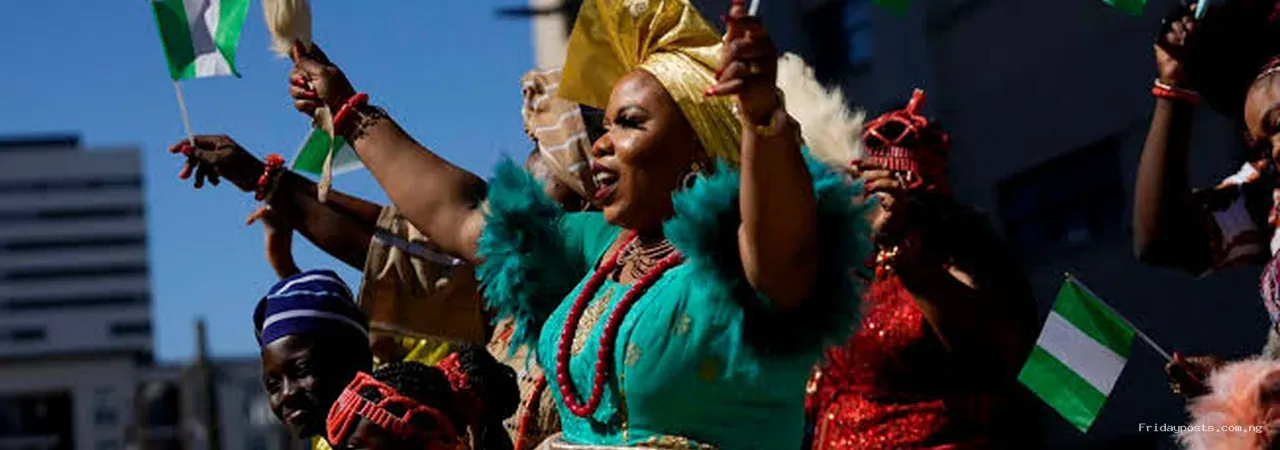
Nigeria will be 66 years independent on 1 October 2026.
Anniversaries tend to produce two competing stories. One is celebratory: Nigeria has survived a civil war, military rule, economic crises and political upheavals while producing globally recognised people, businesses, culture and institutions. The other is disappointed: after 66 years, electricity is still unreliable, poverty remains widespread, public services are weak and too many Nigerians feel the country has not converted its enormous resources into broad prosperity.
Both stories contain truth. Neither is complete.
A better way to examine 66 years is to ask what actually changed. Numbers cannot explain everything, and historical datasets are not always perfectly comparable, but they can discipline nostalgia and disappointment alike.
Here are ten numbers that help tell Nigeria’s story from independence to 2026.
1. Population: about 45 million in 1960, about 238 million by 2025
Population may be the single most important number for understanding modern Nigeria.
World Bank population estimates put Nigeria at roughly 45 million people in 1960. United Nations data put the 2025 population at about 237.5 million.
That means the country has grown to more than five times its independence-era population.
This is both an asset and a burden.
A larger population creates a larger domestic market, a bigger labour force, more entrepreneurs, more consumers and greater geopolitical weight. It helps explain why international companies pay attention to Nigeria and why a successful Nigerian product can achieve scale quickly.
But population growth also multiplies every public-service challenge.
Government does not need merely to build more schools than in 1960. It needs enough schools for hundreds of millions of people. Housing, roads, hospitals, water, jobs and electricity must expand faster than the population if living standards are to improve.
The lesson is simple: population size is not development. It is development potential.
2. Urbanisation: 15.4 per cent in 1960, more than half the population today
In 1960, Nigeria was overwhelmingly rural. World Bank material based on United Nations urbanisation data puts the urban share at about 15.4 per cent.
By 2022, it had reached about 55.6 per cent.
That change is visible everywhere.
Lagos has become a megacity. Abuja, which did not exist as the national capital in 1960, is now a major urban economy. Cities such as Kano, Port Harcourt, Ibadan, Enugu and Benin have expanded dramatically, while smaller cities are growing into larger metropolitan areas.
Urbanisation can increase productivity because people and firms are closer to markets, services, skills and infrastructure.
But unmanaged urbanisation produces congestion, informal housing, flooding, waste problems, expensive rents and pressure on transport.
Nigeria has urbanised faster than many of its cities have been planned.
The next phase of national development will therefore depend heavily on whether states and local governments can make cities productive rather than merely crowded.
3. GDP: roughly $3 billion in 1960, about $375 billion in 2025
A World Bank historical report estimated Nigeria’s 1960 gross domestic product at around £1.1 billion, equivalent at the time to about $3 billion.
UN Data puts 2025 GDP at roughly $375 billion in current US dollars.
The difference is enormous, but it requires caution.
A dollar in 1960 is not equal in purchasing power to a dollar in 2025. Exchange rates, inflation, statistical methods and the structure of the economy have changed. Current-dollar GDP is therefore not a clean measure of how many times richer Nigeria has become.
What the comparison does show is scale.
Nigeria has moved from an economy dominated by agriculture and a small modern sector into a much larger economy containing banking, telecommunications, technology, entertainment, oil and gas, modern retail, aviation and professional services.
The unresolved issue is not whether the economy became bigger.
It is whether economic growth became sufficiently productive and inclusive for the average Nigerian.
4. GDP per person: about $84 in 1960 and $1,646 in 2025, but the comparison is deceptive
The same historical World Bank document put GDP per capita around independence at roughly $84 in contemporary dollars. UN Data reports approximately $1,646 for 2025.
Again, direct comparison across 65 years of inflation and exchange-rate change is misleading if treated as a measure of real welfare.
The more useful lesson is that national output has not risen fast enough, consistently enough, relative to Nigeria’s rapidly expanding population to create the level of prosperity many Nigerians expect.
GDP per capita is a reminder that the size of an economy and the prosperity of its people are different questions.
Nigeria can be one of Africa’s largest economies while millions of citizens still experience low income, weak services and economic insecurity.
The development goal should therefore not be to become a larger economy on paper. It should be to raise real output per person over long periods.
5. Life expectancy: about 37 years in 1960, roughly 55 years in 2024
World Bank data put Nigerian life expectancy at birth at about 37.2 years in 1960.
By 2024, the figure was about 54.6 years.
An increase of more than 17 years is meaningful. It reflects improvements over time in medicine, vaccination, disease control, maternal and child health, sanitation, knowledge and living conditions.
Yet the present number remains low by global standards.
The progress therefore tells two stories at once.
Nigeria has made real advances in keeping people alive longer than at independence. But preventable disease, maternal mortality, infectious disease, cardiovascular conditions, malnutrition and weak access to quality healthcare continue to shorten lives.
National development should ultimately appear in human outcomes. Longer, healthier lives are among the clearest.
6. Electricity access: 62.5 per cent in 2024
There is no perfectly comparable nationwide electricity-access statistic from independence that can be placed beside today’s number.
The modern figure is still revealing.
World Bank data say about 62.5 per cent of Nigerians had access to electricity in 2024.
That means electricity has reached a majority of the population, something far beyond the scale of the early post-independence grid.
But access does not mean reliability.
A household counted as connected may receive limited supply. A factory may be technically connected while spending heavily on diesel, gas or solar backup. Rural communities may be connected through different quality levels of service.
This is one of the most important lessons of Nigeria’s development statistics: quantity and quality are different.
The next electricity milestone should not only be a higher access percentage. It should be reliable, affordable power that households and businesses can actually plan around.
7. Internet: 157.3 million mobile internet subscriptions by July 2026
Nothing illustrates Nigeria’s transformation more dramatically than telecommunications.
There was, of course, no public internet economy in 1960.
By July 2026, the Nigerian Communications Commission reported about 157.3 million active mobile internet subscriptions and more than 124.4 million broadband subscriptions.
These are subscriptions, not unique individual Nigerians, so they should not be read as a count of separate people.
Even with that qualification, the change is extraordinary.
Banking, media, music, retail, education, government services, work and social life increasingly operate through networks that did not exist for most of Nigeria’s history.
The mobile phone has become financial infrastructure, media platform, office, classroom and marketplace.
Digital connectivity may be one of the strongest examples of what happens when technology, regulation, investment and consumer demand align.
The next challenge is quality, affordability, digital skills and extending high-speed connectivity to underserved communities.
8. Government structure: from three regions at independence to 36 states and the FCT
Nigeria’s federal structure has changed repeatedly.
At independence, the federation was organised around three large regions: Northern, Western and Eastern. A Mid-Western Region followed in 1963, and subsequent military governments created states in several rounds.
Today, the Constitution provides for 36 states and the Federal Capital Territory. It lists 768 local government areas in the states and six area councils in the FCT, giving the familiar national total of 774 local government-level units.
The expansion brought government closer geographically to many communities and responded to demands for representation.
It also created a larger administrative state.
Nigeria now supports federal, state and local political and bureaucratic structures on a scale unimaginable in 1960.
The unresolved question is whether this larger structure consistently delivers better services.
Creating more units of government is not the same thing as creating more capable government.
9. Democracy: seven successive general elections from 1999 to 2023
Nigeria’s post-independence political history was interrupted repeatedly by military rule.
That makes the democratic period since 1999 significant.
INEC described the 2023 general election as Nigeria’s seventh successive general election since the return to civilian rule on 29 May 1999.
By October 2026, Nigeria has therefore experienced more than 27 years of uninterrupted civilian government.
Continuity alone does not settle questions about election quality, representation, accountability or government performance. Those remain contested and should be judged with evidence.
But the durability of the constitutional order is itself a major historical change.
A generation of Nigerians has now grown into adulthood without experiencing a military government.
The next democratic challenge is not merely to avoid coups. It is to deepen confidence that votes count, institutions are independent, leaders can be held accountable and government changes can occur peacefully.
10. Exports: from groundnuts, cocoa and palm products to an oil-dominated trade structure
Nigeria’s trade structure has changed dramatically since independence.
A World Bank historical report on the early 1960s shows a diversified agricultural export base. In 1962, groundnuts and related products represented about 24 per cent of exports, cocoa about 20 per cent and palm products about 15 per cent. Petroleum accounted for roughly 10 per cent.
That structure later reversed.
Oil became the dominant source of export earnings and government foreign exchange for decades. Even in 2026, National Bureau of Statistics trade reporting shows crude oil remaining the largest single export category.
Oil transformed Nigeria’s public finances and foreign-exchange earnings.
It also created concentration risk.
The country moved away from a broader commodity export mix without building enough manufacturing and non-oil exports to replace the lost diversity.
One of the central economic tasks of the next 34 years before Nigeria turns 100 is therefore to make the export basket broader again, this time through processed agriculture, manufacturing, technology, services and intellectual property.
The numbers show genuine progress and unfinished development
It is possible to read these ten numbers selectively.
An optimist can point to a population five times larger, longer lives, mass internet access, a much bigger economy, wider electricity access and nearly three decades of civilian government.
A pessimist can point to low life expectancy, unreliable power, weak income per person, urban stress and continued dependence on crude oil.
A serious national assessment has to hold both sets of facts together.
Development is not measured by whether a country changed. Every country changes over 66 years.
The question is whether the change created sufficient capability, prosperity, security and opportunity for citizens.
Nigeria’s greatest achievement may be survival, but survival cannot be the next ambition
Nigeria has passed through a civil war, military governments, oil booms and crashes, debt crises, structural adjustment, banking crises, insurgency, constitutional transitions and repeated economic shocks.
The federation remains intact.
That matters.
But national survival is a foundation, not a final development objective.
A 66-year-old country should now be judged by the strength of its institutions, productivity of its people, quality of its infrastructure and opportunities available to a child regardless of where that child is born.
The country’s size gives it possibilities that many nations do not possess.
Its population is large enough to support significant industries. Its diaspora is globally connected. Its culture travels. Its entrepreneurs repeatedly build around infrastructure constraints. Its geographic and resource base is substantial.
The development failure is not lack of potential. It is inconsistent conversion of potential into systems that work.
The next numbers should matter more than the anniversary slogans
By Nigeria’s 70th anniversary in 2030, citizens should be able to ask specific questions.
Has life expectancy moved meaningfully upward?
Has electricity access approached universality, with better reliability?
Has GDP per capita risen in real terms?
Has learning poverty fallen?
Are non-oil exports growing faster?
Are more Nigerians using high-speed broadband productively?
Are cities becoming easier to live and work in?
Are democratic institutions earning more trust?
Those questions turn Independence Day from nostalgia into accountability.
The best use of national history is not to prove that everything is better or that everything is worse.
It is to establish a baseline for the future.
Nigeria at 66 is larger, more urban, more connected, more complex and institutionally different from Nigeria at independence. The next task is much harder: to make those changes translate into a country where a larger share of citizens can live longer, earn more, trust institutions and build productive lives.
That is the number that ultimately matters, even if no single dataset can capture it.
Sources and further reading
- Federal Ministry of Information, September 2026: Nigeria’s 66th Independence anniversary (https://fmino.gov.ng/fg-inaugurates-inter-ministerial-committee-on-nigerias-66th-independence-day-celebration/)
- UN Data: Nigeria country profile, population and economic indicators (https://data.un.org/en/iso/NG.html)
- World Bank DataBank: Nigeria population estimates and projections (https://databank.worldbank.org/Nigerian-population/id/ad9a3ed7)
- World Bank: Nigeria urban population data (https://data.worldbank.org/indicator/SP.URB.TOTL.IN.ZS?locations=NG)
- World Bank: Nigeria country data, including electricity access (https://data.worldbank.org/country/nigeria)
- World Bank WDI/FRED: Nigeria life expectancy series (https://fred.stlouisfed.org/data/SPDYNLE00INNGA)
- NCC: Nigeria telecommunications industry statistics (https://ncc.gov.ng/market-data-reports/industry-statistics)
- INEC: Report of the 2023 General Election (https://inecnigeria.org/wp-content/uploads/2024/02/2023-GENERAL-ELECTION-REPORT-1.pdf)
- Senate Constitution Review: constitutional structure of 36 states and FCT (https://sccr.gov.ng/?p=121)
- World Bank historical report: Nigeria economic data around independence (https://documents1.worldbank.org/curated/en/272181468098370612/pdf/multi0page.pdf)

A. Joshua Adedeji
A. Joshua Adedeji is a leadership strategist, organisational development consultant, author, teacher and values-driven transformation leader. He writes on leadership, strategy, governance, organisational effectiveness, business, personal development and Nigeria’s social and economic transformation, connecting ideas and current realities to practical implications for leaders, institutions, entrepreneurs and citizens. His work is shaped by a commitment to clear thinking, responsible leadership, stronger institutions and the development of people and systems capable of producing lasting impact.









Reader conversation
0 approved comments