
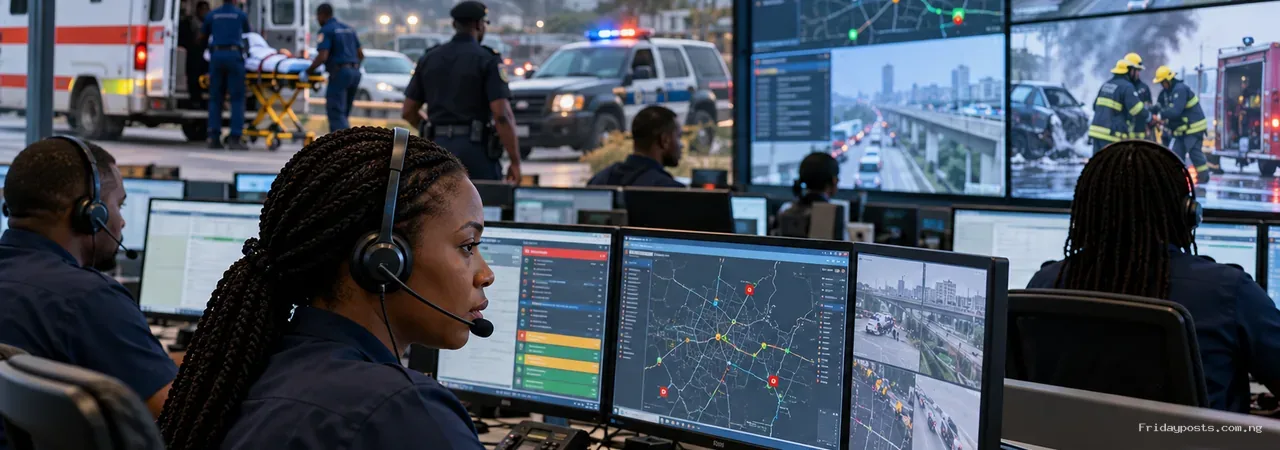
One number is easier to remember. That does not make emergency response easy
Nigeria's decision to standardise 112 as a national emergency number solves a basic communication problem: in a crisis, a person should not have to search through several numbers to decide whether to call the police, fire service, road-safety officials or an ambulance.
The National Economic Council has approved 112 as the single universal toll-free emergency number, while the Federal Government has asked the relevant agencies to complete an operational roadmap and standard procedures for nationwide implementation.
The idea is sound. But a successful emergency system is not a phone number. It is the chain that begins when somebody calls and ends when competent help reaches the right location.
Nigeria is not starting from zero
The Nigerian Communications Commission has been developing Emergency Communications Centres across the country for years. The model is designed so that calls to 112 are routed to a centre, where an operator identifies the emergency and contacts the appropriate response agency.
NCC says 112 is toll-free, works across networks and is intended to connect callers with agencies such as the police, Federal Road Safety Corps, fire and ambulance services. The commission also says multiple emergency centres have already been built across the six geopolitical zones.
The 2026 policy push is therefore less about inventing 112 from nothing and more about making the system truly national, interoperable and consistent across agencies and states.
The most important question is what happens after the operator answers
A caller may report a fire, armed attack, road crash, medical emergency or missing person. Those incidents require different responders and different levels of urgency.
The communications centre has to classify the incident, capture a usable location, contact the right agency, transfer enough information for dispatch and keep a record of what happened. If an ambulance is unavailable or a fire unit is too far away, the operator needs a defined escalation route rather than simply ending the call.
This is why standard operating procedures matter. The same type of emergency should trigger broadly comparable actions whether the call originates in Lagos, Kano, Enugu or a rural community.
Location will be one of the hardest practical problems
Street addressing remains inconsistent in many parts of Nigeria. A caller may know a landmark but not a formal address. In rural areas, responders may need directions based on villages, junctions or local reference points.
A modern emergency platform should therefore combine verbal location, caller information and available network or mapping tools where legally and technically appropriate. Operators also need training to ask concise location questions under pressure.
The goal is not perfect technology before launch. It is reducing the amount of time lost between hearing 'there is an emergency' and understanding exactly where help is required.
A national number needs state-level response capacity
Nigeria's federal structure makes emergency response complex. Fire services, ambulances, police formations, road-safety teams, hospitals and disaster agencies do not all report through one operational chain.
The Federal Government can standardise the number and technical framework, but a call centre cannot dispatch an ambulance that a state does not have or a fire engine that is not operational. Response quality will therefore vary unless states invest in actual first-responder capacity alongside communication infrastructure.
This is the central governance test: 112 must not become a sophisticated switchboard connected to weak local response systems.
Response-time standards would make the system measurable
Nigeria should define service standards rather than judging the programme by the number of centres commissioned. Useful metrics include answer time, call-abandonment rate, percentage of calls correctly classified, dispatch time, responder arrival time and the proportion of incidents closed with a recorded outcome.
Performance should also be published by state and emergency type. A medical call and a road crash may have different operational benchmarks, but both require transparent measurement.
Without public data, citizens will know only their personal experience and officials will be able to describe the programme without showing whether it works.
Abuse, prank calls and language diversity need design solutions
Emergency lines attract non-emergency and prank calls in many countries. Nigeria will need public education and technical systems that discourage abuse without making genuine callers afraid to use the service.
Language is another practical issue. Nigeria's linguistic diversity means centres should be able to handle major local languages or access interpretation support, especially when callers are distressed and cannot communicate comfortably in English.
Accessibility matters too. Over time, emergency communication should consider options for people with hearing or speech disabilities and for situations where speaking openly is unsafe.
Public awareness should explain both when to call and what to expect
A number is useful only when people know it and trust that somebody will answer. Government, telecom operators, schools, transport organisations and health facilities should communicate the same simple message: 112 is for genuine emergencies and can be called without airtime.
The public also needs realistic expectations. A universal number does not guarantee that every response agency will arrive within minutes everywhere in Nigeria. What it should guarantee is a functioning route into the emergency system and an accountable process once the call is received.
That distinction protects confidence. Overselling 112 before response capacity is ready could damage trust faster than a slower, evidence-based rollout.
The real reform is coordinated response
Nigeria needs a national emergency number because emergencies do not respect agency boundaries. A crash may require FRSC, police, fire and medical assistance at the same scene. A flood may involve NEMA, state authorities, health services and security agencies.
The strongest version of 112 would therefore create more than convenience. It would create a shared operating layer through which agencies exchange information, dispatch intelligently and learn from incidents.
The number itself is memorable. Success will depend on everything citizens cannot see behind it: trained operators, dependable centres, accurate location, available responders, interoperable systems and performance standards that turn a phone call into actual help.






Reader conversation
0 approved comments