
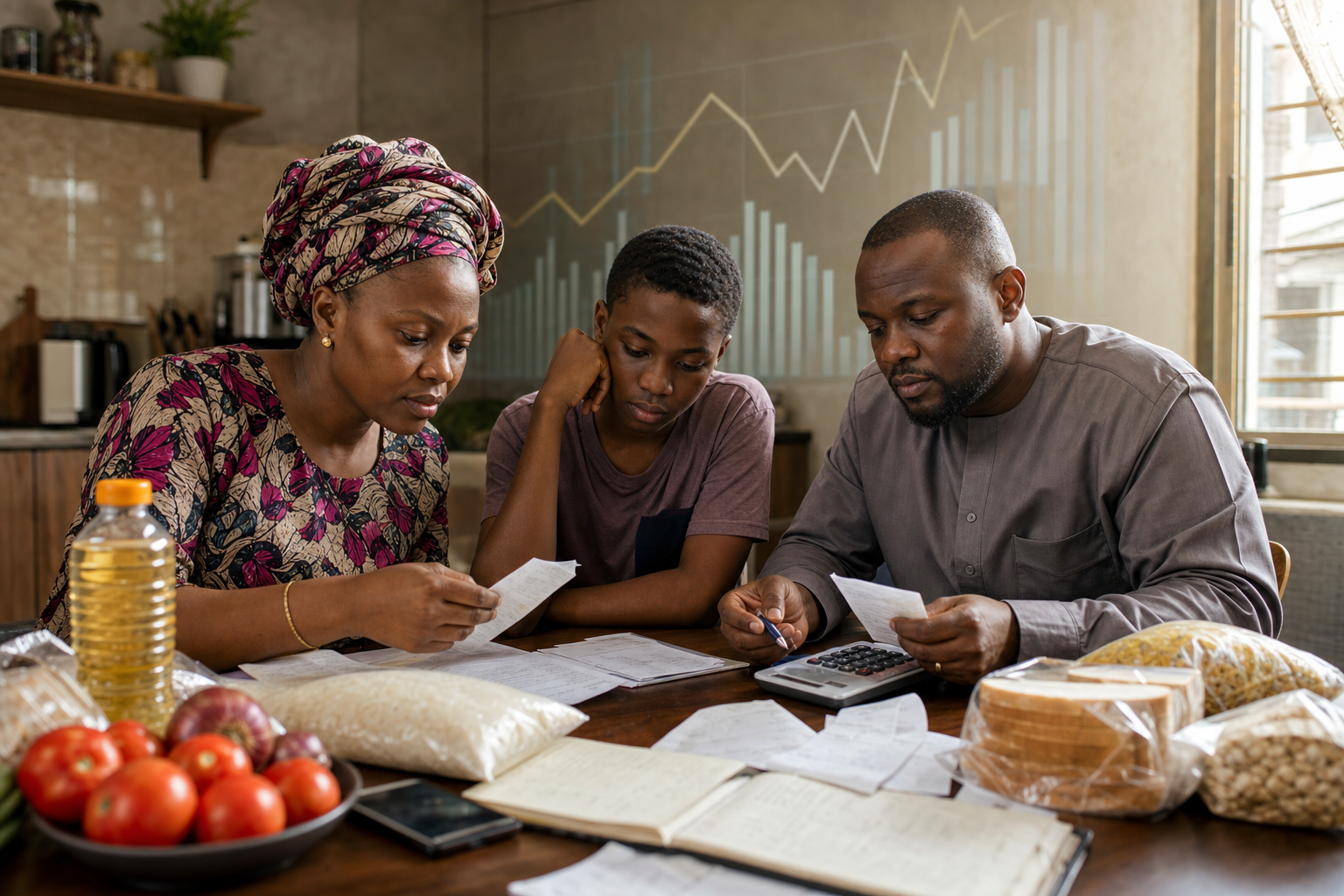
Nigeria’s economy grew by 4.43% year-on-year in the second quarter of 2026, according to figures attributed to the National Bureau of Statistics (NBS) and reported by Premium Times. It was an improvement on the 4.23% recorded in Q2 2025 and the 3.89% recorded in Q1 2026.
That is the central economic news. But it is not yet a household verdict.
The more useful question for Nigerians is whether the expansion translated into higher real incomes, better jobs, more affordable food and stronger capacity to pay for transport, energy, housing and education. The Q2 GDP figures do not answer those questions on their own.
What the GDP figure confirms
Real GDP is measured at constant prices and is intended to capture changes in the volume of goods and services produced. It is therefore a measure of aggregate economic activity, not a direct measure of household income or living standards.
In Q2 2026, nominal GDP stood at ₦119.29 trillion, while real GDP was estimated at ₦53.47 trillion, according to the NBS figures cited by Premium Times. The distinction matters: nominal output reflects current prices, while real GDP is designed to show changes in production volumes.
The non-oil sector accounted for 95.84% of real GDP and grew by 4.31%. Services, the largest component, represented 56.62% of real GDP and expanded by 4.60%.
Agriculture grew by 4.39%, compared with 2.82% in Q2 2025, according to Punch. Industry grew by 3.96%, down from 7.46% a year earlier, based on figures reported by the News Agency of Nigeria.
The oil sector grew by 7.31% year-on-year. Average daily oil production rose to 1.72 million barrels per day from 1.55 million barrels per day in Q1 2026.
Why composition matters to households
The sectoral breakdown provides useful context, but it still does not establish how widely the gains were shared.
Services cover a wide range of activities and work arrangements. Growth in aggregate services activity does not, by itself, reveal whether employees received higher real wages, whether informal operators earned more after costs, or whether new work was secure and adequately paid.
The same caution applies to agriculture. Higher agricultural output could eventually support food supply, but the GDP figure alone cannot show how quickly that effect reached markets, which producers benefited, or whether food became more affordable to consumers.
The reported 95.84% non-oil share implies that oil accounted for a much smaller portion of real GDP. Increased oil production may support public revenue and foreign-exchange conditions, but the GDP figures cannot demonstrate an immediate improvement in household welfare.
Analysis: The weaker year-on-year industrial growth deserves attention because industry, including manufacturing-related activity, can be important to productive capacity, investment and employment. It would be premature to treat the slowdown as proof that the recovery is weakening overall, but it is a reason to examine the quality and durability of growth rather than rely on the headline rate.
The missing household dashboard
A household test of recovery requires several indicators to be read together.
Food and essential costs
The available research for this article did not identify an official August 2026 Consumer Price Index release. Current food-inflation evidence should therefore not be added without verification.
Even where inflation slows, households may continue to struggle if prices remain substantially above earlier levels. A slower rate of increase is not the same as a return to previous prices.
Wages and earnings
GDP data do not show whether average earnings kept pace with prices. No verified national series for Q2 2026 real-wage growth or household purchasing power was identified in the research pack.
An economy can produce more while workers’ real incomes remain under pressure, particularly if additional output is concentrated among businesses or sectors that do not generate broad wage gains.
Employment quality
The latest publicly available NBS labour-force dataset identified in the research pack covers Q2 2024 through Q2 2025. It includes employment, unemployment, underemployment, earnings and informal-work indicators, according to the NBS Microdata Portal.
That material does not provide evidence for a Q2 2026 employment comparison. Consequently, the GDP result cannot establish whether employment expanded in the latest quarter, whether more people moved into paid work, or whether workers remained dependent on informal and underemployed activity.
What the release cannot tell us
The Q2 GDP figures do not identify:
- which income groups captured the benefits of growth;
- which regions or household types benefited;
- whether real wages increased;
- whether employment became more secure or productive;
- whether food, transport and energy became more affordable; or
- whether households increased their consumption capacity.
These are not minor statistical details. They determine whether growth is experienced as recovery or merely reported as recovery.
A practical test for future GDP releases
Future GDP announcements should be read alongside four household indicators: real income, job quality, food affordability and consumption capacity.
For Nigerians at home, that means asking whether earnings after inflation cover more of the weekly basket than before. For Nigerians in the diaspora supporting relatives, it means looking beyond aggregate growth to the costs faced by recipient households and the reliability of their income.
For policymakers, the implication is direct. Stronger output is valuable, but the next test is whether expansion broadens employment, supports productive industry, protects purchasing power and improves access to essentials.
The 4.43% figure indicates that economic activity accelerated in Q2 2026. It does not establish that household welfare improved. That conclusion will require evidence on prices, earnings, employment and distribution.

A. Joshua Adedeji
A. Joshua Adedeji is a leadership strategist, organisational development consultant, author, teacher and values-driven transformation leader. He writes on leadership, strategy, governance, organisational effectiveness, business, personal development and Nigeria’s social and economic transformation, connecting ideas and current realities to practical implications for leaders, institutions, entrepreneurs and citizens. His work is shaped by a commitment to clear thinking, responsible leadership, stronger institutions and the development of people and systems capable of producing lasting impact.







Reader conversation
0 approved comments